
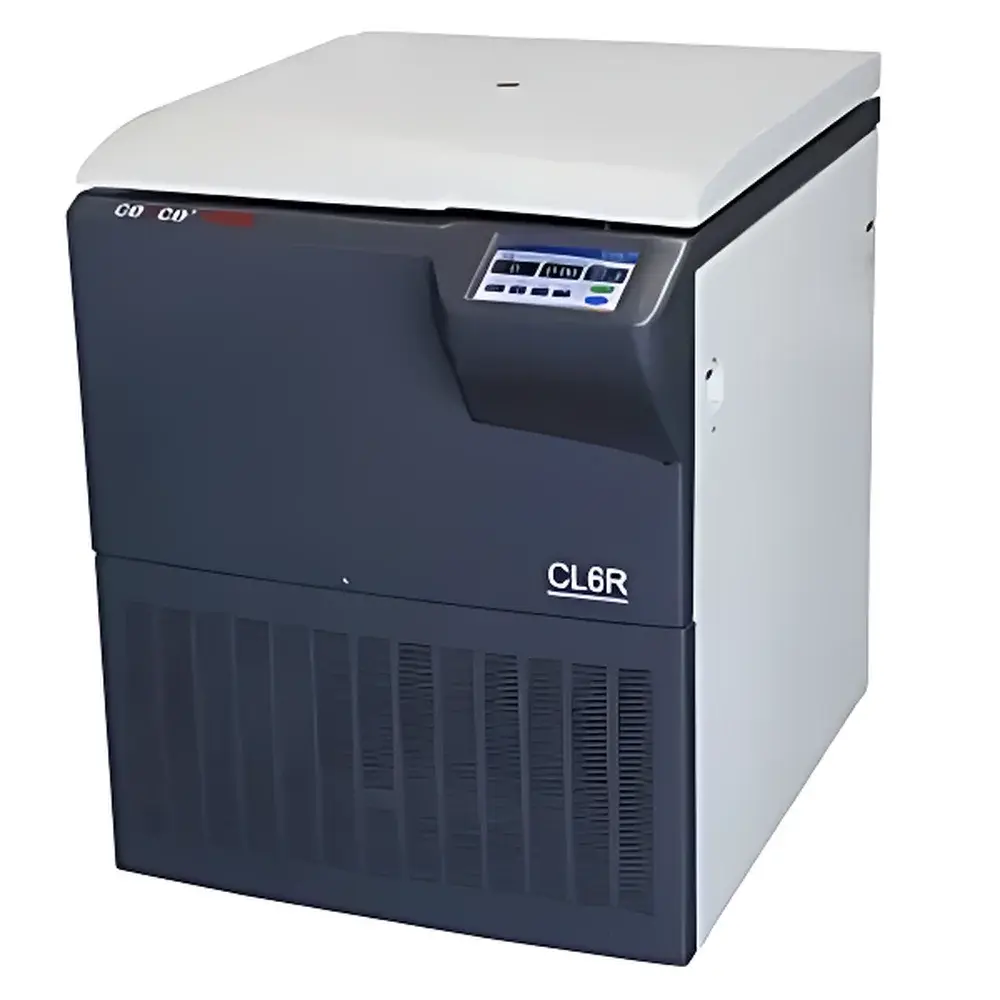
Xiangyi CL6R High-Capacity Refrigerated Centrifuge
| Brand | Xiangyi |
|---|---|
| Origin | Hunan, China |
| Manufacturer Type | Direct Manufacturer |
| Product Category | Domestic |
| Model | CL6R |
| Instrument Type | Floor-Standing Centrifuge |
| Speed Classification | Low-Speed Centrifuge (≤10,000 rpm) |
| Function | Refrigerated Centrifuge |
| Configuration | Horizontal Rotor System |
| Separation Class | Biological Macromolecules |
| Maximum Capacity | 6 × 1000 mL |
| Maximum Speed | 6000 rpm (angular), 4200 rpm (horizontal) |
| Maximum RCF | 6680 × g (angular), 5100 × g (horizontal) |
| Dimensions | 730 × 930 × 960 mm (L×W×H) |
Overview
The Xiangyi CL6R is a floor-standing, high-capacity refrigerated centrifuge engineered for reproducible, high-throughput separation of large-volume biological samples under precisely controlled thermal conditions. It operates on the principle of sedimentation force generation via rotational acceleration—applying controlled relative centrifugal force (RCF) to separate components based on density, size, and shape in suspension. Designed specifically for demanding applications in blood banking, biopharmaceutical manufacturing, and academic life science laboratories, the CL6R supports both angular and horizontal rotor configurations, enabling flexible adaptation across diverse sample formats—from 1.5 mL microtubes to 1000 mL bottles and quadruple blood bags. Its refrigeration system maintains chamber temperatures between −20 °C and +40 °C with ±1 °C accuracy, ensuring thermal stability even at maximum speed and full load—a critical requirement for preserving labile biomolecules such as plasma proteins, exosomes, and nucleic acid complexes.
Key Features
- High-capacity dual-rotor compatibility: Supports up to 6 × 1000 mL in horizontal configuration (5100 × g at 4200 rpm) or 6 × 500 mL in angular configuration (6680 × g at 6000 rpm).
- Intelligent refrigeration architecture: Equipped with a high-efficiency imported R404a compressor unit; achieves and sustains ≤−4 °C internal temperature at peak speed and full load.
- 7-inch capacitive touchscreen interface with intuitive UI: Displays real-time parameters—including speed, RCF, time, temperature, acceleration/deceleration curves—and supports simultaneous parameter setting and monitoring.
- Comprehensive safety suite: Non-contact imbalance detection, automatic rotor identification, overspeed/overtemperature/motor overheat protection, electromagnetic door lock with interlocked operation, and mechanical latch redundancy.
- Acoustic optimization: Noise emission <65 dB(A) at 1 m distance—suitable for shared laboratory environments without acoustic isolation.
- Programmable multi-step protocols: Up to 5-stage gradient centrifugation sequences; 9 acceleration and 10 deceleration profiles to minimize resuspension and maximize pellet integrity.
- Robust data governance: Built-in audit trail with timestamped run logs, fault codes, and system events; exportable via USB for GLP/GMP-compliant record retention.
Sample Compatibility & Compliance
The CL6R accommodates a broad spectrum of primary and secondary containment vessels, including conical-bottom centrifuge bottles (100–1000 mL), blood collection bags (up to quadruple configuration), PCR tubes, and standard polypropylene centrifuge tubes (1.5–50 mL). Its rotor recognition system ensures only certified, mechanically matched rotors are operational—preventing misuse and guaranteeing mechanical integrity per ISO 13485 design controls. The instrument complies with IEC 61010-1:2010 for electrical safety and IEC 61010-2-020:2016 for centrifuge-specific requirements. Optional firmware enables 21 CFR Part 11–compliant electronic signatures and audit trails when deployed in regulated biomanufacturing or clinical diagnostic settings.
Software & Data Management
The embedded control system provides full traceability through persistent local storage of ≥1000 run records and ≥500 fault entries. All timestamps include date, operator ID (via role-based login), rotor ID, cycle parameters, and environmental conditions. USB export supports CSV-formatted logs compatible with LIMS integration and statistical process analysis tools. User permission levels (Administrator, Technician, Operator) enforce procedural compliance—e.g., only Administrators may modify calibration constants or disable safety interlocks. Curve-based runtime visualization allows immediate assessment of thermal and rotational stability during operation, supporting root-cause analysis for protocol deviations.
Applications
- Blood component processing: Efficient separation of red blood cells, platelets, and plasma from whole blood in centralized transfusion services—validated for 6 × 400 mL triple-bag systems.
- Biopharmaceutical upstream/downstream processing: Clarification of mammalian cell culture harvests, viral vector pelleting, and large-volume buffer exchange prior to chromatography.
- Genomics & proteomics: High-yield isolation of extracellular vesicles, ribonucleoprotein complexes, and subcellular organelles from tissue homogenates or biofluids.
- Vaccine development: Purification of inactivated pathogens, adjuvant formulations, and antigen aggregates under cold-chain conditions.
- Clinical diagnostics: Routine serum/plasma preparation for immunoassays, coagulation testing, and metabolite profiling in high-volume core labs.
FAQ
What is the maximum RCF achievable with the CL6R, and under what rotor configuration?
The CL6R delivers a maximum RCF of 6680 × g using the angular rotor (No.1) at 6000 rpm with 6 × 500 mL capacity.
Does the CL6R support GMP-compliant data integrity requirements?
Yes—when configured with firmware version ≥2.3.1, it provides electronic signature capability, immutable audit trails, and user-access tiering aligned with FDA 21 CFR Part 11 Annex 11 expectations.
Can the instrument maintain −4 °C during continuous operation at 6000 rpm with full rotor load?
Yes—the refrigeration system is thermally rated for sustained operation at −4 °C or lower under maximum mechanical load, verified per ISO 13485 production testing.
Is rotor calibration required before each use?
No—automatic rotor identification eliminates manual calibration; however, annual verification of RCF accuracy against NIST-traceable tachometer standards is recommended.
What power supply specifications must be met for safe installation?
A dedicated 220 V ±22 V, 50 Hz, 25 A circuit with proper grounding and surge protection is mandatory; total connected load is 5.5 kW.



