
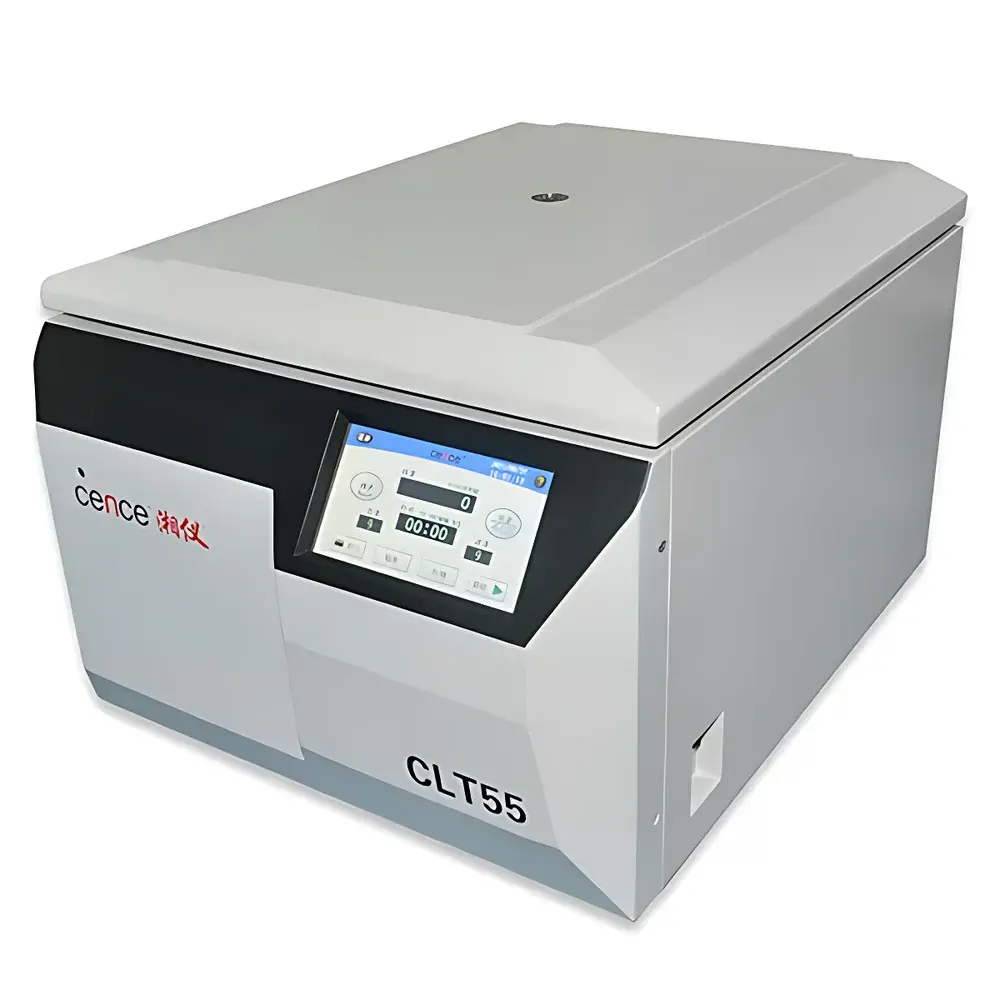
Xiangyi CLT55 Benchtop Low-Speed High-Capacity Centrifuge
| Brand | Xiangyi |
|---|---|
| Origin | Hunan, China |
| Manufacturer Type | Direct Manufacturer |
| Product Category | Domestic |
| Model | CLT55 |
| Instrument Type | Benchtop Centrifuge |
| Speed Range | 0–5500 rpm |
| Maximum RCF | 5951 × g |
| Maximum Capacity | 4 × 750 mL |
| Dimensions (W×D×H) | 510 × 635 × 398 mm |
| Display | 7-inch capacitive touchscreen (800 × 480 resolution) |
| Temperature Control (CLT55R only) | PID dynamic regulation, ±0.5 °C accuracy, dual-channel variable-frequency refrigeration system |
| Acceleration/Deceleration | 11 acceleration & 12 deceleration settings (including one user-definable setting) |
| Timer Options | 1 s–99 min 59 s or 1 h–99 h 59 min |
| Programmability | Up to 100 user-named protocols |
| Data Logging | Automatic runtime and fault event logging with timestamped records |
| Motor | AC brushless frequency-controlled motor (speed stability < ±10 rpm |
| Rotor Compatibility | Horizontal swing-out rotors with hermetic sealed buckets |
| Sample Vessel Support | 0.5 mL to 750 mL tubes, microplates, and enzyme-linked immunosorbent assay (ELISA) plates |
| Noise Level | Optimized acoustic enclosure design (typical operational noise < 62 dB(A) at 1 m) |
| Compliance | Designed to meet ISO 13485 requirements for in vitro diagnostic (IVD) environments |
Overview
The Xiangyi CLT55 is a benchtop low-speed high-capacity centrifuge engineered for routine separation tasks in clinical laboratories, biobanking facilities, blood banks, and cell culture core labs. It operates on the principle of sedimentation under controlled gravitational force—generating up to 5951 × g at its maximum rotational speed of 5500 rpm—to separate components based on density differentials in heterogeneous liquid samples. Unlike high-speed or ultracentrifuges used for subcellular fractionation or macromolecular isolation, the CLT55 is optimized for robust, reproducible processing of large-volume biological suspensions—including whole blood, cell pellets, tissue homogenates, and fermentation broths—without inducing shear-induced damage to fragile cells or extracellular vesicles. Its horizontal rotor architecture ensures uniform radial distribution of g-force across all sample positions, minimizing inter-tube variability and supporting standardized workflows compliant with CLIA, CAP, and ISO 15189 preanalytical requirements.
Key Features
- 7-inch capacitive touchscreen interface (800 × 480 resolution) enabling glove-compatible operation and simultaneous display of setpoints and real-time parameters (rpm, RCF, time remaining, temperature, acceleration/deceleration status).
- Intelligent parameter entry: direct numeric input for rpm, RCF, time, and temperature—eliminating iterative button cycling required by legacy membrane-key systems.
- Bi-directional unit conversion: one-touch toggle between rpm and RCF, with automatic internal recalculation based on current rotor radius.
- Flexible timing architecture: selectable timer ranges (1 second to 99 hours 59 minutes) and three trigger modes—start-initiated, speed-attained, or continuous—supporting both fixed-duration runs and kinetic assays requiring precise temporal synchronization.
- Advanced programmability: storage for 100 user-defined, named protocols; support for up to five-step sequential programs enabling automated multi-phase separations (e.g., initial low-g pelleting followed by high-g washing without manual intervention).
- Granular motion control: 11 acceleration and 12 deceleration profiles—including one fully customizable ramp setting—allow fine-tuning of transient forces to preserve integrity of sensitive samples such as primary leukocytes or organoid aggregates.
- Acoustically optimized chamber design reduces operational noise to ≤62 dB(A), meeting occupational safety thresholds per OSHA 29 CFR 1910.95 and facilitating placement in shared lab spaces without dedicated sound-dampened enclosures.
Sample Compatibility & Compliance
The CLT55 accommodates a broad spectrum of primary and secondary containment formats through interchangeable swing-out rotors and autoclavable adapters. Standard configurations support 0.5 mL microtubes, 15 mL and 50 mL conical tubes, 7 mL vacuum blood collection tubes (up to 168 per run), 96-well microplates, and custom-sized bottles up to 750 mL. Optional hermetically sealed buckets meet IEC 61010-2-020 requirements for containment of biohazardous aerosols during centrifugation of infectious specimens. All rotor assemblies and adapter inserts are validated for steam sterilization at 121 °C for 20 minutes, ensuring compliance with CDC/NIH biosafety level 2 (BSL-2) decontamination protocols. The instrument’s mechanical and electrical architecture conforms to EN 61010-1:2010 for laboratory equipment safety, while its data logging subsystem provides timestamped runtime and fault records suitable for GLP audit trails and FDA 21 CFR Part 11–aligned electronic record retention when paired with validated LIMS integration.
Software & Data Management
Embedded firmware maintains persistent, non-volatile storage of all operational events—including start/stop timestamps, achieved RCF values, temperature excursions, error codes, and user-executed protocol selections. Logs are exportable via USB interface in CSV format for downstream analysis in statistical software or laboratory information management systems (LIMS). No proprietary software installation is required; raw log files are human-readable and structured to align with ISO/IEC 17025 clause 7.7.2 on result reporting traceability. For CLT55R models, the dual-channel variable-frequency refrigeration system employs PID-based thermal regulation certified to ±0.5 °C accuracy across the full operating range (–20 °C to +40 °C), with pre-cool scheduling capability enabling unattended temperature stabilization prior to operator arrival—a feature particularly valuable in high-throughput clinical labs adhering to CAP checklist GEN.40800 for environmental control verification.
Applications
- Clinical diagnostics: Routine plasma/serum separation from whole blood; PBMC isolation using Ficoll density gradients; urine sediment concentration.
- Cell culture & bioprocessing: Harvesting adherent and suspension mammalian cells; clarifying conditioned media; pelleting microbial cultures for downstream DNA/RNA extraction.
- Blood banking: Platelet-rich plasma (PRP) preparation; red blood cell washing; cryoprecipitate recovery.
- Food & environmental testing: Microbial pellet concentration from water or food homogenates prior to PCR or ELISA analysis.
- Veterinary laboratories: Serum separation from animal blood samples; synovial fluid processing for cytology.
FAQ
What is the maximum tube capacity per run?
Four 750 mL bottles can be processed simultaneously using the standard horizontal rotor configuration—equivalent to 3000 mL total volume per cycle.
Is the CLT55 compatible with ISO-certified rotor validation documentation?
Yes—Xiangyi provides rotor-specific certificates of conformance detailing maximum load ratings, angular momentum limits, and material certifications (SS304/SS316L), issued per ISO 15195:2018 calibration traceability standards.
Can the centrifuge operate without refrigeration?
The base CLT55 model is air-cooled and operates at ambient temperature. The CLT55R variant includes active refrigeration with programmable setpoint control and pre-cool scheduling functionality.
How does the instrument ensure reproducibility across shifts?
By combining hardware-level speed stability (< ±10 rpm), digital RCF calculation referenced to actual rotor geometry, and protocol-based execution—each run is executed identically regardless of operator input sequence or experience level.
Are rotor imbalance tolerances documented per IEC 61010-2-020?
Yes—the CLT55’s integrated imbalance detection system triggers immediate deceleration if mass asymmetry exceeds 5 g per bucket position, satisfying Clause 7.3.3 of IEC 61010-2-020 for centrifugal equipment safety.



