
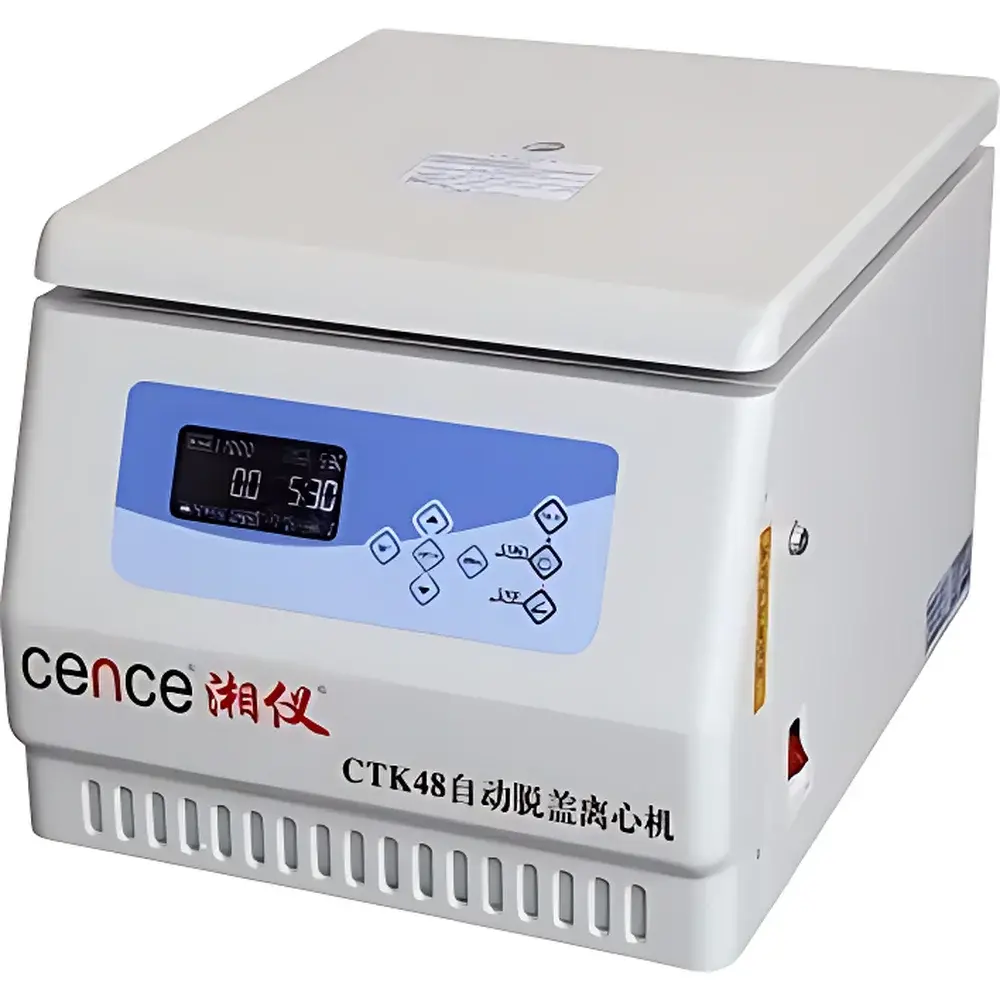
Xiangyi CTK48 Automated Cap-Removal Benchtop Centrifuge
| Brand | Xiangyi |
|---|---|
| Origin | Hunan, China |
| Manufacturer Type | Direct Manufacturer |
| Product Category | Domestic |
| Model | CTK48 |
| Instrument Type | Benchtop Centrifuge |
| Speed Class | Low-Speed Centrifuge (≤4000 rpm) |
| Function | Standard Centrifugation with Integrated Cap Removal |
| Configuration | Horizontal Rotor System |
| Max Capacity | 48 × vacuum blood collection tubes (4 × 12 configuration) |
| Max Speed | 4000 rpm |
| Max RCF | 3030 × g |
| Dimensions (L×W×H) | 420 × 535 × 370 mm |
| Weight | 48 kg |
| Power Supply | AC 220 V ±22 V, 50 Hz, 6 A |
| Power Consumption | 600 W |
| Noise Level | ≤65 dB(A) |
| Timer Range | 1 sec – 99 min 59 sec |
| Speed Accuracy | ±30 rpm |
| Rotor Type | Fixed-angle horizontal rotor assembly with interchangeable adapters for 75 mm and 100 mm tube lengths |
| Safety | Electronic lid lock with interlock-triggered shutdown |
| Vibration Control | Dual-stage damping system with auto-balance compensation |
| Display | Large LCD touchscreen interface |
| Cap Removal Success Rate | >90% |
| Tube Compatibility | Ø13 mm × 75 mm / 100 mm vacuum blood collection tubes |
Overview
The Xiangyi CTK48 Automated Cap-Removal Benchtop Centrifuge is engineered specifically for clinical laboratories performing high-volume blood sample processing. Unlike conventional centrifuges requiring manual cap removal post-spin, the CTK48 integrates a synchronized mechanical decapping mechanism directly into the centrifugation workflow—eliminating operator intervention between centrifugation and downstream analysis. Its operation follows standard low-speed sedimentation principles: samples are subjected to radial acceleration (RCF) up to 3030 × g at 4000 rpm, enabling efficient phase separation of whole blood into serum/plasma and cellular components within vacuum collection tubes. The integrated decapping module actuates immediately after rotor deceleration, engaging tube caps via precision-aligned grippers and applying controlled torsional force to unscrew standard-threaded closures. This design mitigates re-suspension risks caused by manual handling, reduces aerosol generation, and supports biosafety compliance in CLIA- and ISO 15189-accredited environments.
Key Features
- Automated cap removal with documented success rate exceeding 90% across both 75 mm and 100 mm vacuum blood collection tubes (Ø13 mm diameter)
- Horizontal rotor configuration supporting 48-tube capacity (4 × 12 layout), optimized for standard clinical tube racks
- AC variable-frequency motor delivering precise speed control (±30 rpm accuracy) and rapid acceleration/deceleration profiles
- Real-time RCF calculation and display, automatically updated based on selected rotor radius and set speed
- Dual-stage vibration-damping architecture with dynamic auto-balancing—ensuring stable operation even with minor load imbalances
- Electronically interlocked safety lid: centrifuge remains inert until fully latched; immediate motor cutoff upon unauthorized lid opening during operation
- Intuitive 5.7-inch LCD touchscreen interface with multilingual support (English default), password-protected parameter settings, and audit-ready event logging
Sample Compatibility & Compliance
The CTK48 accommodates standard vacuum blood collection tubes conforming to ISO 6710 and CLSI H26-A4 specifications—including EDTA, heparin, citrate, and serum separator tubes (SST). It accepts both 75 mm and 100 mm tube lengths without hardware modification, using dedicated adapter sleeves that maintain axial alignment and rotational integrity. All mechanical decapping actions comply with IEC 61010-1:2010 safety requirements for laboratory equipment. The device supports GLP-aligned documentation through timestamped operation logs (start/stop time, speed, duration, lid status, error codes), and its firmware architecture allows integration into LIMS via RS232 or optional USB-to-serial interface. While not FDA 21 CFR Part 11–certified out-of-the-box, the system’s deterministic behavior, non-volatile event memory, and configurable user access levels facilitate validation under internal QA protocols.
Software & Data Management
The embedded firmware provides local data retention for up to 1,000 run records, each storing rotor ID, speed profile, timer setting, actual RCF, total runtime, and cap-removal status (success/failure per position). Export is supported via USB flash drive in CSV format for traceability and QC review. No cloud connectivity or proprietary software installation is required—operation is self-contained. Audit trail entries include operator ID (if assigned), date/time stamp, and system-generated fault codes (e.g., “E07: Cap grip timeout”, “E12: Load imbalance >5g”). Firmware updates are performed offline using signed binary files distributed through Xiangyi’s authorized service portal.
Applications
- Routine serum and plasma preparation in hospital core labs and reference laboratories
- Pre-analytical automation for immunoassay, clinical chemistry, and coagulation testing workflows
- Blood bank specimen processing where cap integrity and contamination control are critical
- Research studies requiring standardized, hands-free post-centrifugation handling of biobanked samples
- Point-of-care satellite labs seeking benchtop consolidation of centrifugation and decapping functions
FAQ
What tube sizes does the CTK48 support?
The CTK48 accepts standard Ø13 mm vacuum blood collection tubes in both 75 mm and 100 mm lengths using dedicated, snap-in adapters included with the instrument.
Is rotor balancing required before each run?
No—the system features active auto-balancing compensation and tolerates minor mass asymmetries (<5 g difference between opposing positions); however, symmetric loading is still recommended for optimal longevity.
Can the decapping function be disabled?
Yes—cap removal is a user-selectable step; the centrifuge operates as a standard horizontal rotor unit when this feature is deactivated via the touchscreen menu.
What maintenance intervals are recommended?
Xiangyi specifies quarterly inspection of gripper alignment and torque calibration, annual verification of electronic lid interlock response time, and biannual replacement of damping elements—full procedures documented in the English-language service manual.
Does the CTK48 meet international electromagnetic compatibility standards?
Yes—it complies with EN 61326-1:2013 for EMC in laboratory environments and carries CE marking under the Low Voltage Directive 2014/35/EU.



