
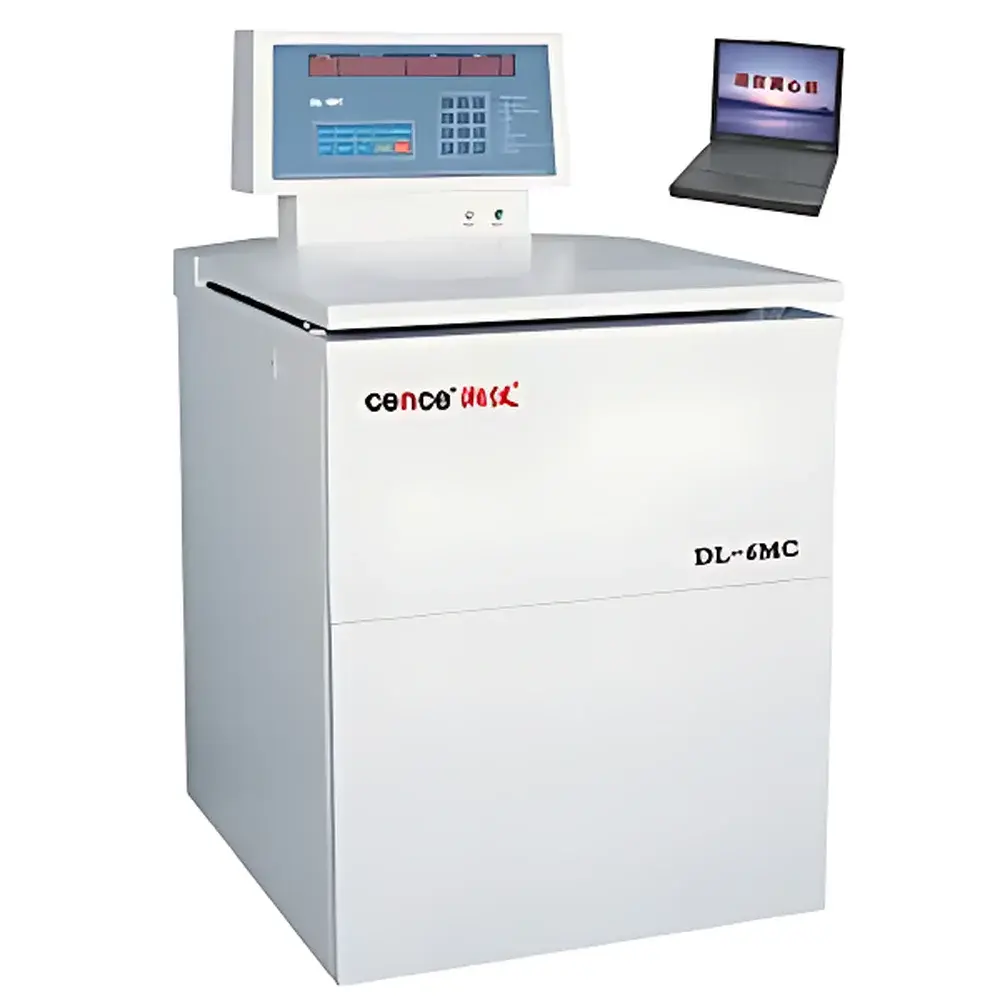
Xiangyi DL-6MC Microprocessor-Controlled High-Capacity Refrigerated Centrifuge
| Brand | Xiangyi |
|---|---|
| Origin | Hunan, China |
| Manufacturer Type | Direct Manufacturer |
| Instrument Type | Floor-Standing Centrifuge |
| Speed Category | Low-Speed Centrifuge (≤10,000 rpm) |
| Function | Refrigerated Centrifuge |
| Configuration | Horizontal Rotor Centrifuge |
| Separation Class | Large Organelles / Viruses |
| Maximum Capacity | 6 × 1000 mL |
| Maximum Speed | 6000 rpm (angular rotor), 4200 rpm (horizontal rotor) |
| Maximum RCF | 6680 × g (angular), 5100 × g (horizontal) |
| Dimensions (L×W×H) | 730 × 840 × 1200 mm |
| Weight | 260 kg |
| Temperature Range | −20 °C to +40 °C |
| Temperature Stability | ±1 °C |
| Acceleration/Deceleration Profiles | 9 acceleration steps, 10 deceleration steps |
| Speed Accuracy | ±10 rpm |
| Noise Level | <65 dB(A) |
| Power Supply | AC 220 V ±22 V, 50 Hz, 30 A |
| Total Power | 3.0 kW |
| Refrigerant | R404a (non-ozone-depleting) |
| Drive System | High-torque brushless frequency-controlled motor |
| Safety Features | Automatic imbalance detection, overspeed protection, overtemperature cutoff, door interlock, triple-layer safety enclosure |
Overview
The Xiangyi DL-6MC is a floor-standing, microprocessor-controlled refrigerated centrifuge engineered for high-capacity, low-speed separation tasks in biopharmaceutical manufacturing, blood banking, and large-scale cell culture processing. It operates on the principle of sedimentation under controlled gravitational force (RCF), enabling reproducible pelleting of large organelles, viral particles, whole cells, and precipitated macromolecules. Designed for routine operation at industrial or central laboratory scale, the DL-6MC integrates precise thermal management with robust mechanical architecture—supporting continuous operation across extended run durations while maintaining sample integrity at temperatures as low as −20 °C. Its dual-rotor capability (angular and horizontal configurations) ensures flexibility in protocol alignment, particularly for applications requiring high-volume processing without compromising temperature stability—even at maximum rotational speed.
Key Features
- Microprocessor-based control system with direct PC interface via RS-485 or Ethernet, enabling remote operation, real-time parameter monitoring, and full audit trail logging.
- High-torque brushless frequency-controlled motor delivering consistent torque across the entire speed range (100–6000 rpm), eliminating carbon brush wear and reducing maintenance intervals.
- Environmentally compliant refrigeration system using R404a refrigerant, meeting international ozone depletion potential (ODP) and global warming potential (GWP) regulatory thresholds.
- Precise temperature regulation (−20 °C to +40 °C) with ±1 °C accuracy; maintains ≤−4 °C at maximum rotor speed during prolonged runs.
- Programmable acceleration and deceleration profiles (9 acceleration steps, 10 deceleration steps) to minimize shear stress on sensitive biological samples.
- Triple-layer safety architecture: mechanical door lock, electronic imbalance detection, and independent overspeed/overtemperature cut-off circuits.
- Low-noise operation (<65 dB[A]) achieved through vibration-damped base design, precision-balanced rotor assembly, and acoustic insulation.
- Full steel chassis construction with reinforced load-bearing frame, rated for 260 kg operational weight and compliant with IEC 61010-1 safety standards.
Sample Compatibility & Compliance
The DL-6MC supports a broad range of primary and secondary containers—including standard 1000 mL centrifuge bottles (round and square), blood bags (up to 250 mL), conical tubes (15–50 mL), microtubes (1.5–5 mL), and multi-well formats (e.g., 37 × 7 mL or 24 × 5 mL). Its horizontal rotor configuration accommodates high-volume clinical and process-scale workflows common in blood fractionation, vaccine production, and stem cell isolation. The instrument complies with ISO 13485 requirements for medical device manufacturing environments and meets essential safety criteria per EN 61010-2-020 (centrifuges). While not inherently 21 CFR Part 11–compliant out-of-the-box, its PC-integrated data logging system supports configurable audit trails, electronic signatures, and secure user access levels when deployed within validated IT infrastructure.
Software & Data Management
The DL-6MC’s embedded firmware enables comprehensive data acquisition and traceability. All operational parameters—including speed, RCF, time, temperature, acceleration/deceleration curves, and cumulative runtime—are logged automatically with timestamping and stored onboard for up to ten years. Data export is supported via USB or network interface in CSV or XML format for integration into LIMS or ELN platforms. Optional software packages provide graphical visualization of real-time run profiles (speed ramping, temperature drift, integrated RCF), trend analysis across multiple runs, and automated report generation aligned with GLP documentation standards. Remote diagnostics and firmware updates are accessible via authenticated web interface.
Applications
- Large-volume plasma and serum separation in blood banks and transfusion centers.
- Harvesting mammalian or insect cells from bioreactor harvest streams (up to 6 L per run).
- Virus concentration and purification in vaccine development pipelines.
- Isolation of mitochondria, lysosomes, and other subcellular fractions from tissue homogenates.
- Clarification of fermentation broths and downstream purification of recombinant proteins.
- Preparative centrifugation for diagnostic reagent manufacturing under GMP conditions.
FAQ
What rotor configurations are supported by the DL-6MC?
The DL-6MC accepts two primary rotor types: an angular rotor (6 × 500 mL, max 6000 rpm, 6680 × g) and a horizontal rotor (6 × 1000 mL, max 4200 rpm, 5100 × g), including interchangeable round and square buckets with universal adapters for tubes ranging from 1.5 mL to 250 mL.
Does the DL-6MC support pre-cooling of the chamber?
Pre-cooling is not available as a dedicated function; however, the unit achieves rapid thermal stabilization due to its high-efficiency compressor and insulated chamber design—reaching −20 °C from ambient in approximately 35 minutes.
Can the instrument be integrated into a networked laboratory environment?
Yes—the DL-6MC features both RS-485 serial communication and optional Ethernet connectivity, supporting centralized control, data aggregation, and integration with facility-wide SCADA or MES systems.
Is validation documentation available for GxP-regulated use?
Xiangyi provides IQ/OQ documentation templates and factory calibration certificates. Site-specific PQ execution requires collaboration with qualified validation partners, as environmental and procedural variables affect final qualification outcomes.
What maintenance schedule is recommended for long-term reliability?
Annual preventive maintenance is advised, including rotor inspection (crack detection via dye penetrant testing), refrigerant pressure verification, drive belt tension check (if applicable), and calibration of temperature and speed sensors against NIST-traceable references.



