
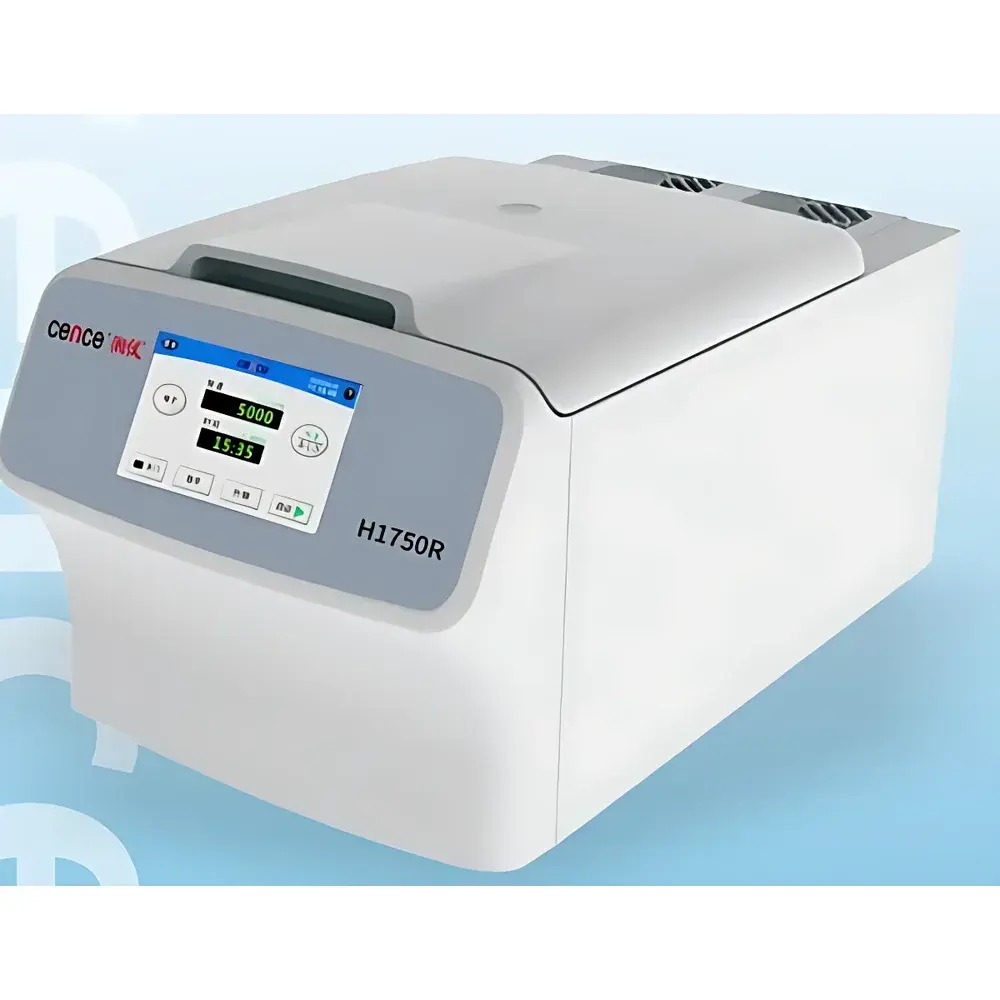
Xiangyi H1750R Benchtop High-Speed Refrigerated Centrifuge
| Brand | Xiangyi |
|---|---|
| Origin | Hunan, China |
| Manufacturer Type | Direct Manufacturer |
| Product Category | Domestic |
| Model | H1750R |
| Instrument Type | Benchtop Centrifuge |
| Speed Range | High-Speed (10,000–30,000 rpm) |
| Function | Refrigerated Centrifuge |
| Configuration | Horizontal Rotor Centrifuge |
| Separation Class | Biomacromolecules |
| Maximum Capacity | 4 × 100 mL |
| Maximum Speed | 17,500 rpm |
| Maximum RCF | 29,302 × g |
| Dimensions (W × D × H) | 380 × 660 × 330 mm |
| Display | 7-inch HD Touchscreen |
| Rotor Compatibility | 15 Standard Rotors (including 24 × 1.5 mL, PCR strips, microplates, 15/50 mL conical tubes, blood collection tubes) |
| Temperature Range | –20 °C to +40 °C |
| Drive System | Brushless DC Motor |
| Cooling System | Inverter-Controlled Eco-Friendly Compressor |
| Acceleration/Deceleration Profiles | 11 Accel + 12 Decel Curves (10 Customizable) |
| Safety Features | Aerosol-Tight Rotors, Auto Rotor Recognition, Lid Interlock, Over-Speed/Over-Temp/Motor Overheat Protection, Stainless Steel Chamber, Condensate Management Tray |
| Software | Multi-Program Storage with User-Defined Naming |
| Compliance | Designed per ISO 13485-aligned manufacturing practices |
Overview
The Xiangyi H1750R Benchtop High-Speed Refrigerated Centrifuge is an engineered solution for laboratories requiring precise, reproducible separation of biomacromolecules—including proteins, nucleic acids, organelles, and virus particles—under controlled thermal conditions. Operating on the principle of sedimentation equilibrium and rate-zonal centrifugation, the H1750R delivers a maximum relative centrifugal force (RCF) of 29,302 × g at 17,500 rpm, enabling rapid pelleting of subcellular components while maintaining sample integrity through active refrigeration (–20 °C to +40 °C). Its compact footprint (380 × 660 × 330 mm) and ergonomic height optimize bench space in QC labs, core facilities, and academic research environments without compromising performance against floor-standing counterparts.
Key Features
- Brushless DC motor drive ensures high torque consistency, low vibration, and extended service life with minimal maintenance.
- Inverter-controlled refrigeration system uses eco-friendly R134a refrigerant and maintains ±1 °C temperature stability across the full speed range, critical for heat-sensitive samples such as RNA or membrane vesicles.
- Aerosol-tight horizontal rotors—validated for biosafety containment—prevent cross-contamination and comply with WHO BSL-2 handling recommendations for clinical and diagnostic workflows.
- Seven-inch capacitive touchscreen interface supports intuitive navigation, real-time parameter monitoring (speed, RCF, time, temperature, rotor ID), and graphical run progress visualization.
- Programmable acceleration/deceleration profiles (11 accel + 12 decel curves, 10 user-definable) minimize resuspension during braking—essential for gradient-based separations and delicate pellet recovery.
- Integrated condensate management tray and corrosion-resistant stainless-steel chamber lining mitigate moisture accumulation and extend structural longevity under continuous low-temperature operation.
- Comprehensive safety architecture includes automatic lid interlock, real-time rotor imbalance detection, over-speed cutoff, motor thermal protection, and automatic RCF recalculation upon rotor selection.
Sample Compatibility & Compliance
The H1750R accommodates 15 standardized rotor configurations—including fixed-angle, swing-bucket, and microplate carriers—supporting volumes from 0.2 mL PCR tubes to 100 mL centrifuge bottles. It is routinely deployed for applications involving human serum, plasma, PBMCs, bacterial lysates, and cell culture supernatants. All rotors undergo static and dynamic balance validation per ISO 21501-4. The instrument’s electrical safety design conforms to IEC 61010-1 and IEC 61010-2-020; its mechanical construction follows ISO 13485 principles for medical device manufacturing environments. While not FDA 510(k)-cleared, its operational parameters align with CLIA and CAP requirements for routine clinical centrifugation.
Software & Data Management
The embedded firmware supports up to 99 user-defined protocols, each assignable with alphanumeric identifiers for traceability. All run logs—including date/time stamp, rotor ID, speed, temperature, duration, and error codes—are stored locally with timestamped audit trails. Data export is available via USB port in CSV format, compatible with LIMS integration and GLP-compliant documentation workflows. No cloud connectivity or remote access is implemented—ensuring data sovereignty and alignment with institutional IT security policies.
Applications
- Purification of plasmid DNA and genomic DNA from bacterial cultures using silica-membrane or cesium chloride gradient protocols.
- Isolation of exosomes and extracellular vesicles from conditioned media at ≥100,000 × g equivalent via sequential centrifugation steps.
- Preparation of clarified lysates for SDS-PAGE and Western blotting, minimizing protease release through cold rotor operation.
- Separation of erythrocytes from whole blood in transfusion medicine settings, with validated hematocrit consistency across 24 × 1.5 mL rotor loads.
- High-throughput processing of 96-well microplates in drug discovery pipelines, leveraging swing-bucket plate carriers with uniform RCF distribution.
FAQ
What is the minimum detectable rotor imbalance threshold?
The system detects imbalances ≥5 g at 17,500 rpm and halts acceleration before reaching operational speed.
Can the H1750R be used for ultracentrifugation protocols?
No—it is rated for high-speed, not ultracentrifugation; maximum RCF is 29,302 × g, below the 100,000 × g threshold defining ultracentrifuges.
Are rotor certifications provided with each unit?
Yes—each rotor ships with a serialized calibration certificate indicating balance verification, material lot traceability, and fatigue cycle compliance.
Does the centrifuge support 21 CFR Part 11-compliant electronic signatures?
No—the system lacks user role-based authentication or electronic signature functionality; it is intended for non-GMP research and routine QA use.
How often does the compressor require servicing?
Under standard usage (≤6 hrs/day), the inverter-driven compressor requires no scheduled maintenance for 5 years; annual visual inspection of condensate tray and air intake filters is recommended.



