
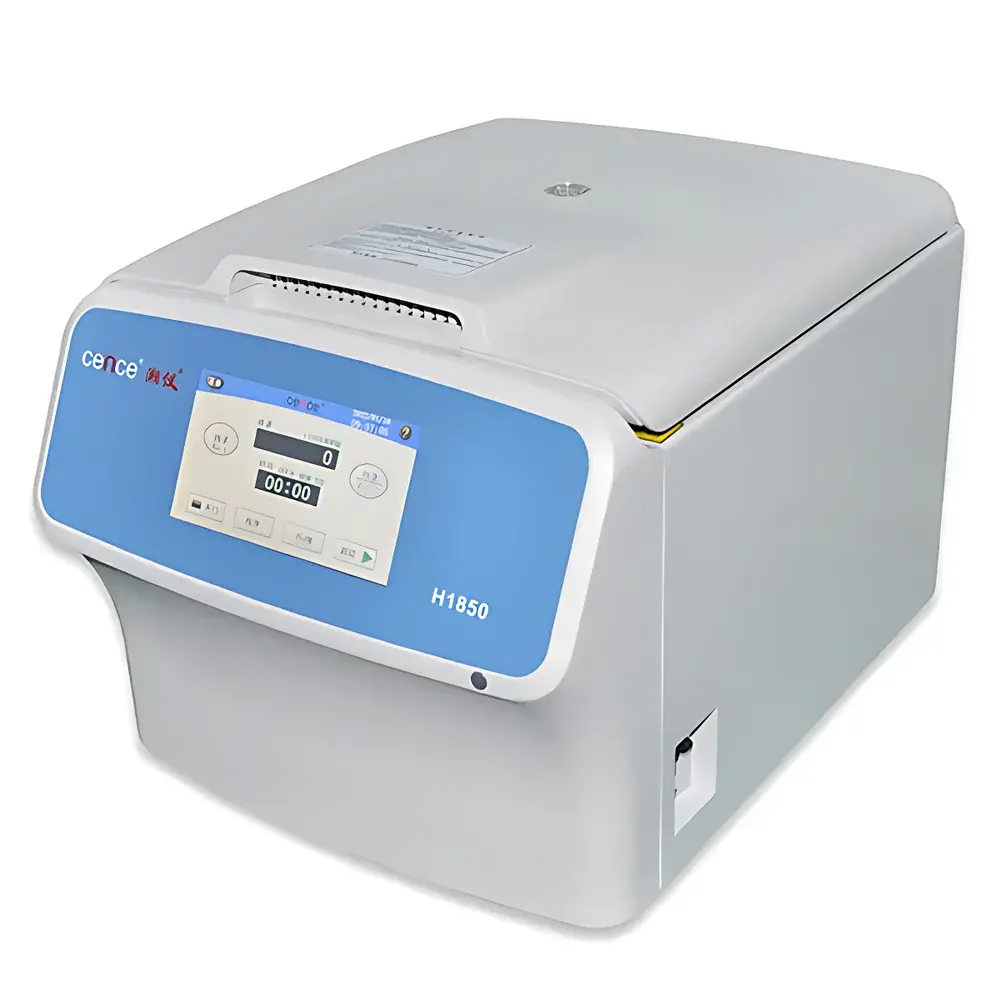
Xiangyi H1850 Benchtop High-Speed Centrifuge
| Brand | Xiangyi |
|---|---|
| Origin | Hunan, China |
| Manufacturer Type | Direct Manufacturer |
| Product Category | Domestic |
| Model | H1850 |
| Instrument Type | Benchtop Centrifuge |
| Speed Range | High-Speed (10,000–30,000 rpm) |
| Function | General-Purpose Centrifugation |
| Configuration | Fixed-Angle Rotor Centrifuge |
| Target Applications | Biomolecular Separation |
| Maximum Capacity | 4 × 100 mL |
| Maximum Speed | 18,500 rpm |
| Maximum RCF | 23,797 × g |
| Dimensions (W × D × H) | 420 mm × 530 mm × 370 mm |
| Control Interface | 7-inch HD Touchscreen |
| Drive System | High-Torque AC Brushless Frequency-Controlled Motor |
| Rotor Recognition | Auto-detection for 15 Rotor Types |
| Safety Features | Overspeed, Overtemperature, Motor Overheat, Lid Interlock, Stainless Steel Chamber, Triple-Layer Rotor Protection |
| Programmability | 11 Acceleration Profiles, 12 Deceleration Profiles, 10 Customizable Ramp Settings, Multi-Program Storage with Descriptive Naming |
| Optional Accessories | Airtight Rotors with Aerosol-Containment Certification |
Overview
The Xiangyi H1850 Benchtop High-Speed Centrifuge is an engineered solution for routine and advanced biomolecular separation tasks in academic, clinical, and industrial laboratories. Designed around the principles of rotor dynamics and centrifugal force optimization, it delivers reproducible sedimentation performance at speeds up to 18,500 rpm and relative centrifugal forces (RCF) reaching 23,797 × g. Its compact benchtop footprint integrates high-speed capability with large-volume processing—supporting up to four 100 mL tubes simultaneously—without compromising thermal stability or mechanical integrity. The unit employs a precision-engineered airflow management system that maintains consistent chamber temperature during prolonged runs, critical for preserving labile biological samples such as plasmids, viral particles, and subcellular organelles. Built on a rigid cast-aluminum chassis with proprietary vibration-damping architecture, the H1850 ensures minimal operational noise and long-term rotational accuracy—even under asymmetric loading conditions.
Key Features
- 7-inch high-resolution capacitive touchscreen interface with intuitive icon-based navigation and real-time parameter visualization
- Direct-drive AC brushless frequency-controlled motor delivering rapid acceleration (0–18,500 rpm in ≤18 s) and precise speed regulation (±10 rpm accuracy)
- Automatic recognition of 15 distinct rotor types—including fixed-angle, swing-out, and aerosol-tight configurations—eliminating manual rotor ID entry and reducing setup error
- Comprehensive ramp control: 11 preconfigured acceleration profiles, 12 deceleration profiles, and 10 fully programmable ramp segments allowing user-defined time-based transitions for gradient-sensitive applications
- Aerosol-containment certified rotors available as optional accessories, compliant with WHO biosafety level 2 (BSL-2) containment requirements for handling infectious agents
- Multi-program memory supporting ≥99 user-defined protocols, each assignable with alphanumeric descriptors for traceable method recall
- Triple-tier safety architecture: hardware-enforced overspeed cutoff, thermistor-monitored chamber temperature limit, lid interlock with electromagnetic locking mechanism, and stainless-steel rotor chamber with reinforced polymer shielding
Sample Compatibility & Compliance
The H1850 accommodates a broad spectrum of sample formats through its modular rotor ecosystem—including conical-bottom tubes (15–50 mL), microcentrifuge tubes (0.2–2.0 mL), PCR strips, and specialized adapters for cryovials and blood collection tubes. Its standard 6-position fixed-angle rotor (6 × 50 mL) supports both round-bottom and conical (sharp-tip) tubes, enabling optimal pelleting efficiency across nucleic acid, protein, and cell fractionation workflows. All rotors are manufactured to ISO 15197:2013 dimensional tolerances and undergo dynamic balancing per ISO 21501-4. The instrument meets IEC 61010-1:2010 safety standards for laboratory electrical equipment and includes documentation supporting GLP-compliant validation protocols. While not FDA 21 CFR Part 11–certified out-of-the-box, audit trails and electronic log export capabilities can be enabled via firmware configuration for regulated QC environments.
Software & Data Management
Operation is managed exclusively through the embedded Linux-based control system, which logs all run parameters—including speed, time, RCF, temperature, rotor ID, and user login timestamp—to non-volatile memory. Data export is supported via USB 2.0 port in CSV format, compatible with LIMS integration and statistical analysis platforms (e.g., JMP, GraphPad Prism). No cloud connectivity or remote access functionality is included, preserving data sovereignty in sensitive research settings. Firmware updates are delivered via signed binary files loaded from encrypted USB drives, ensuring integrity verification prior to installation.
Applications
- Purification of genomic DNA, plasmid DNA, and RNA from bacterial lysates and mammalian cell cultures
- Isolation of exosomes and extracellular vesicles using differential ultracentrifugation protocols
- Preparative separation of mitochondria, lysosomes, and nuclear fractions in subcellular fractionation studies
- Routine serum/plasma separation in clinical chemistry and hematology workflows
- Concentration of recombinant proteins and antibodies prior to chromatographic analysis
- Particle size distribution analysis of colloidal suspensions and nanoparticle formulations
FAQ
What is the maximum allowable imbalance tolerance for the H1850?
The centrifuge accepts ±0.5 g imbalance per tube position when using matched tubes; automatic imbalance detection triggers immediate deceleration if threshold is exceeded.
Can the H1850 be validated for GMP compliance?
Yes—its deterministic control logic, full parameter logging, and configurable audit trail support IQ/OQ/PQ execution per ASTM E2500 and EU Annex 15 guidelines.
Is refrigeration available as an option?
No—the H1850 is a non-refrigerated model; ambient temperature operation is maintained within ±3°C of setpoint via passive airflow design.
How frequently should rotor calibration be performed?
Xiangyi recommends annual verification of rotor geometry and balance using certified calibration weights traceable to NIST standards.
Does the unit support serial communication for automation integration?
RS-232 and Modbus RTU interfaces are available via optional expansion module for integration into automated liquid handling systems.



