
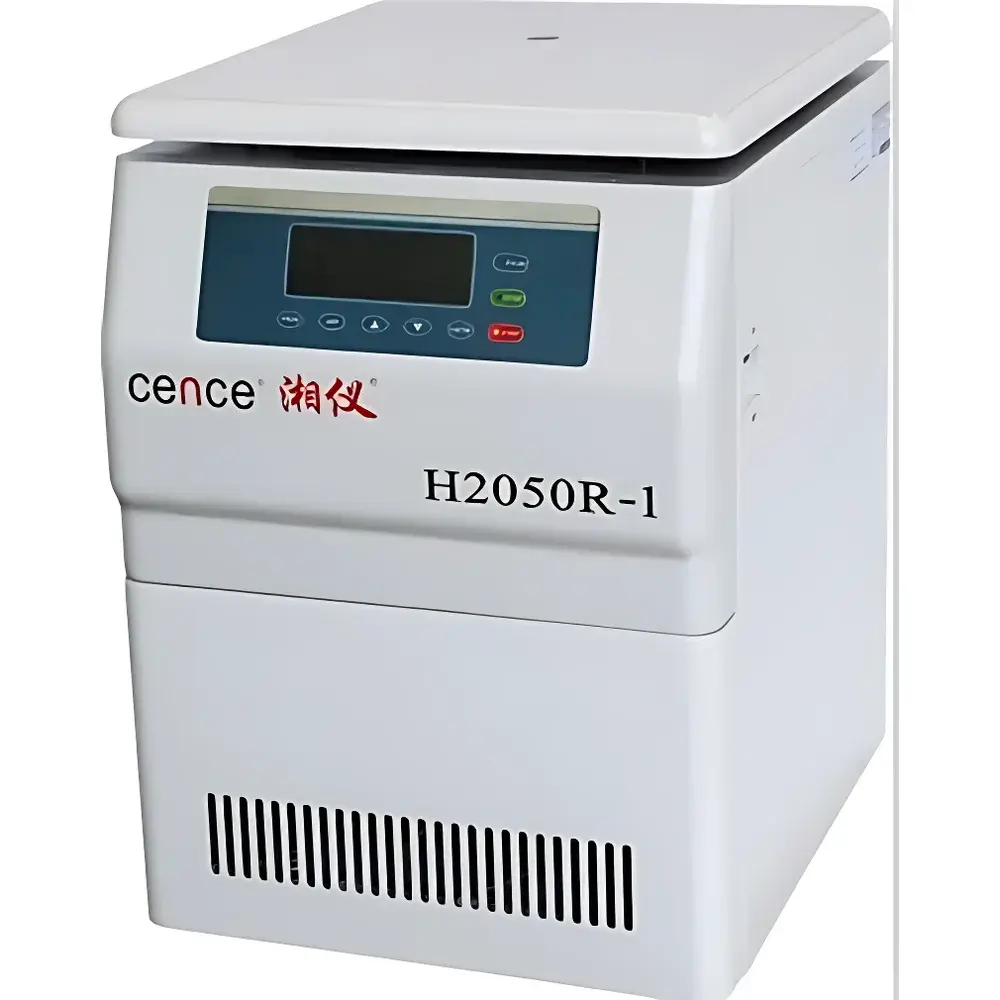
Xiangyi H2050R-1 High-Speed Refrigerated Centrifuge
| Brand | Xiangyi |
|---|---|
| Origin | Hunan, China |
| Manufacturer Type | Direct Manufacturer |
| Product Category | Domestic |
| Model | H2050R-1 |
| Instrument Type | Floor-Standing Centrifuge |
| Speed Range | High-Speed (10,000–30,000 rpm) |
| Function | Refrigerated Centrifuge |
| Configuration | Horizontal Rotor Centrifuge |
| Target Applications | Biomolecular Separation |
| Maximum Capacity | 4 × 750 mL |
| Maximum Speed | 20,500 rpm |
| Maximum RCF | 29,200 × g |
| Dimensions (W×D×H) | 550 × 650 × 840 mm |
Overview
The Xiangyi H2050R-1 High-Speed Refrigerated Centrifuge is an engineered floor-standing instrument designed for high-throughput, temperature-sensitive biomolecular separations in regulated laboratory environments. It operates on the principle of sedimentation under controlled centrifugal force, enabling efficient isolation of subcellular components, nucleic acids, proteins, and viral particles based on density and size differentials. With a maximum rotational speed of 20,500 rpm and a peak relative centrifugal force (RCF) of 29,200 × g, the system delivers reproducible pelleting and gradient separations across diverse sample volumes—from microliter-scale clinical specimens to multi-liter preparative batches. Its integrated refrigeration maintains chamber temperatures between –20 °C and +40 °C, with stable operation at ≤ –4 °C even at maximum speed—critical for preserving labile macromolecular integrity during prolonged runs.
Key Features
- Direct-drive brushless AC frequency-controlled motor delivering high torque, low vibration, and extended service life without carbon brushes or gearboxes.
- Microprocessor-based control system with large backlit LCD interface supporting programmable protocols, real-time parameter monitoring, and password-protected user access levels.
- 12 interchangeable rotor options—including horizontal, fixed-angle, and swing-out configurations—each automatically recognized by the system to enforce speed limits and prevent overspeeding.
- Comprehensive safety architecture: triple-layer rotor protection (mechanical, electronic, and software-based), automatic lid interlock, stainless-steel chamber lining, and overtemperature/overspeed/failure diagnostics.
- Advanced deceleration management with 10 selectable braking profiles (including free-coast mode) and 9 customizable acceleration ramps to minimize sample resuspension and thermal shock.
- Three-stage damping system optimized for stability during high-speed operation with large-volume rotors, ensuring consistent run-to-run reproducibility and reduced maintenance intervals.
Sample Compatibility & Compliance
The H2050R-1 accommodates a broad range of biospecimen types—including whole blood, plasma, cell lysates, tissue homogenates, and recombinant protein solutions—across standard polypropylene, polycarbonate, and stainless-steel centrifuge tubes (up to 750 mL per bucket). Its design aligns with core requirements for GLP-compliant workflows and supports audit-ready documentation when paired with validated SOPs. While not certified to ISO 13485 or FDA 21 CFR Part 11 out-of-the-box, the system’s programmable parameters, event logging capability, and hardware-level rotor authentication provide foundational traceability for internal validation and quality system integration.
Software & Data Management
The embedded firmware records operational metadata—including rotor ID, speed, time, temperature, acceleration/deceleration profile, and fault codes—for every run. All data are timestamped and stored locally on non-volatile memory; export is supported via USB interface in CSV format for downstream LIMS or ELN integration. Optional PC-based configuration software (available upon request) enables remote protocol deployment, batch scheduling, and trend analysis of maintenance events—facilitating preventive servicing and compliance with internal QA/QC policies.
Applications
- Preparative isolation of mitochondria, nuclei, and membrane fractions in cell biology research.
- Clinical specimen processing for serum/plasma separation prior to immunoassay or molecular diagnostics.
- Downstream purification steps in biopharmaceutical manufacturing, including monoclonal antibody clarification and virus harvesting.
- Radioimmunoassay (RIA) sample preparation requiring cold, high-g-force pelleting to minimize radiolabel degradation.
- Academic and industrial research involving nucleic acid extraction, exosome isolation, and lipoprotein fractionation.
FAQ
What is the minimum operating temperature at maximum speed?
At 20,500 rpm, the chamber maintains ≤ –4 °C using the imported high-efficiency refrigeration system.
Does the centrifuge support regulatory-compliant data archiving?
Yes—each run generates a timestamped log file containing critical parameters; exported CSV files support long-term archival and review per institutional data retention policies.
Can third-party rotors be used with the H2050R-1?
No—the system performs automatic rotor identification and enforces speed limits only for factory-calibrated Xiangyi rotors to ensure mechanical safety and performance consistency.
Is routine calibration required?
Speed and temperature sensors are factory-calibrated; users should verify accuracy annually using NIST-traceable reference standards as part of their laboratory’s equipment qualification program.
What maintenance intervals are recommended?
Routine cleaning and visual inspection every 3 months; full rotor inspection and bearing assessment every 12 months or after 1,000 runs—whichever occurs first.



