
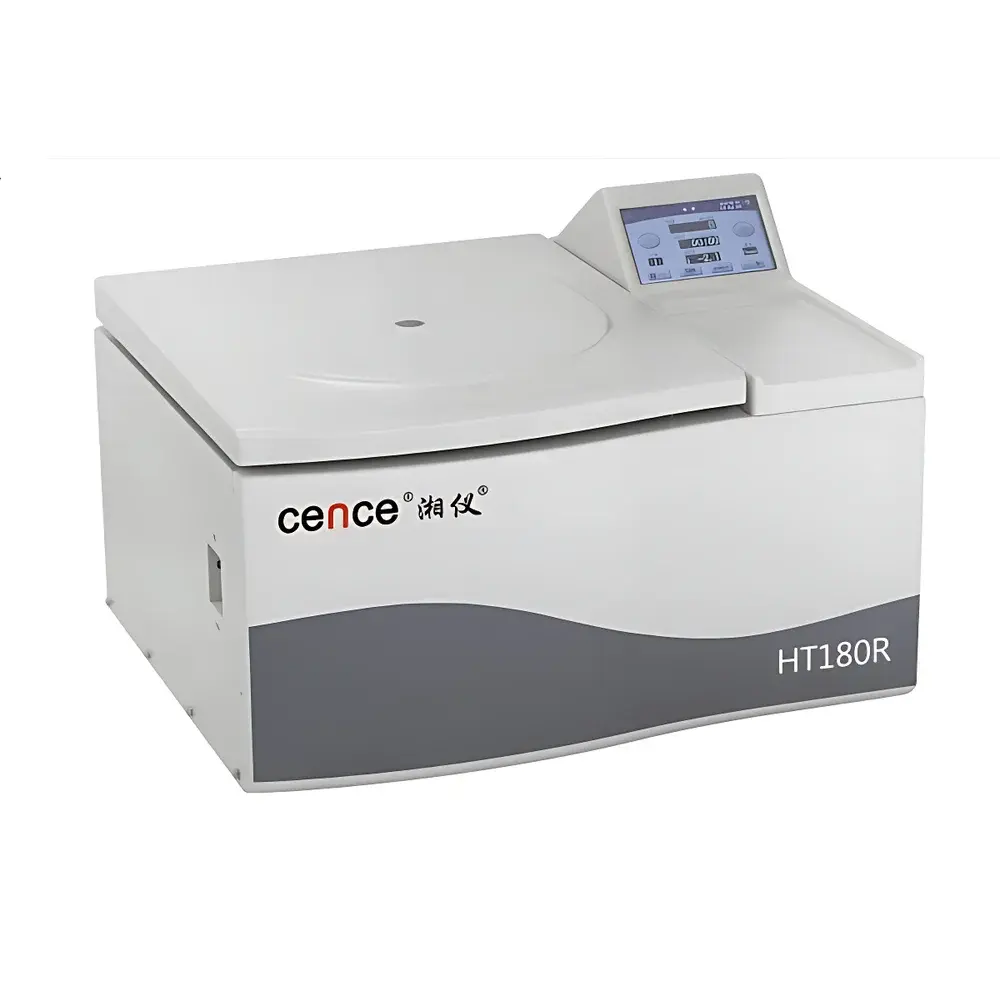
Xiangyi HT180R Benchtop High-Speed Refrigerated Centrifuge
| Brand | Xiangyi |
|---|---|
| Origin | Hunan, China |
| Manufacturer Type | Direct Manufacturer |
| Product Category | Domestic |
| Model | HT180R |
| Instrument Type | Benchtop Centrifuge |
| Speed Range | 200–18,000 rpm |
| Maximum RCF | 31,006 × g |
| Maximum Capacity | 4 × 250 mL (horizontal rotor) |
| Temperature Range | –20 °C to +40 °C |
| Dimensions (W×D×H) | 710 × 560 × 450 mm |
| Motor | AC Frequency-Controlled Brushless Motor |
| Refrigeration System | Eco-Friendly Imported Compressor |
| Control Interface | Full-Touch LCD Display |
| Rotor Recognition | Automatic |
| Safety Features | Imbalance Detection, Over-Speed Protection, Over-Temperature Protection, Door Interlock, Motor Overheat Protection |
| Program Storage | 99 User-Defined Protocols |
| Parameter Input Options | rpm or RCF Selection |
| Compliance | Designed for GLP-compliant laboratories |
Overview
The Xiangyi HT180R is a high-performance benchtop refrigerated centrifuge engineered for precision separation of biological macromolecules—including proteins, nucleic acids, organelles, and subcellular particles—in research, clinical diagnostics, and quality control laboratories. It operates on the principle of sedimentation under controlled gravitational force (RCF), where rotational motion generates centrifugal acceleration proportional to rotor radius and angular velocity squared. The HT180R achieves a maximum speed of 18,000 rpm and delivers up to 31,006 × g, enabling rapid pelleting of dense biomolecular complexes while maintaining thermal stability through its integrated eco-friendly refrigeration system (-20 °C to +40 °C). Its compact footprint (710 × 560 × 450 mm) and horizontal rotor configuration support scalable sample processing without compromising floor space—ideal for mid-throughput labs requiring reproducible, temperature-sensitive separations.
Key Features
- Microprocessor-controlled operation with full-touch LCD interface for intuitive navigation and real-time parameter monitoring.
- AC frequency-controlled brushless motor ensures high torque delivery, low vibration, and extended service life—critical for long-duration runs at elevated speeds.
- Automatic rotor identification prevents inadvertent overspeed operation by validating rotor type, maximum rated speed, and load capacity before run initiation.
- Electromechanical door lock with safety interlock guarantees secure lid closure during operation and immediate deceleration upon forced opening.
- Dual-parameter input mode allows users to define protocols using either rotational speed (rpm) or relative centrifugal force (RCF), facilitating method transfer across instruments with varying rotor geometries.
- Comprehensive safety architecture includes imbalance detection, over-temperature protection (both chamber and motor), over-speed cutoff, and compressor fault monitoring—fully compliant with IEC 61010-1 safety standards.
- 99 programmable protocols with user-defined naming support standardized workflows and reduce manual entry errors in regulated environments.
Sample Compatibility & Compliance
The HT180R accommodates standard horizontal rotors supporting up to four 250 mL conical tubes (e.g., 50 mL, 15 mL, or microcentrifuge formats via adapters), making it suitable for cell harvesting, plasma separation, viral pellet recovery, and polymer precipitation. All rotor materials meet ISO 15190:2020 biocompatibility guidelines for contact with biological samples. The instrument is designed to operate within GLP and GMP frameworks: temperature logging, run history timestamps, and parameter traceability align with FDA 21 CFR Part 11 expectations when paired with compliant data management software. It also supports ISO/IEC 17025-accredited testing laboratories through documented calibration intervals and maintenance records.
Software & Data Management
While the HT180R operates as a standalone instrument, its embedded firmware logs critical operational metadata—including start/stop time, set parameters, actual RCF achieved, temperature profile, and error codes—for each run. These logs are exportable via USB interface in CSV format for integration into LIMS or ELN systems. Optional PC-based software (sold separately) enables remote monitoring, batch protocol deployment, electronic signature capture, and automated report generation—features essential for audit readiness in pharmaceutical QC and clinical research settings.
Applications
- Isolation of mitochondria, lysosomes, and nuclei from tissue homogenates.
- Purification of plasmid DNA and genomic DNA using polyethylene glycol (PEG) or cesium chloride gradient protocols.
- Concentration and desalting of monoclonal antibodies and recombinant proteins prior to HPLC or mass spectrometry analysis.
- Preparation of platelet-poor plasma (PPP) and platelet-rich plasma (PRP) in translational medicine studies.
- Routine separation of whole blood components in hospital core labs and biobanking facilities.
- Processing of nanoparticle suspensions and liposome formulations requiring temperature-controlled sedimentation.
FAQ
What is the minimum and maximum operating temperature range?
The HT180R maintains chamber temperatures between –20 °C and +40 °C, with ±1 °C accuracy at 4 °C and stable ramping performance across the full range.
Does the centrifuge support rotor calibration verification?
Yes—rotor identification is hardware-based and verified at power-on; optional calibration certificates are available for individual rotors upon request.
Can I export run logs directly to Excel?
Yes—via USB port, the device exports timestamped CSV files containing all run parameters and system events, compatible with Microsoft Excel and statistical analysis tools.
Is the HT180R suitable for BSL-2 applications?
When used with sealed buckets and aerosol-tight rotors, the HT180R meets containment requirements for BSL-2 agents; biosafety cabinet integration is recommended for open-tube handling.
What maintenance schedule is recommended?
Routine cleaning and visual inspection every 3 months; refrigeration system service and rotor fatigue assessment every 12 months or after 10,000 cycles—whichever occurs first.
Related Products



