
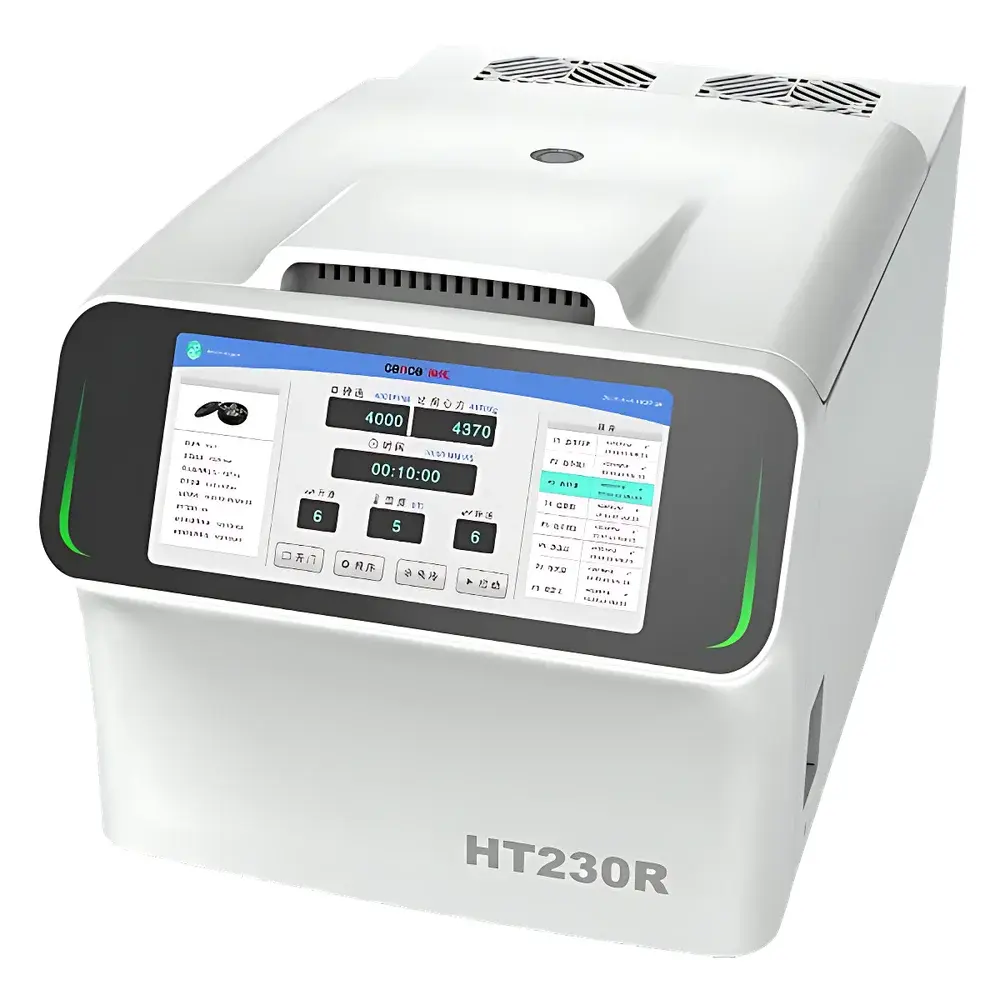
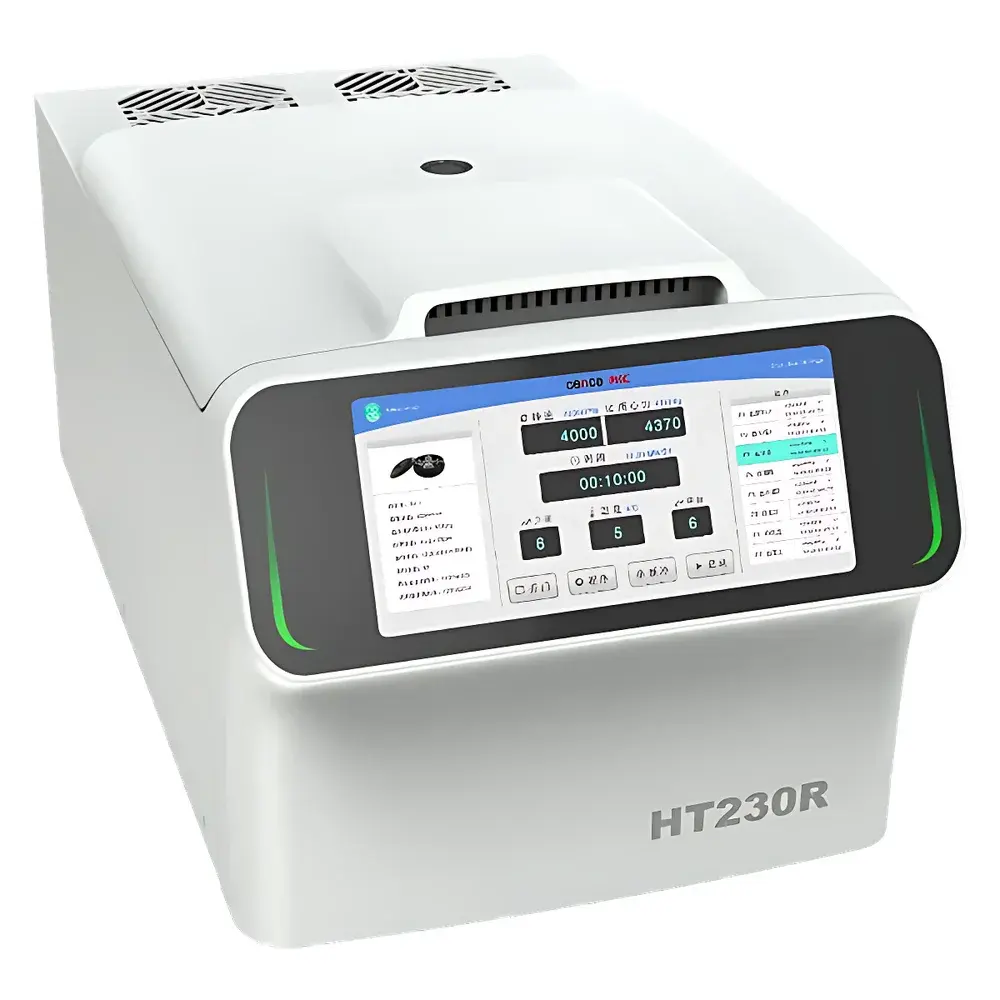
Xiangyi HT230R High-Speed Refrigerated Benchtop Centrifuge
| Brand | Xiangyi |
|---|---|
| Origin | Hunan, China |
| Manufacturer Type | Direct Manufacturer |
| Instrument Type | Benchtop Centrifuge |
| Speed Range | 23,000 rpm (max) |
| RCF Max | 36,756 × g |
| Capacity | 6 × 100 mL (horizontal rotor) |
| Temperature Range | –20 °C to +40 °C |
| Speed Accuracy | ±10 rpm |
| Timer Modes | Start-time, Speed-reached-time, Instant-run, Continuous-run |
| Pre-cooling & Delayed Start | Supported |
| Drive System | High-efficiency brushless frequency-converter motor |
| Cooling Technology | Inverter-controlled refrigeration |
| Energy Savings | ~30% vs. conventional benchtop refrigerated centrifuges |
| Dimensions (W×D×H) | 380 × 690 × 400 mm |
| Net Weight | 72 kg |
| Safety Certifications | CE-compliant design |
Overview
The Xiangyi HT230R is a high-performance refrigerated benchtop centrifuge engineered for precision separation of biological macromolecules—including proteins, nucleic acids, organelles, and viral particles—under controlled thermal conditions. Utilizing a brushless frequency-converter motor and inverter-driven refrigeration system, the HT230R achieves stable rotational dynamics at speeds up to 23,000 rpm and delivers a maximum relative centrifugal force (RCF) of 36,756 × g. Its compact footprint (380 × 690 × 400 mm) enables seamless integration into biosafety cabinets, cold rooms, or shared core lab environments without compromising operational capability. Designed for routine and method-critical applications in molecular biology, clinical diagnostics, and biopharmaceutical QC labs, the HT230R operates within a precisely regulated temperature range of –20 °C to +40 °C, with real-time thermal feedback ensuring sample integrity during extended runs.
Key Features
- High-efficiency inverter refrigeration system delivering consistent temperature control and reducing energy consumption by approximately 30% compared to conventional fixed-speed compressor-based units.
- Brushless frequency-converter drive ensuring smooth acceleration/deceleration profiles, low acoustic emission (<65 dB[A] at 2 m), and exceptional run-to-run reproducibility.
- Multi-mode timing architecture: start-time scheduling, speed-reached timing, instantaneous pulse operation, and continuous runtime—enabling compliance with SOP-defined protocols.
- Comprehensive safety suite: automatic rotor recognition (via mechanical coding), dual electromechanical door interlock, real-time imbalance detection, overspeed cutoff, and overtemperature shutdown.
- Fast pre-cooling function (reaches –20 °C in ≤15 min from ambient), minimizing sample warm-up time prior to loading.
- Ergonomic horizontal rotor configuration supporting six 100 mL tubes—optimized for high-volume pelleting of cell lysates, serum separation, and density gradient preparations.
Sample Compatibility & Compliance
The HT230R accommodates standard polypropylene, polycarbonate, and stainless-steel centrifuge tubes (10–100 mL) and is compatible with common rotor adapters for microtubes and PCR strips. Its thermal stability and RCF consistency support methodologies aligned with ISO 22870:2016 (in vitro diagnostic medical devices), CLSI EP05-A3 (precision evaluation of quantitative measurement procedures), and FDA-recommended centrifugation parameters for biologics manufacturing. While not certified under 21 CFR Part 11 out-of-the-box, audit-ready operation is achievable through documented user access controls, electronic log export (via USB), and timestamped event records—including rotor ID, setpoint deviations, and emergency stops.
Software & Data Management
The HT230R features an embedded 4.3-inch capacitive touchscreen interface with intuitive icon-based navigation and multilingual support (English, German, French, Spanish, Chinese). All operational parameters—including speed, time, temperature, acceleration/deceleration ramps, and rotor-specific settings—are stored in non-volatile memory. Event logs capture date/time stamps for every run initiation, parameter change, alarm trigger, and door opening. Data export is supported via USB 2.0 port in CSV format, facilitating traceability in GLP/GMP environments. Optional PC connectivity (RS-232 or Ethernet) enables remote monitoring and integration into LIMS platforms using Modbus RTU or ASCII command protocols.
Applications
- Isolation of subcellular fractions (mitochondria, nuclei, lysosomes) from mammalian tissue homogenates.
- Purification of plasmid DNA and RNA using cesium chloride or iodixanol density gradients.
- Clarification of bacterial and yeast fermentation broths prior to chromatographic downstream processing.
- Preparation of platelet-poor plasma (PPP) and platelet-rich plasma (PRP) in clinical laboratories.
- Concentration of extracellular vesicles (exosomes) from cell culture supernatants and biofluids.
- Routine quality control of vaccine suspensions, monoclonal antibody formulations, and nanoparticle dispersions.
FAQ
What is the maximum rotor capacity for the HT230R?
The standard horizontal rotor supports six 100 mL tubes, with optional adapters available for 50 mL, 15 mL, and 5 mL conical tubes.
Does the HT230R support rotor auto-recognition?
Yes—the rotor identification system uses mechanical coding to verify compatibility and enforce speed/temperature limits per rotor type.
Can the instrument maintain –20 °C during a 60-minute run at maximum speed?
Under typical laboratory conditions (25 °C ambient, 40% RH), the HT230R sustains –20 °C ±1.5 °C throughout a full-duration 23,000 rpm run when properly loaded and sealed.
Is the HT230R compliant with international electrical safety standards?
The unit meets IEC 61010-1:2010 requirements for laboratory equipment and carries CE marking under the Low Voltage Directive and EMC Directive.
How is data integrity ensured during power interruption?
All active run parameters and event logs are written to flash memory in real time; unsaved changes are retained across power cycles, and interrupted runs can be resumed from last valid state upon restart.



