
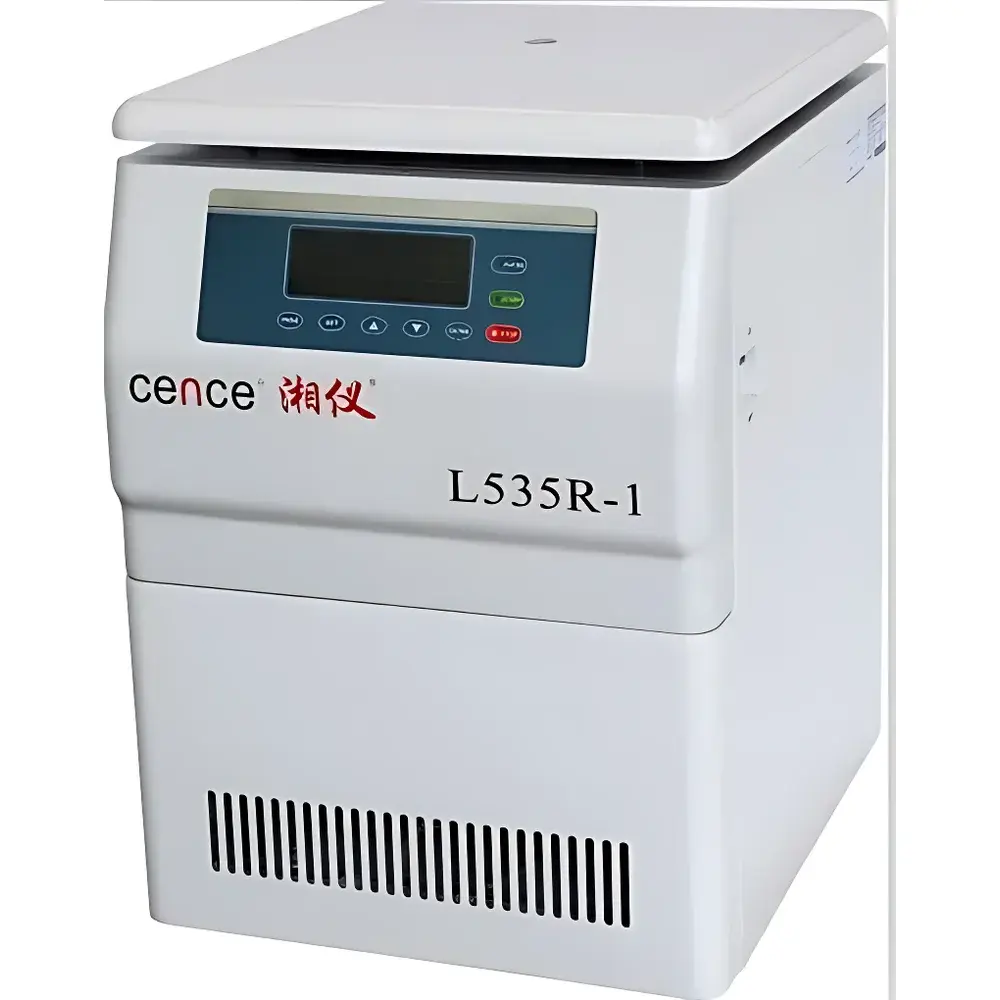
Xiangyi L535R-1 Low-Speed Refrigerated Centrifuge
| Brand | Xiangyi |
|---|---|
| Origin | Hunan, China |
| Manufacturer Type | Direct Manufacturer |
| Product Category | Domestic |
| Model | L535R-1 |
| Instrument Type | Floor-Standing Centrifuge |
| Speed Class | Low-Speed Centrifuge (≤6,000 rpm) |
| Function | Refrigerated Centrifuge |
| Configuration | Horizontal Rotor Centrifuge |
| Separation Level | Cell & Bacterial Pelletization |
| Max Capacity | 4 × 750 mL |
| Max Speed | 5,350 rpm |
| Max RCF | 5,030 × g |
| Dimensions | 565 × 660 × 850 mm |
| Weight | 120 kg |
| Temperature Range | –20 °C to +40 °C |
| Temp. Accuracy | ±1 °C |
| Refrigerant | R404a (Environmentally Compliant) |
| Noise Level | <65 dB(A) |
| Power Supply | AC 220 V ±22 V, 50 Hz, 16 A |
| Power Consumption | 1,700 W |
| Speed Accuracy | ±10 rpm |
| Timer Range | 1–99 min |
| Drive System | AC Brushless Motor |
| Control | Microprocessor-Based |
| Rotor Programmability | Multi-Program Storage |
| Acceleration/Deceleration Profiles | 9 Acceleration & 10 Deceleration Curves |
| Suspension System | Dual-Stage Damping |
| Safety Features | Overspeed Protection, Overtemperature Protection, Lid Interlock, Imbalance Detection |
Overview
The Xiangyi L535R-1 is a floor-standing, low-speed refrigerated centrifuge engineered for high-capacity, temperature-sensitive separation tasks in academic, clinical, and industrial laboratories. Designed around the principles of sedimentation kinetics under controlled thermal conditions, it enables reliable pelleting of mammalian cells, bacterial cultures, yeast, platelets, and subcellular organelles—without compromising structural integrity or metabolic viability. Its maximum relative centrifugal force (RCF) of 5,030 × g at 5,350 rpm provides sufficient g-force for gentle yet effective separation of large-volume biological suspensions, while the integrated R404a-based refrigeration system maintains sample temperatures as low as –20 °C with ±1 °C stability—even at peak rotational speed. The unit complies with IEC 61010-1:2010 safety standards for laboratory electrical equipment and meets electromagnetic compatibility (EMC) requirements per EN 61326-1.
Key Features
- High-efficiency, eco-friendly R404a refrigeration system with imported compressor—ensures stable sub-zero operation (down to –20 °C) during extended runs, critical for heat-labile samples such as primary cell isolates or enzyme-containing lysates.
- AC brushless motor drive delivering high torque, zero carbon dust emission, and maintenance-free operation over >20,000 h MTBF (mean time between failures).
- Microprocessor-controlled interface with real-time RCF calculation and automatic conversion between rpm and ×g—eliminating manual lookup errors and ensuring protocol reproducibility.
- Dual-stage damping suspension and 10 programmable deceleration profiles—including soft-stop modes—to minimize resuspension of delicate pellets and prevent secondary turbidity.
- Comprehensive safety architecture: lid interlock with mechanical and electronic redundancy, overspeed cutoff, real-time rotor imbalance detection, and overtemperature shutdown—all logged with timestamped event records.
- Multi-rotor compatibility supporting horizontal, angular, microplate, and specialized carriers (e.g., 4 × 750 mL buckets, 4 × 24 × 5 mL blood tube holders, 2 × 2 × 96-well microplate adapters), enabling method standardization across diverse workflows.
Sample Compatibility & Compliance
The L535R-1 accommodates a broad spectrum of sample formats—from 0.2 mL PCR tubes to 750 mL disposable bottles—via interchangeable rotors certified to ISO 15197:2013 mechanical stress limits and ASME BPE-2021 material compatibility guidelines. All aluminum rotors undergo anodization per MIL-A-8625 Type II and are validated for repeated autoclaving (121 °C, 20 min). The instrument supports GLP-compliant documentation when paired with optional external audit-trail software (not bundled). It meets CE marking requirements under the EU Machinery Directive 2006/42/EC and Low Voltage Directive 2014/35/EU. Refrigerant handling conforms to EPA SNAP Program criteria for ozone depletion potential (ODP = 0.39) and global warming potential (GWP = 3,922).
Software & Data Management
The embedded control firmware supports up to 99 user-defined protocols, each storing speed, time, temperature, acceleration/deceleration ramping, and rotor ID. All parameters are non-volatile and retained after power loss. Event logs capture operational anomalies (e.g., lid open during spin, temperature deviation >±2 °C) with ISO 8601 timestamps. While no proprietary PC software is included, ASCII-formatted run reports can be exported via RS-232 serial port for integration into LIMS environments compliant with ASTM E1578-19 data exchange protocols. Optional USB-to-serial adapters enable direct transfer to Windows/Linux workstations for CSV-based analysis.
Applications
- Cell culture harvest: Recovery of adherent and suspension cells (HEK293, CHO, Jurkat) from bioreactor harvests at volumes up to 3 L per run.
- Clinical diagnostics: Routine separation of whole blood into serum/plasma fractions using 4 × 24 × 5 mL vacuum tubes—validated per CLSI H18-A3 centrifugation guidelines.
- Virology & vaccine development: Clarification of lentiviral supernatants and adeno-associated virus (AAV) preps prior to ultracentrifugation or chromatography.
- Food & beverage QC: Sediment analysis in dairy homogenates, yeast counting in brewing wort, and fat globule isolation in cream emulsions.
- Environmental microbiology: Concentration of waterborne bacteria (e.g., E. coli, Legionella) from 1–10 L filtration eluates using 750 mL conical bottles.
FAQ
What is the minimum operating temperature at maximum speed?
At 5,350 rpm, the chamber maintains ≤ –4 °C continuously, verified by NIST-traceable thermocouple calibration per ISO/IEC 17025.
Are all rotors supplied with rotor-specific calibration certificates?
Yes—each rotor includes a factory-issued certificate listing max speed, RCF, and mass balance tolerance (±0.5 g) per ISO 21501-4 Annex B.
Can the L535R-1 be integrated into a 21 CFR Part 11–compliant workflow?
With third-party electronic signature and audit trail software (e.g., LabArchives or Thermo Fisher SampleManager), full Part 11 compliance is achievable; the device itself provides raw data export and tamper-evident event logging.
Is rotor No.4 (4 × 750 mL horizontal) suitable for density gradient separations?
Yes—its swing-out geometry and certified angular alignment support sucrose, Percoll, and Ficoll gradients; maximum gradient height is 120 mm per bucket.
What maintenance intervals are recommended for the refrigeration system?
Compressor oil and filter-drier replacement every 36 months or 6,000 operating hours—whichever occurs first—as specified in the service manual (Rev. 3.2, 2023).



