
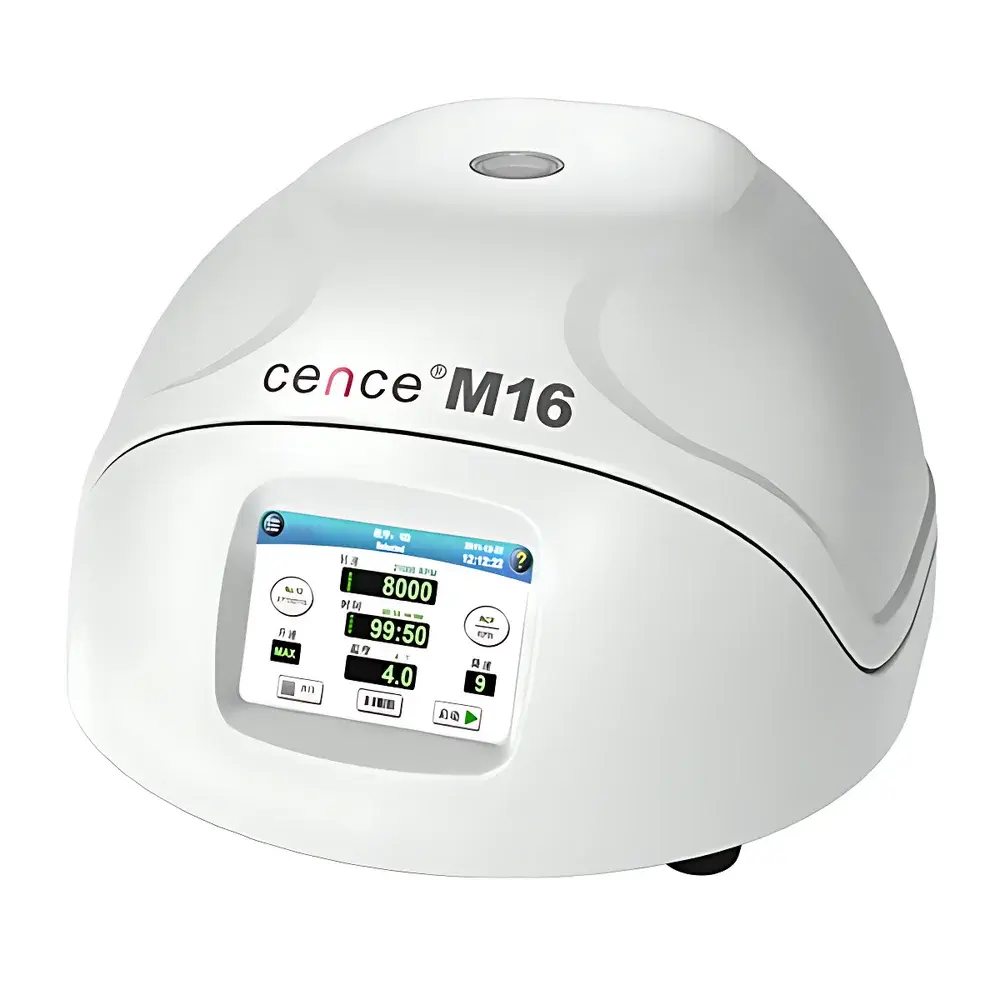
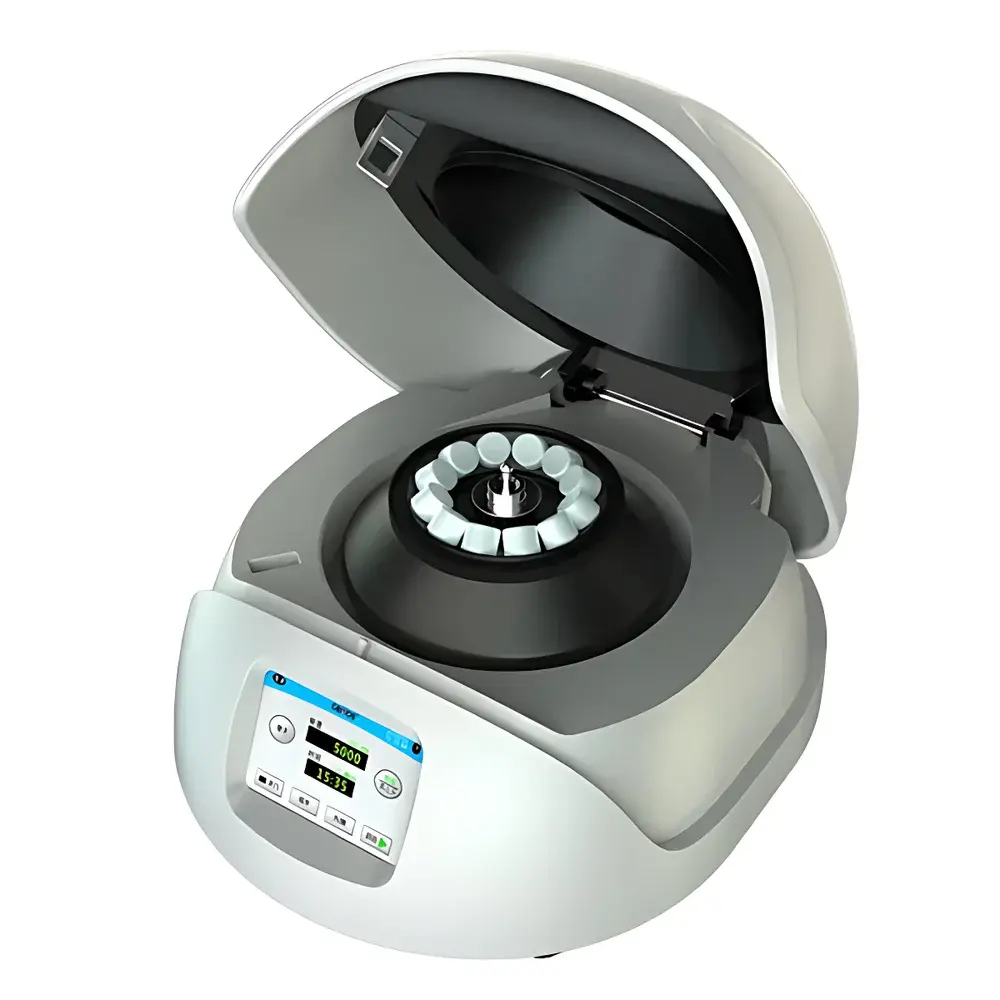
Xiangyi M16 Benchtop High-Speed Microcentrifuge
| Brand | Xiangyi |
|---|---|
| Origin | Hunan, China |
| Manufacturer | Xiangyi Scientific Instrument Co., Ltd. |
| Type | Benchtop Centrifuge |
| Speed Range | 300–16,000 rpm (±30 rpm accuracy) |
| Max RCF | 17,602 × g |
| Max Capacity | 12 × 1.5/2.0 mL tubes |
| Rotor Type | Fixed-angle metal rotor (autoclavable) |
| Timer Range | 1 s – 99 min 59 s, continuous mode supported |
| Temperature Rise | ≤ +10 °C above ambient during operation |
| Display | 3.5-inch capacitive touchscreen (glove-compatible) |
| Programmability | 50 user-defined protocols with custom naming |
| Motor | Brushless DC motor, maintenance-free |
| Safety | Emergency lid release mechanism, hermetically sealed optional rotors for aerosol containment |
| Dimensions (W×D×H) | 260 × 240 × 145 mm |
| Compliance | Designed per ISO 13485 principles |
Overview
The Xiangyi M16 Benchtop High-Speed Microcentrifuge is an engineered solution for rapid, reproducible pelleting and separation of microliter-scale biological samples in resource-constrained or space-limited laboratory environments. Utilizing fixed-angle rotor geometry and precise brushless DC motor control, the M16 operates on the principle of centrifugal sedimentation—applying radial acceleration to accelerate phase separation based on particle density, size, and medium viscosity. With a maximum rotational speed of 16,000 rpm and a corresponding relative centrifugal force (RCF) of 17,602 × g, it meets the performance requirements for nucleic acid precipitation, protein pellet recovery, cell organelle isolation, and microfiltration of clarified lysates—particularly where sample volumes are limited to 1.5–2.0 mL per tube. Its compact footprint (260 × 240 × 145 mm) and low acoustic signature (<55 dB(A) at full speed) make it suitable for shared core facilities, teaching labs, clinical diagnostics benches, and biosafety cabinets.
Key Features
- Glove-compatible 3.5-inch capacitive touchscreen interface with real-time dual-parameter display—showing both setpoints (speed, time, RCF) and live operational values simultaneously.
- Precision speed regulation across 300–16,000 rpm range, with ±30 rpm accuracy ensured by closed-loop digital tachometry and adaptive motor feedback.
- 50 programmable protocols, each assignable with alphanumeric identifiers (e.g., “DNA-Extraction-v2”, “PBMC-Wash”), enabling strict adherence to SOP-driven workflows and inter-lab method transfer.
- Optimized thermal management via passive airflow channeling—limiting internal chamber temperature rise to ≤ +10 °C above ambient, critical for preserving enzymatic activity or RNA integrity during extended runs.
- Standard autoclavable aluminum fixed-angle rotor (12 × 1.5/2.0 mL), validated for repeated sterilization at 121 °C / 15 psi for 20 minutes without dimensional drift or surface oxidation.
- Optional hermetically sealed all-metal rotors with O-ring compression sealing, certified to contain aerosols generated during high-speed spin-down of infectious or volatile samples—aligned with WHO BSL-2 containment recommendations.
- Fail-safe mechanical emergency lid release, concealed beneath the front panel and operable without tools, compliant with IEC 61010-2-020 safety requirements for centrifuge access under power loss.
Sample Compatibility & Compliance
The M16 supports standard microcentrifuge tubes (1.5 mL and 2.0 mL polypropylene or PCR-grade variants), including those with hinged caps, snap caps, and low-retention surfaces. It accommodates common biochemical reagents (e.g., ethanol, isopropanol, guanidine thiocyanate buffers) and viscous matrices such as glycerol-containing lysates or serum supernatants. While not certified to ISO/IEC 17025 as a testing laboratory instrument, its design follows risk-based engineering practices consistent with ISO 13485 for in vitro diagnostic support equipment. The system supports audit-ready documentation when integrated with laboratory information management systems (LIMS) via timestamped protocol logs exportable via USB—facilitating compliance with FDA 21 CFR Part 11 for electronic records in regulated environments.
Software & Data Management
The embedded firmware stores all executed run metadata—including date/time stamp, selected protocol ID, actual speed profile, elapsed time, and final RCF—with automatic overwrite protection for the last 100 cycles. No proprietary software installation is required: configuration and history review occur entirely through the onboard interface. For integration into centralized data ecosystems, the USB port enables export of CSV-formatted run logs containing ISO 8601 timestamps, protocol names, and deviation flags (e.g., “speed error > ±50 rpm”). These files are compatible with Python/Pandas-based QC dashboards or Excel-based trend analysis for preventive maintenance scheduling.
Applications
- Routine nucleic acid purification workflows (plasmid prep, PCR cleanup, column-based RNA isolation).
- Microscale protein concentration and desalting prior to LC-MS or SDS-PAGE analysis.
- Clarification of bacterial or mammalian cell lysates prior to affinity chromatography.
- Preparative isolation of exosomes and microvesicles from conditioned media (in combination with sequential ultracentrifugation).
- Quality control centrifugation in point-of-care molecular testing platforms requiring benchtop scalability.
- Student training in fundamental centrifugation theory, rotor dynamics, and RCF calculation (with built-in unit conversion between rpm and ×g).
FAQ
Is the M16 suitable for use inside a biosafety cabinet?
Yes—the unit’s compact depth (240 mm) and low heat dissipation allow stable placement within Class II A2 cabinets without compromising airflow integrity.
Can the standard rotor be sterilized in an autoclave?
Yes—the included aluminum fixed-angle rotor is rated for repeated autoclaving at 121 °C / 15 psi for 20 minutes; no degradation in balance tolerance or angular precision has been observed after ≥50 cycles.
Does the M16 support variable acceleration/deceleration rates?
No—it employs fixed-rate ramp profiles optimized for microtube integrity; however, the 1-second minimum timer setting enables manual interruption for sensitive pelleting steps.
What safety certifications does the M16 hold?
It conforms to IEC 61010-1 (electrical safety) and IEC 61010-2-020 (particular requirements for centrifuges), with CE marking issued under EU Directive 2014/30/EU (EMC) and 2014/35/EU (LVD).
Is remote monitoring or network connectivity available?
Not natively—the M16 is designed as a standalone, single-user instrument; networked telemetry requires external USB-to-Ethernet gateways interfaced via third-party middleware.
Related Products



