
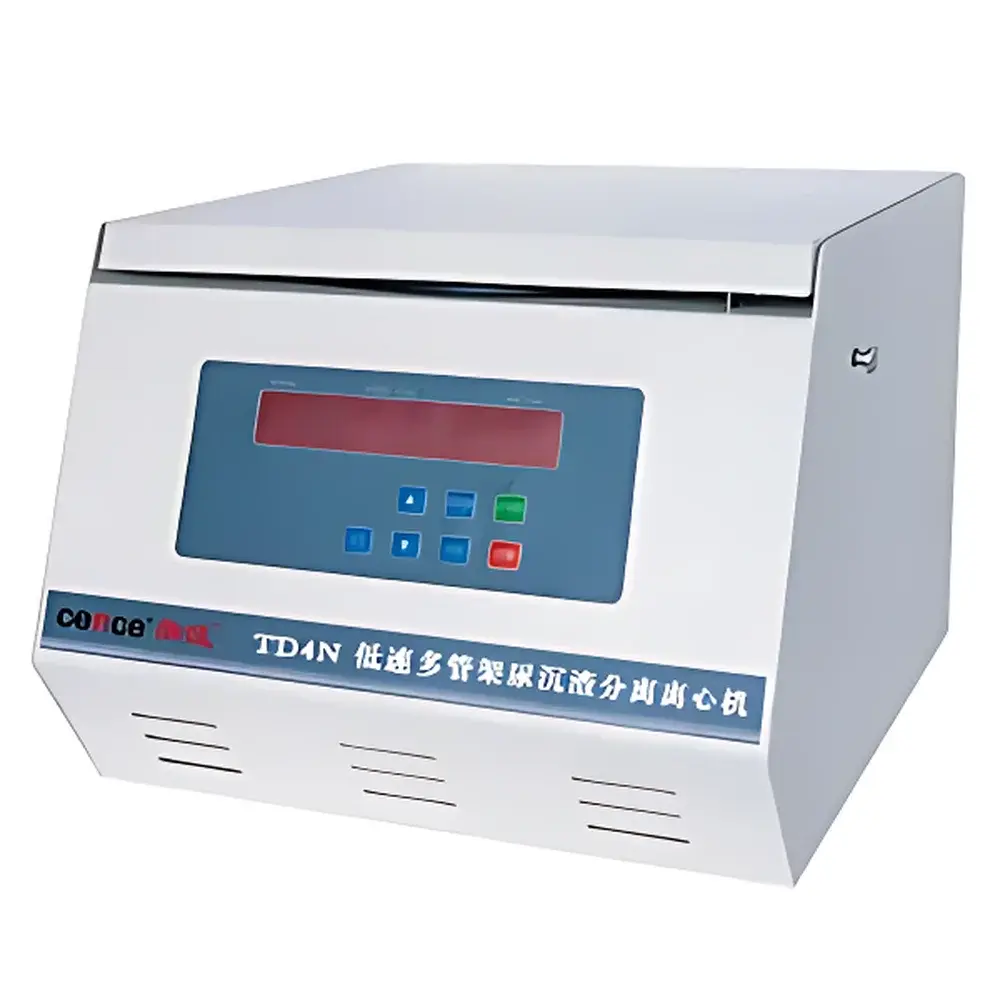
Xiangyi TD4N Low-Speed Multi-Rotor Urine Sediment Centrifuge
| Brand | Xiangyi |
|---|---|
| Origin | Hunan, China |
| Manufacturer Type | Direct Manufacturer |
| Product Category | Domestic Laboratory Equipment |
| Model | TD4N |
| Instrument Type | Benchtop Centrifuge |
| Speed Range | Up to 4000 rpm |
| Max RCF | 2800 × g |
| Max Capacity | 32 × 15 mL |
| Rotor Configuration | Horizontal Swing-Out Rotor (4 × 8 × 15 mL) |
| Speed Accuracy | ±30 rpm |
| Timer Range | 1–99 min |
| Noise Level | ≤65 dB(A) |
| Power Supply | AC 220 V ±22 V, 50/60 Hz, 10 A |
| Power Consumption | 400 W |
| Dimensions (L×W×H) | 450 × 545 × 380 mm |
| Net Weight | 40 kg |
Overview
The Xiangyi TD4N Low-Speed Multi-Rotor Urine Sediment Centrifuge is a purpose-engineered benchtop centrifuge designed specifically for clinical urinalysis workflows. It operates on the principle of sedimentation-based separation under controlled gravitational force (RCF), enabling efficient pelleting of urinary cellular elements—including erythrocytes, leukocytes, epithelial cells, casts, and crystalline debris—while preserving morphological integrity for subsequent microscopic evaluation. Unlike high-speed or ultracentrifugation systems, the TD4N delivers optimized low-speed rotational dynamics (up to 4000 rpm, 2800 × g), minimizing shear-induced disruption of fragile sediment components. Its fixed-angle horizontal rotor configuration ensures uniform radial distribution of sample tubes during acceleration and deceleration, supporting reproducible pellet formation across all 32 positions. The unit complies with IEC 61010-1 safety standards for laboratory electrical equipment and is engineered for continuous operation in ISO 15189-accredited clinical laboratories and hospital core labs.
Key Features
- Benchtop footprint with compact dimensions (450 × 545 × 380 mm) suitable for space-constrained clinical workstations.
- Horizontal swing-out rotor (NO.1 type) accommodating 32 × 15 mL conical-bottom graduated tubes—compatible with standard urine collection vials used in automated urinalysis platforms.
- Precision speed control with ±30 rpm accuracy across the full 300–4000 rpm operating range, ensuring consistent sedimentation kinetics between runs.
- Digital timer with 1–99 minute programmable interval, supporting both fixed-duration protocols and extended sedimentation cycles per CLSI GP16-A3 guidelines.
- Acoustic optimization delivering ≤65 dB(A) noise emission at 1 m distance—critical for open-plan lab environments and operator comfort during prolonged use.
- Thermally stable brushless DC motor with integrated over-speed and imbalance detection, meeting EN 61000-6-3 EMC requirements.
- Robust steel housing with epoxy-coated interior chamber and removable stainless-steel rotor carrier for easy decontamination and compliance with CDC-recommended biosafety cleaning protocols.
Sample Compatibility & Compliance
The TD4N accepts standard 15 mL polypropylene conical centrifuge tubes (including tapered,刻度-marked variants) without adapter requirements. It is validated for use with native, preservative-free, and formalin-fixed urine specimens. All wetted materials comply with USP Class VI biocompatibility standards. The system supports GLP-aligned documentation practices through manual logbook integration and is compatible with laboratory information systems (LIS) via optional RS-232 interface (available upon request). While not FDA 510(k)-cleared as an IVD device, its operational parameters align with ASTM E2917-20 (Standard Practice for Validation of Clinical Laboratory Instruments) and ISO 22870:2016 (Point-of-care testing—Requirements for quality and competence).
Software & Data Management
The TD4N operates via an embedded microcontroller with non-volatile memory storing up to 10 user-defined protocols. Each protocol retains rotor speed, run time, and acceleration/deceleration profiles. No proprietary software installation is required; parameter recall and real-time status monitoring occur via the front-panel LCD interface. Audit trail functionality is maintained through physical operator logs per CAP checklist GEN.40520 (Centrifuge Maintenance Records). For facilities requiring electronic record retention, the unit supports integration with third-party LIMS via TTL-level trigger outputs synchronized to start/stop events.
Applications
- Routine urine sediment preparation prior to phase-contrast or brightfield microscopy per CLIA-waived and moderate-complexity testing regulations.
- Pre-analytical processing for automated urine analyzers (e.g., Sysmex UF-series, Beckman Coulter Iris iQ200) requiring standardized pellet volume and morphology preservation.
- Research-grade sediment isolation in nephrology and urology studies involving exosome-enriched fractions from centrifuged supernatants (post-2800 × g pre-clearing step).
- Quality control of reagent stability in urine dipstick and turbidimetric assays where particulate interference must be eliminated prior to optical measurement.
- Training applications in medical technology and clinical laboratory science programs due to intuitive interface and mechanical reliability.
FAQ
Is the TD4N compliant with international electrical safety standards?
Yes—the unit conforms to IEC 61010-1:2010 and carries CE marking for laboratory equipment.
Can the rotor accommodate tubes other than 15 mL conical formats?
The NO.1 horizontal rotor is mechanically optimized for 15 mL conical-bottom tubes; alternative tube geometries require validation of balance tolerance and sediment recovery efficiency.
What maintenance intervals are recommended for routine operation?
Rotor inspection and chamber cleaning are advised after every 500 runs or quarterly—whichever occurs first—as documented in the included maintenance log template.
Does the centrifuge support variable acceleration and deceleration profiles?
No—the TD4N uses fixed ramp rates optimized for urine sediment integrity; programmable gradient control is not implemented.
Is remote monitoring or network connectivity available?
Standard configuration includes only local control; Ethernet or Wi-Fi modules are not supported, though RS-232 serial output enables basic external event logging.



