
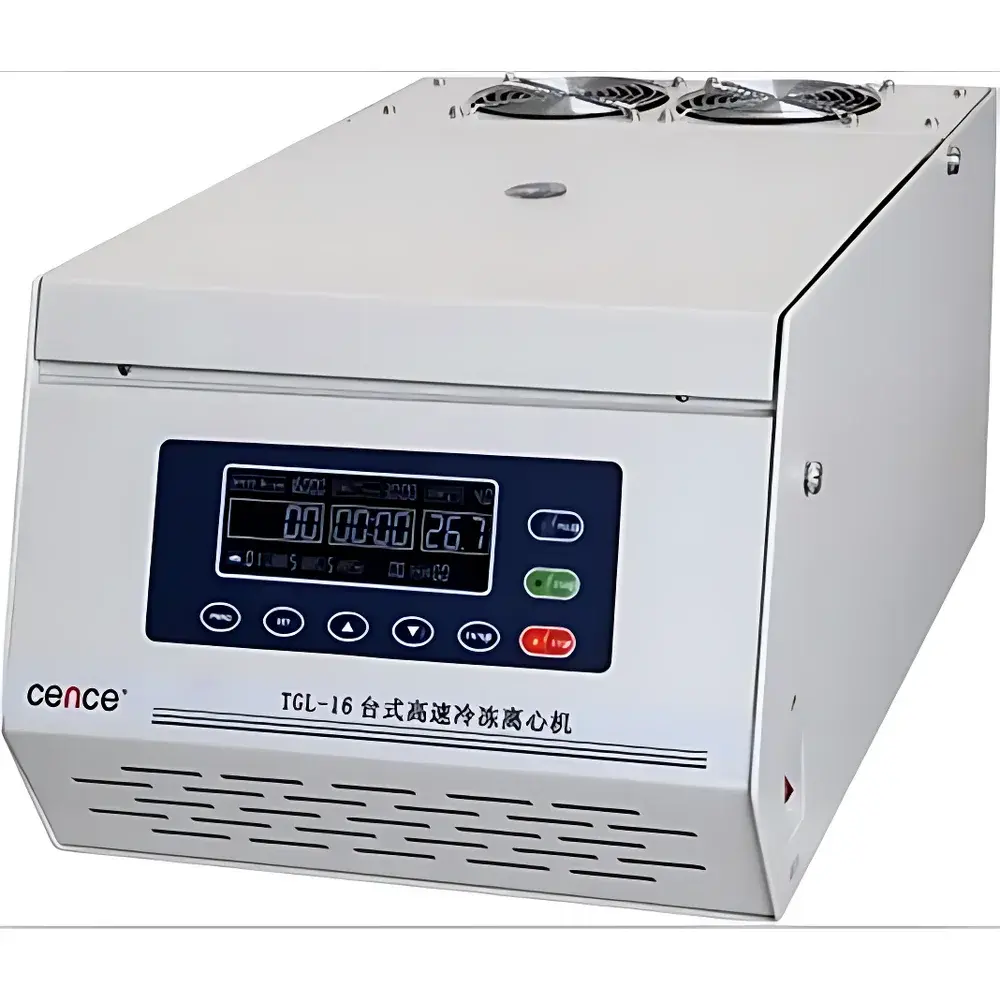
Xiangyi TGL-16 Benchtop High-Speed Refrigerated Centrifuge
| Brand | Xiangyi |
|---|---|
| Origin | Hunan, China |
| Manufacturer | Xiangyi Instrument Co., Ltd. |
| Type | Benchtop Refrigerated Centrifuge |
| Max Speed | 16,000 rpm |
| Max RCF | 21,532 ×g |
| Max Capacity | 12 × 5 mL |
| Temperature Range | −20 °C to +40 °C |
| Temp. Accuracy | ±1 °C |
| Noise Level | ≤57 dB(A) |
| Power Supply | AC 220 V ±22 V, 50 Hz, 10 A |
| Dimensions (L×W×H) | 350 × 630 × 300 mm |
| Weight | 65 kg |
| Motor | Brushless DC Motor |
| Control | Microprocessor-based LCD interface with 15 programmable protocols |
| Safety | Electronic lid lock, auto imbalance detection, overspeed/overtemperature diagnostics |
| Refrigerant | R134a |
Overview
The Xiangyi TGL-16 Benchtop High-Speed Refrigerated Centrifuge is an engineered solution for laboratories requiring precise, reproducible separation of biological macromolecules—including nucleic acids, proteins, and subcellular organelles—under temperature-controlled conditions. Designed around a high-efficiency brushless DC motor and a sealed, environmentally compliant R134a refrigeration system, the TGL-16 delivers stable thermal performance down to −20 °C with ±1 °C regulation accuracy, even at maximum rotational speed (16,000 rpm). Its compact footprint (350 × 630 × 300 mm) and benchtop form factor make it suitable for space-constrained molecular biology labs, PCR preparation areas, and quality control environments where consistent cold centrifugation is critical. The unit operates on standard 220 V/50 Hz mains power and meets international electrical safety standards for laboratory instrumentation.
Key Features
- Brushless DC motor ensures extended service life, low maintenance, and ultra-low operational noise (<57 dB[A])—critical for shared lab spaces and ISO 14644-compliant cleanrooms.
- Microprocessor-controlled LCD interface with intuitive menu navigation and 15 user-programmable protocols for repeatable method execution across shifts or operators.
- Real-time RCF calculation via dedicated RCF key, enabling immediate verification of g-force without manual conversion.
- Integrated electronic lid interlock and automatic rotor recognition logic prevent operation unless the lid is fully secured and compatible rotors are detected.
- Comprehensive self-diagnostic system monitors and displays error codes for overspeed, overtemperature, imbalance, and lid status—supporting GLP-compliant instrument logbook entries.
- Optimized airflow design and high-efficiency compressor maintain sample integrity during prolonged runs; achieves and sustains −4 °C at 16,000 rpm.
Sample Compatibility & Compliance
The TGL-16 accommodates a broad range of tube formats through seven interchangeable angular rotors—covering capacities from 0.2 mL PCR strips (3 × 8 × 0.2 mL) to 5 mL conical tubes (12 × 5 mL), with maximum RCF ranging from 9,178 ×g to 21,532 ×g. It supports common biosample containers including polypropylene microcentrifuge tubes, PCR plates, and cryovials. The system complies with IEC 61010-1 (Safety Requirements for Electrical Equipment for Measurement, Control, and Laboratory Use) and incorporates R134a refrigerant in accordance with EU F-Gas Regulation (EU No 517/2014) and EPA SNAP program guidelines. While not certified for GMP manufacturing environments, its programmability, audit-ready error logging, and temperature traceability support FDA 21 CFR Part 11–aligned workflows when paired with validated SOPs.
Software & Data Management
The TGL-16 features embedded firmware with non-volatile memory for storing up to 15 user-defined centrifugation protocols—including speed, time, temperature setpoint, acceleration/deceleration profiles, and hold-at-end settings. All run parameters and fault events are timestamped and displayed on the LCD screen in real time. Though the device lacks Ethernet or USB data export, its deterministic protocol recall and visible diagnostic codes facilitate consistent method transfer between users and simplify internal validation documentation. For laboratories implementing electronic lab notebooks (ELNs), manual entry of protocol IDs and run logs is supported by the unit’s clear parameter labeling and error-message transparency—aligning with ALCOA+ principles (Attributable, Legible, Contemporaneous, Original, Accurate, Complete, Consistent, Enduring, Available).
Applications
- Purification of plasmid DNA, genomic DNA, and RNA from bacterial lysates or mammalian cell suspensions.
- Clarification of protein extracts prior to chromatography or electrophoresis.
- Preparation of viral vectors and exosomes under chilled conditions to preserve structural integrity.
- High-yield pelleting of mitochondria, nuclei, and membrane fractions in subcellular fractionation workflows.
- Routine PCR product cleanup and enzyme removal using silica-membrane spin columns.
- Quality control testing of biopharmaceutical intermediates where temperature-sensitive aggregation must be minimized.
FAQ
What is the minimum operating temperature at maximum speed?
At 16,000 rpm, the chamber temperature stabilizes at ≤−4 °C under ambient conditions of 25 °C and 60% RH.
Does the TGL-16 support rotor calibration or speed verification?
No built-in tachometer calibration function is provided; external speed verification using a certified handheld tachometer is recommended per ISO/IEC 17025-accredited maintenance schedules.
Can the unit be integrated into a LIMS or automated workflow?
The TGL-16 does not feature digital communication ports (RS-232, USB, or Ethernet); integration requires manual protocol loading and visual confirmation of run completion.
Is rotor No.3 (24 × 1.5/2.2 mL) compatible with all listed max RCF values?
Yes—rotor No.3 achieves 21,532 ×g at 15,000 rpm with 1.5 mL tubes; full RCF specification assumes use of certified tubes rated for ≥22,000 ×g.
What safety certifications does the TGL-16 carry?
It conforms to IEC 61010-1:2010 and GB 4793.1–2007 (Chinese national equivalent), with CE marking for EMC and low-voltage directive compliance.



