
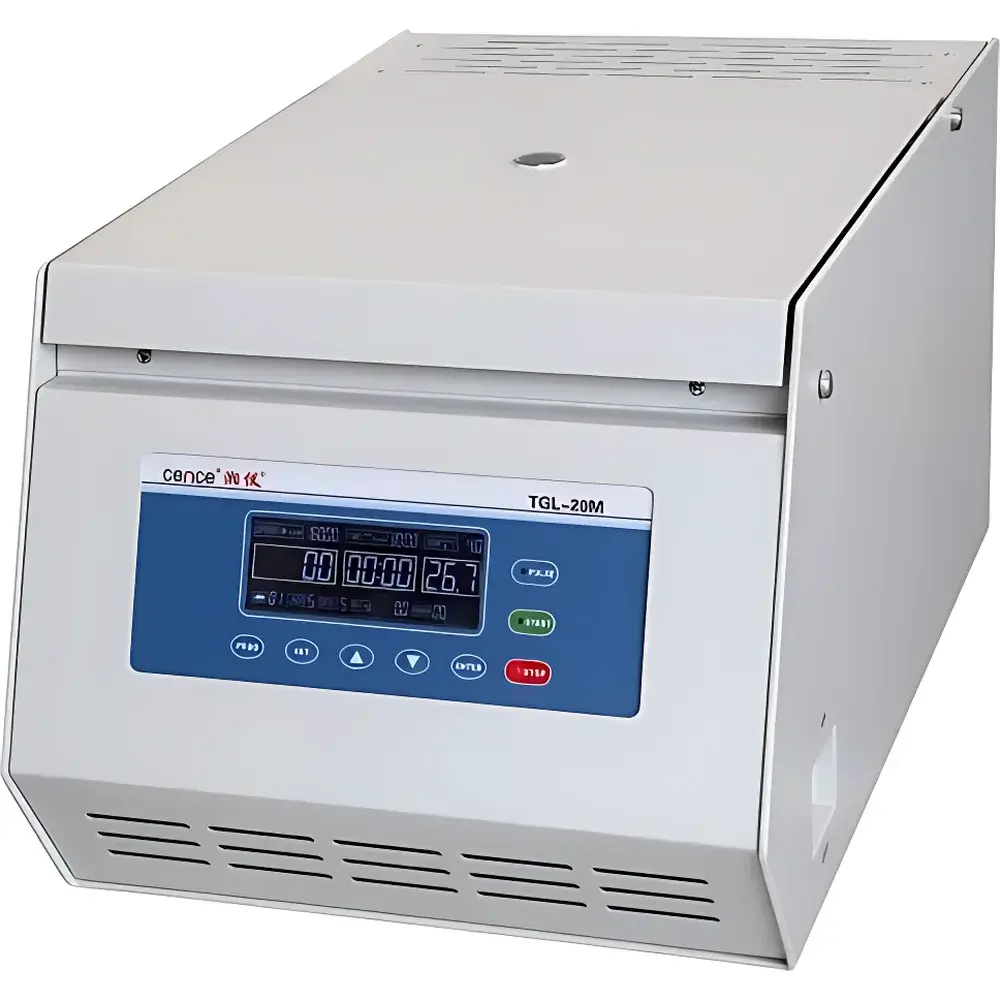
Xiangyi TGL-20M Benchtop High-Speed Refrigerated Centrifuge
| Brand | Xiangyi |
|---|---|
| Origin | Hunan, China |
| Manufacturer Type | Direct Manufacturer |
| Product Category | Domestic |
| Model | TGL-20M |
| Instrument Type | Benchtop Centrifuge |
| Speed Range | 10,000–30,000 rpm (High-Speed) |
| Function | Refrigerated Centrifuge |
| Configuration | Fixed-Angle Rotor Centrifuge |
| Separation Class | Biomolecular Applications |
| Max Capacity | 4 × 100 mL |
| Max Speed | 20,000 rpm |
| Max RCF | 27,800 × g |
| Dimensions (L×W×H) | 410 × 700 × 360 mm |
| Weight | 85 kg |
| Temperature Range | −20 °C to +40 °C |
| Temp. Accuracy | ±1 °C |
| Refrigerant | R404a |
| Noise Level | <65 dB(A) |
| Power Supply | AC 220 V ±22 V, 50/60 Hz, 10 A |
| Power Consumption | 1200 W |
| Timer Range | 1 min – 99 min 59 sec or Continuous |
| Speed Accuracy | ±30 rpm |
| Acceleration/Deceleration | 9 programmable acceleration & 10 deceleration profiles |
| Safety Features | Overspeed protection, overtemperature cutoff, automatic door interlock, stainless-steel rotor chamber, triple-layer safety shielding |
| Drive System | Microprocessor-controlled, brushless DC frequency-converter motor |
| Display | Large backlit LCD |
| Programmability | Multi-step protocols with storage for user-defined methods |
Overview
The Xiangyi TGL-20M Benchtop High-Speed Refrigerated Centrifuge is engineered for precise, reproducible separation of biomolecular samples under controlled thermal conditions. Utilizing fixed-angle rotor geometry and high-RCF sedimentation dynamics, it delivers consistent pelleting of nucleic acids, proteins, subcellular organelles, and virus particles across a broad range of sample volumes—from microliter-scale microtubes to 100 mL conical tubes. Its refrigerated architecture maintains sample integrity during extended high-speed runs by actively stabilizing the chamber temperature between −20 °C and +40 °C, with ±1 °C thermal accuracy—critical for heat-labile enzymes, RNA preparations, and cryopreserved cell lysates. Designed for integration into molecular biology labs, QC/QA environments, and academic core facilities, the TGL-20M conforms to fundamental mechanical and electrical safety standards applicable to Class II laboratory centrifuges in CE-aligned regulatory frameworks.
Key Features
- Microprocessor-based control system with intuitive touch-panel interface and large backlit LCD display for real-time monitoring of speed, RCF, time, temperature, and rotor identification.
- Brushless DC frequency-converter motor ensures high torque delivery at low noise (<65 dB[A]), minimal vibration, and extended service life without carbon brush maintenance.
- Comprehensive rotor library: 10 interchangeable rotors—including 12-position microtube, 24-position PCR strip, 4×50 mL, and 4×100 mL fixed-angle configurations—supporting diverse applications from plasmid prep to exosome isolation.
- Programmable acceleration and deceleration profiles (9 acceleration / 10 deceleration settings) with three-stage damping to minimize sample resuspension and maximize pellet integrity.
- Triple-tier safety architecture: electronic overspeed detection, thermal cutoff circuitry, auto-locking lid with position sensing, corrosion-resistant stainless-steel chamber, and reinforced rotor containment housing compliant with ISO 15529:2021 mechanical safety guidelines.
- Energy-efficient refrigeration system using environmentally optimized R404a refrigerant and high-efficiency compressor; achieves stable setpoint temperatures within ≤3 minutes after cold start.
Sample Compatibility & Compliance
The TGL-20M accommodates standard ANSI/SLAS-compliant tubes and plates—including 0.2–2.2 mL microcentrifuge tubes, 5–100 mL conical polypropylene tubes, and 96-well PCR plates—without adapter modification for most configurations. Its maximum RCF of 27,800 × g enables effective resolution of ribosomal subunits (e.g., 50S/30S), mitochondrial fractions, and extracellular vesicles. While not certified to IEC 61010-2-020 Annex BB for Class III biocontainment, the unit meets general-purpose biosafety requirements for BSL-1 and BSL-2 laboratories when used with sealed rotors and appropriate tube caps. Routine operation aligns with GLP documentation practices through timestamped protocol logging and user-accessible audit trails.
Software & Data Management
The embedded firmware supports up to 99 user-programmable methods with customizable ramp profiles, hold steps, and end actions (e.g., “chill hold” or “brake stop”). All run logs—including date/time stamp, rotor ID, final speed, actual RCF, temperature deviation, and error codes—are stored internally for ≥1,000 cycles and exportable via USB port in CSV format. No proprietary software is required; exported data integrates natively with LIMS platforms supporting ASTM E1384-compliant metadata tagging. Firmware updates are delivered via secure USB firmware loader, maintaining traceability per FDA 21 CFR Part 11 principles for electronic records where local validation protocols are implemented.
Applications
- Purification of plasmid DNA, genomic DNA, and total RNA from bacterial, mammalian, and plant lysates.
- Isolation of mitochondria, nuclei, lysosomes, and plasma membrane fractions via differential centrifugation.
- Concentration and purification of viral vectors (e.g., AAV, lentivirus) and extracellular vesicles (exosomes, microvesicles).
- Clarification of protein expression supernatants and antibody-containing hybridoma culture media.
- Preparative separation of synthetic nanoparticles, liposomes, and polymer micelles in nanomedicine development.
- Enzyme activity assays requiring rapid cold-spin quenching of kinetic reactions.
FAQ
What is the maximum allowable imbalance tolerance for the TGL-20M?
The instrument tolerates ≤2 g mass imbalance per rotor half, consistent with ISO 15529:2021 recommendations for benchtop high-speed units.
Can the TGL-20M operate continuously at −20 °C?
Yes—the refrigeration system sustains −20 °C setpoints during continuous operation up to 99 min 59 sec; ambient temperature must remain ≤30 °C for full thermal performance.
Are rotor certifications provided with each unit?
Each rotor carries engraved serial numbers and is supplied with individual calibration certificates verifying RCF values at specified speeds, traceable to national metrology institutes.
Does the TGL-20M support remote monitoring or network connectivity?
No Ethernet or Wi-Fi interface is included; however, USB data export enables integration with centralized lab informatics systems via secondary automation scripting.
What maintenance intervals are recommended?
Annual verification of temperature calibration, rotor balance, and door interlock function is advised; compressor oil and refrigerant charge require inspection only if cooling efficiency declines beyond ±2 °C deviation.



