
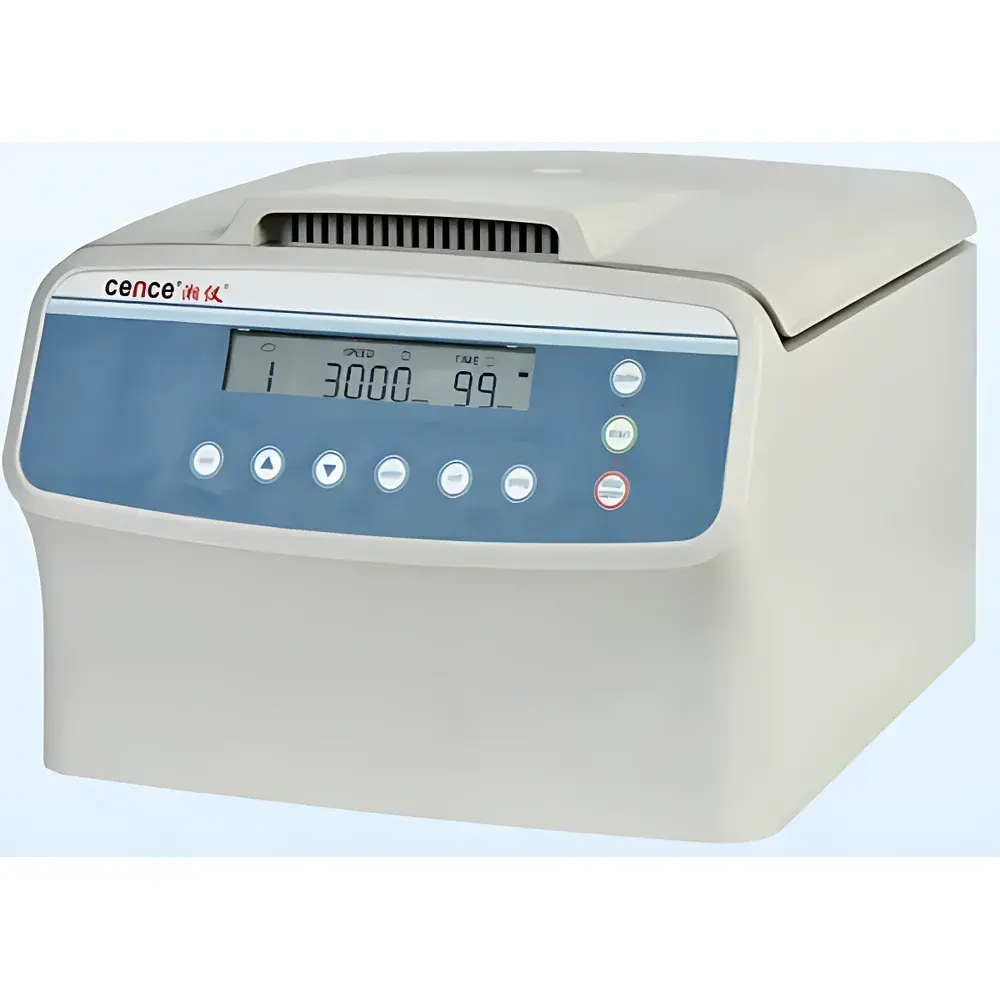
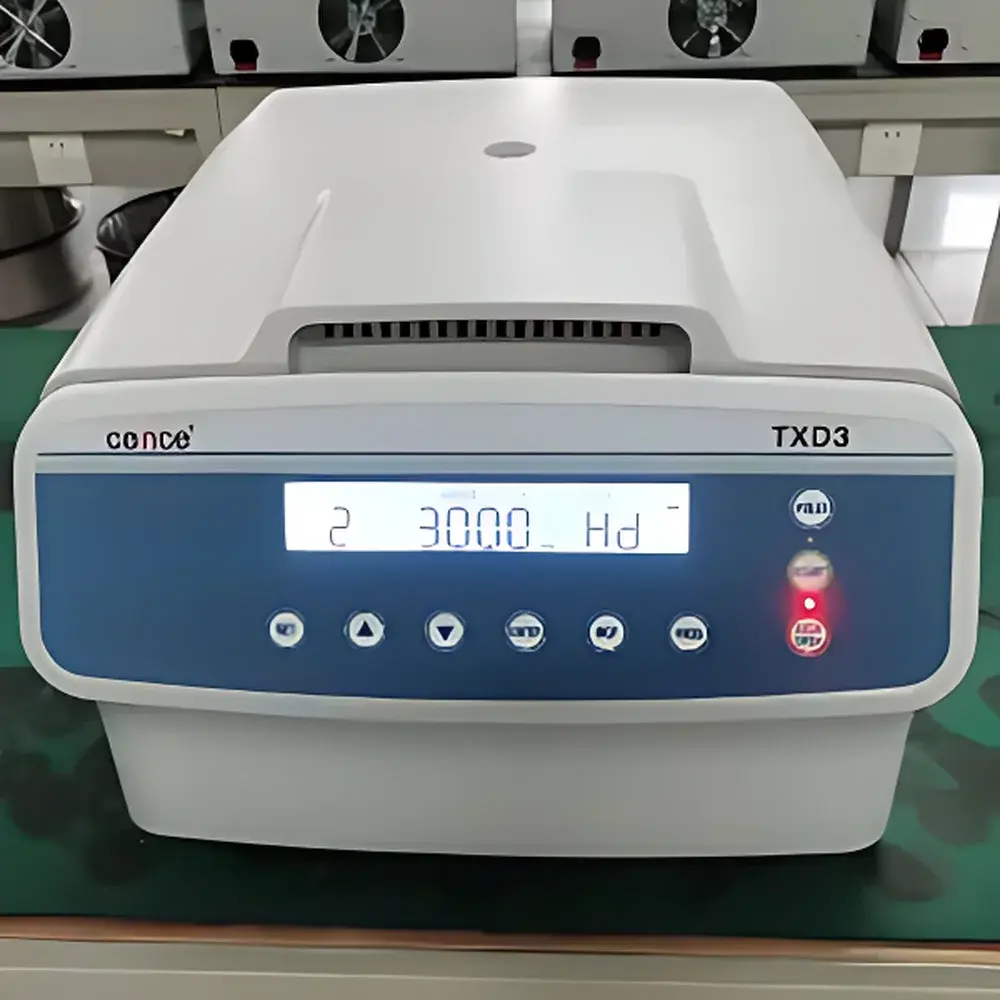
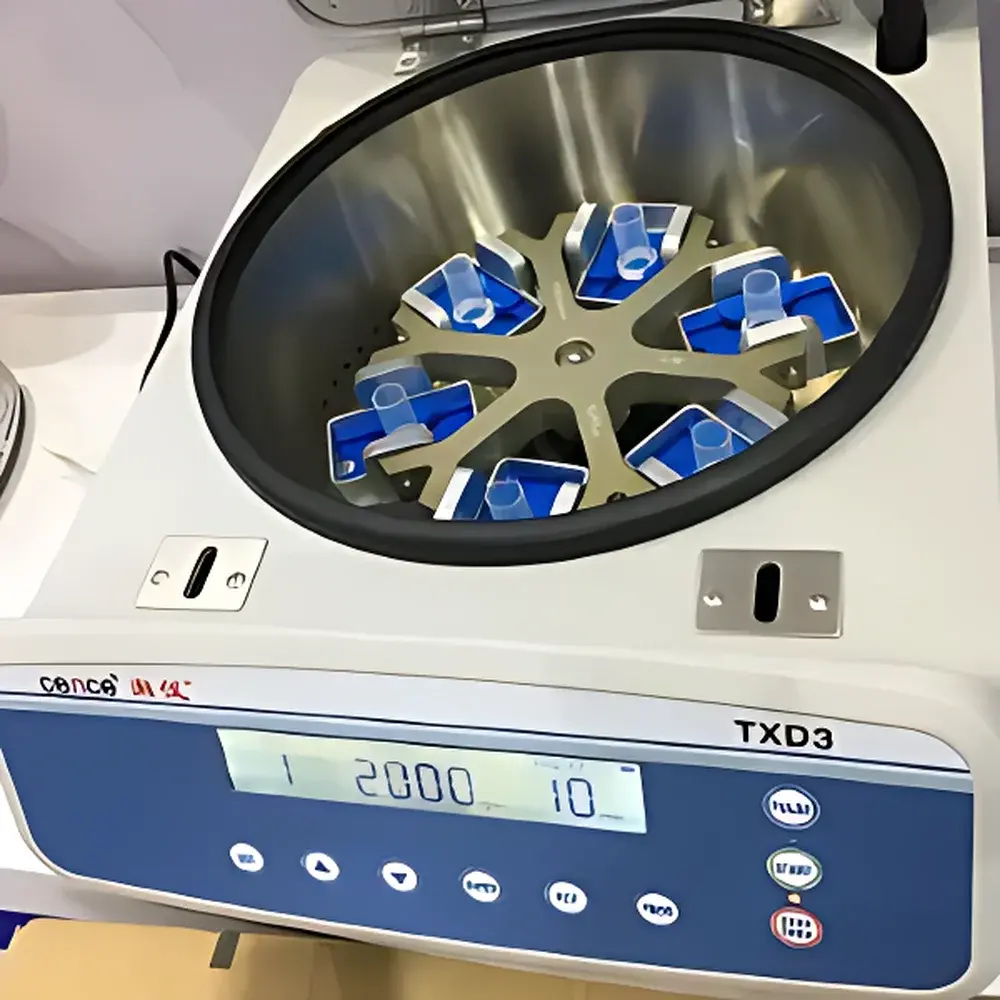
Xiangyi TXD3 Benchtop Cytocentrifuge
| Brand | Xiangyi |
|---|---|
| Origin | Hunan, China |
| Manufacturer Type | Direct Manufacturer |
| Product Category | Domestic |
| Model | TXD3 |
| Instrument Type | Benchtop Centrifuge |
| Speed Range | Up to 3,000 rpm |
| Max RCF | 890 × g |
| Max Capacity | 12 cytology slides per run |
| Rotor Type | Horizontal swing-out cytocentrifuge rotor |
| Separation Target | Large organelles, intact cells, and cellular sediments (e.g., effusions, CSF, BAL fluid) |
| Dimensions (W×D×H) | 380 × 500 × 300 mm |
| Drive System | Microprocessor-controlled DC brushless motor |
| Safety Features | Electronic lid interlock, automatic imbalance detection, auto-stop on error |
| Display | LCD with real-time RPM/RCF readout, 50-user rotor memory, soft-touch interface |
| Vibration Control | Integrated damping system with self-balancing capability |
| Special Function | Dedicated cytocentrifugation protocol suite for monolayer cell deposition |
Overview
The Xiangyi TXD3 Benchtop Cytocentrifuge is a purpose-engineered low-speed centrifugal instrument designed specifically for standardized cytological slide preparation from low-cellularity body fluids. Unlike general-purpose centrifuges, the TXD3 employs controlled sedimentation kinetics—leveraging precisely regulated rotational velocity (up to 3,000 rpm) and optimized rotor geometry—to deposit intact, evenly distributed monolayers of cells onto glass slides without mechanical distortion or nuclear shearing. Its operational principle aligns with the fundamental requirements of diagnostic cytopathology: preservation of cellular morphology, minimization of background debris, and reproducible cell density across sequential runs. The device complies with core procedural standards referenced in CAP (College of American Pathologists) checklist CYT.20410 (specimen processing for cytology) and supports laboratory adherence to ISO 15189:2022 clause 5.5.2 regarding equipment suitability for intended clinical use.
Key Features
- Microprocessor-controlled DC brushless motor delivering consistent torque output, zero carbon dust generation, and maintenance-free operation over extended service life.
- Intuitive touch-sensitive LCD interface with real-time display of RPM, RCF, time remaining, and rotor identification; automatic RCF calculation based on selected rotor radius and speed.
- Dedicated horizontal swing-out cytocentrifuge rotor accommodating up to 12 standard microscope slides (76 × 26 mm) per run—compatible with all common cytology slide types including frosted-end, adhesive-coated, and charged-glass variants.
- Integrated active damping system with dynamic imbalance compensation, enabling stable operation even with asymmetric sample loading (±1 slide tolerance).
- Electromechanical lid lock meeting IEC 61010-1 safety requirements: centrifuge remains inert until full lid closure is confirmed; rotation halts immediately if lid is opened mid-run or abnormal vibration exceeds threshold.
- User-programmable protocol storage for up to 50 rotor configurations—including custom acceleration/deceleration profiles and hold times—supporting method standardization across multiple operators and shifts.
Sample Compatibility & Compliance
The TXD3 is validated for processing clinically relevant low-volume, low-cellularity specimens including cerebrospinal fluid (CSF), pleural and peritoneal effusions, synovial fluid, bronchoalveolar lavage (BAL) fluid, urine sediment, and fine-needle aspiration (FNA) washings. Its sedimentation profile maintains viability and structural integrity of fragile cells such as lymphocytes, mesothelial cells, and reactive macrophages—critical for subsequent Papanicolaou (Pap) staining, immunocytochemistry (ICC), or molecular testing. The instrument’s design conforms to GLP-relevant operational controls: audit-trail-capable parameter logging (via optional RS-232/USB export), traceable rotor ID assignment, and programmable run validation checks. While not FDA 510(k)-cleared, its functional equivalence to Class II cytocentrifuges (e.g., Thermo Shandon Cytospin 4) enables integration into CLIA-certified and CAP-accredited laboratories under locally validated SOPs.
Software & Data Management
The TXD3 operates via embedded firmware with no external PC dependency. All critical run parameters—including rotor ID, speed, time, RCF, start/stop timestamps, and error codes—are stored in non-volatile memory for the last 100 cycles. Data export is supported via USB flash drive (FAT32 formatted) or serial interface (RS-232), generating CSV-formatted logs compatible with LIMS ingestion. Optional firmware upgrade paths support future integration with 21 CFR Part 11–compliant electronic signature modules, including user authentication, parameter change history, and immutable audit trails—facilitating alignment with GxP documentation requirements for clinical trial specimen processing.
Applications
- Routine cytological screening of body cavity effusions for malignant cell detection.
- Preparation of high-quality monolayers from CSF samples for meningitis workup and tumor cell identification.
- Standardized BAL fluid processing in interstitial lung disease diagnostics.
- Urine cytology workflows requiring low-shear sedimentation to preserve urothelial architecture.
- Research applications involving primary cell isolation from ascites or pleural fluid prior to culture or flow cytometry.
- Training environments where operator-independent reproducibility reduces inter-observer variability in slide interpretation.
FAQ
What types of cytology slides are compatible with the TXD3 rotor?
Standard 76 × 26 mm glass slides—including frosted-end, silane-coated, poly-L-lysine–treated, and electrostatically charged variants—are fully supported. Slide thickness tolerance: 0.9–1.2 mm.
Can the TXD3 be used for microbiological smear preparation (e.g., AFB staining)?
Yes—the low-shear sedimentation preserves bacillary morphology and clumping patterns required for Ziehl-Neelsen or fluorescent acid-fast staining protocols.
Is rotor calibration required before each use?
No. The TXD3 uses factory-calibrated rotor recognition; however, annual verification of RCF accuracy using an NIST-traceable tachometer is recommended per ISO/IEC 17025 guidelines.
Does the instrument support variable acceleration/deceleration rates?
Yes—each stored protocol allows independent setting of ramp-up (0–30 s) and coast-down (0–60 s) durations to minimize resuspension of delicate pellets.
What maintenance intervals are specified for the brushless motor?
None. The motor contains no brushes, bearings requiring lubrication, or consumable wear parts; only periodic cleaning of the rotor chamber and lid seal is advised.



