
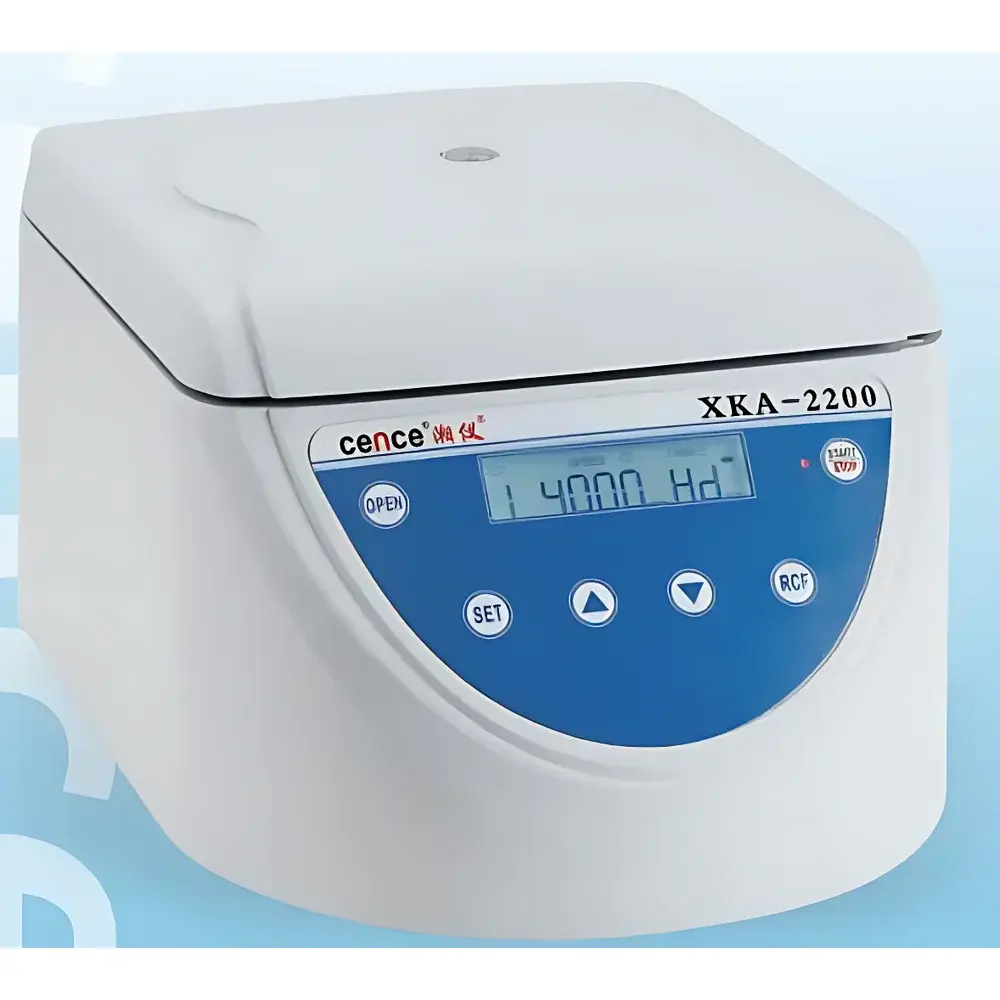
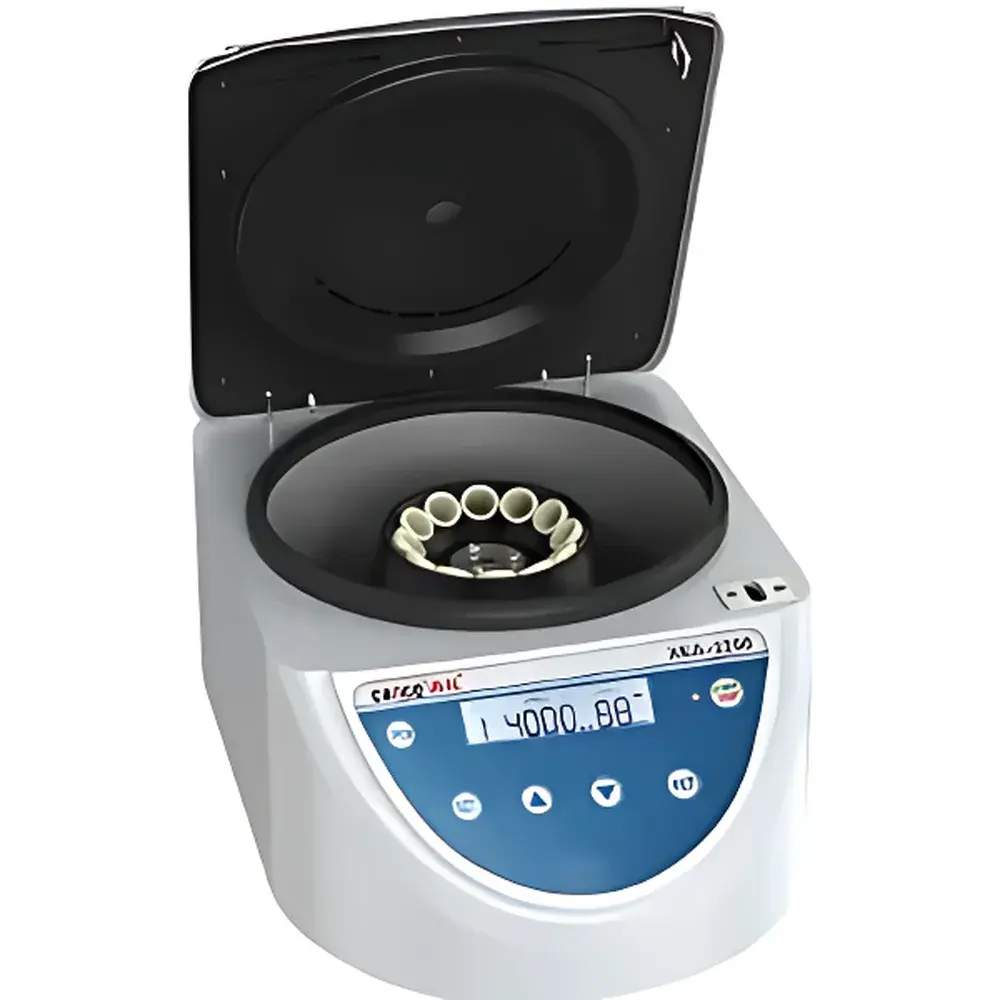
Xiangyi XKA-2200 Immunohematology Benchtop Centrifuge
| Brand | Xiangyi |
|---|---|
| Origin | Hunan, China |
| Manufacturer Type | Direct Manufacturer |
| Product Category | Domestic |
| Model | XKA-2200 |
| Instrument Type | Benchtop Centrifuge |
| Speed Class | Low-Speed Centrifuge |
| Max. Speed | 4500 rpm |
| Max. RCF | 2000 × g |
| Max. Capacity | 12 × (0.25–1 mL) |
| Rotor Configuration | Horizontal Swing-Out Rotor |
| Dimensions (W×D×H) | 456 × 330 × 266 mm |
| Drive System | Brushless DC Motor |
| Control System | Microprocessor-Based Touch Interface |
| Safety Features | Electronic Lid Lock, Automatic Rotor Imbalance Detection, Soft-Start/Soft-Stop |
| Vibration Damping | Integrated Passive Damping System with Auto-Balancing Capability |
Overview
The Xiangyi XKA-2200 Immunohematology Benchtop Centrifuge is a purpose-engineered low-speed centrifuge designed specifically for routine immunohematological workflows in clinical laboratories, blood banks, and transfusion medicine units. It operates on the principle of sedimentation-based separation under controlled gravitational force (RCF), enabling precise stratification of whole blood components—including red blood cells (RBCs), white blood cells (WBCs), platelets, and plasma—without inducing hemolysis or cellular activation. Its optimized rotor geometry and calibrated acceleration/deceleration profiles meet the operational requirements of standardized serological procedures such as antigen-antibody agglutination assays, RBC washing (e.g., for Coombs testing), lymphocyte isolation (HLA typing preparation), and serum separation (SERO protocols). The unit complies with IEC 61010-1:2010 safety standards for laboratory electrical equipment and is engineered for continuous duty cycles in GLP-aligned environments.
Key Features
- Brushless DC motor drive ensures consistent torque delivery across the full speed range (0–4500 rpm), eliminating carbon brush wear, electrical noise, and particulate contamination—critical for sterile and cleanroom-compatible operation.
- Microprocessor-controlled touch interface with backlit LCD display provides intuitive parameter entry, real-time monitoring of speed, time, RCF, and remaining run duration (with second-level resolution for runs <60 s).
- Dedicated SERO and HLA swing-out rotors are pre-programmed into firmware, supporting protocol-specific acceleration profiles and dwell times required by CLSI EP12-A2 and AABB Technical Manual Chapter 7 guidelines.
- Integrated passive damping system with self-centering bushings minimizes vibration transmission during operation; automatic imbalance detection halts rotation if mass asymmetry exceeds ±5% per bucket.
- Electromechanical lid interlock prevents rotor engagement unless the lid is fully seated and locked; latch mechanism requires <15 N of actuation force, supporting ergonomic single-hand operation.
- Monolithic polymer housing (injection-molded ABS/PC blend) offers chemical resistance to common disinfectants (e.g., 70% ethanol, 0.5% sodium hypochlorite) and meets UL 94 V-0 flammability rating.
Sample Compatibility & Compliance
The XKA-2200 accommodates standard immunohematology tubes including 12 × 0.25–1 mL microtubes (e.g., BD Microtainer® K2EDTA, Greiner Bio-One Polypropylene Serology Tubes). Rotor compatibility extends to ISO 8573-1 Class 3 clean air-rated accessories for use in laminar flow hoods. The centrifuge conforms to ISO 13485:2016 design control requirements for in vitro diagnostic (IVD) ancillary equipment and supports audit readiness for CAP, COLA, and JCI-accredited facilities. All firmware logic is traceable to version-controlled source code, and runtime logs (start/stop time, speed, RCF, error codes) are retained for ≥30 days without external storage.
Software & Data Management
While the XKA-2200 operates as a standalone instrument, its embedded controller stores up to 99 user-defined protocols with timestamped execution history. Audit trail functionality records operator ID (via optional RFID badge reader integration), method parameters, and anomaly events (e.g., lid open mid-run, overtemperature alert) in non-volatile memory. Export of log data via USB 2.0 port supports CSV-formatted output compatible with LIMS platforms compliant with FDA 21 CFR Part 11 Annex 11 requirements for electronic records integrity.
Applications
- RBC washing prior to indirect antiglobulin test (IAT) and autocontrol preparation
- Serum separation from clotted specimens for antibody screening and identification panels
- Lymphocyte pelleting in HLA class I/II typing workflows using density gradient media
- Platelet-rich plasma (PRP) preparation for crossmatch validation studies
- Quality control centrifugation of reagent red cells and commercial antisera
- Calibration verification of automated blood grouping analyzers using standardized sedimentation controls
FAQ
What is the maximum relative centrifugal force (RCF) achievable with the XKA-2200?
The maximum RCF is 2000 × g at 4500 rpm with the standard horizontal rotor loaded at full capacity.
Does the XKA-2200 support regulatory-compliant data archiving for clinical labs?
Yes—audit trails, protocol logs, and error records are stored internally and exportable via USB in tamper-evident CSV format, supporting 21 CFR Part 11 and ISO 15189 documentation requirements.
Can the SERO and HLA rotors be autoclaved?
Both rotors are constructed from anodized aluminum alloy and are rated for steam sterilization at 121 °C, 15 psi for 20 minutes; rotor balance must be verified post-sterilization using certified calibration weights.
Is remote monitoring or network connectivity available?
No native Ethernet or Wi-Fi interface is provided; however, third-party serial-to-Ethernet adapters may be used for basic status polling via RS-232 (TTL-level) port, subject to local IT security policy approval.
What maintenance intervals are recommended for long-term reliability?
Brushless motor requires no scheduled maintenance; annual verification of lid lock torque (±0.5 N·m), rotor thread integrity, and damping pad compression set is advised per manufacturer’s service manual (Rev. 3.1, 2023).



