
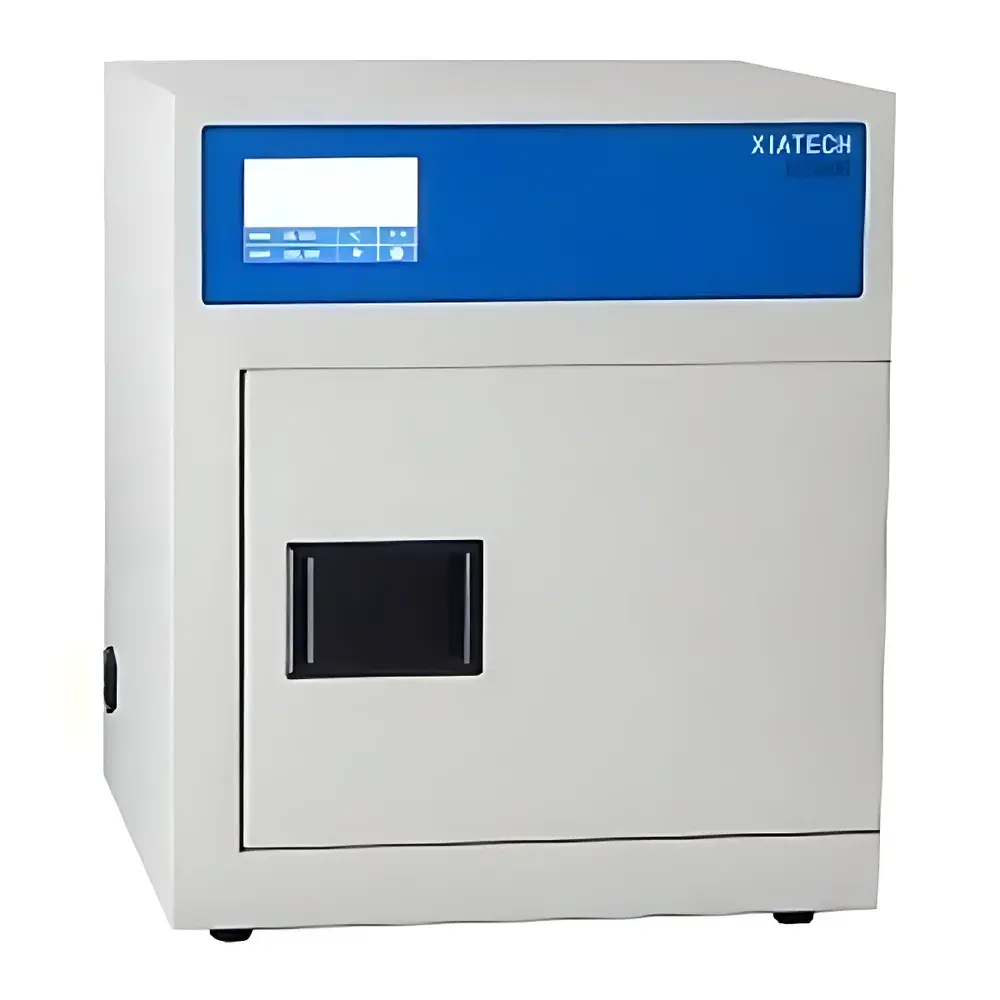
Xiatech TC5000 Transient Plane Source (TPS) Thermal Conductivity Analyzer
| Brand | Xiatech |
|---|---|
| Origin | Shaanxi, China |
| Model | TC5000 |
| Measurement Principle | Transient Plane Source (TPS) Method |
| Sample Capacity | Single sample per test |
| Test Environment | Ambient pressure, air atmosphere |
| Dimensions (L×W×H) | 550 × 500 × 650 mm |
| Accuracy | Thermal conductivity ±3 %, Thermal diffusivity ±5 %, Volumetric heat capacity ±7 % |
| Repeatability | Thermal conductivity ±3 %, Thermal diffusivity ±5 %, Volumetric heat capacity ±5 % |
| Thermal Conductivity Range | 0.005–20 W/(m·K) |
| Sample Forms | Solid blocks, sheets, pastes, powders, granules, gels — including irregular, circular or square geometries |
| Minimum Sample Thickness | 0.3 mm |
| Minimum Lateral Dimension | 25 mm |
Overview
The Xiatech TC5000 is a benchtop Transient Plane Source (TPS) thermal property analyzer engineered for precise, rapid, and non-destructive determination of thermal conductivity, thermal diffusivity, and volumetric heat capacity in heterogeneous and anisotropic materials. Based on the ISO 22007-2 standard for transient plane source methods, the TC5000 employs a symmetric dual-sensor configuration—where a thin, electrically heated nickel foil sensor acts both as heat source and resistance thermometer—to deliver simultaneous measurements without requiring prior knowledge of material density or specific heat. This eliminates dependence on contact thermal resistance, enabling reliable characterization of soft, porous, hydrated, or low-density samples—including soils, biological tissues, phase-change composites, aerogels, and thermal interface materials—under ambient atmospheric conditions.
Key Features
- True dual-parameter acquisition: Simultaneous output of thermal conductivity (λ), thermal diffusivity (α), and volumetric heat capacity (Cv = λ/α) in a single 5-minute test cycle.
- Robust TPS architecture: Patented symmetrical sensor design minimizes boundary effects and inherently compensates for interfacial thermal resistance—critical for testing powders, pastes, and irregular solids without compression or surface polishing.
- Minimal sample requirements: Accepts specimens as thin as 0.3 mm and as small as 25 mm in lateral dimension; accommodates discs, squares, irregular shapes, granules, and semi-solids without custom fixtures or sensor swaps.
- Integrated high-speed data acquisition: 24-bit resolution ADC with microsecond-level timing control ensures stable transient response capture across the full 0.005–20 W/(m·K) range.
- USB 2.0 connectivity and plug-and-play operation: Host communication, sensor interfacing, and power delivery consolidated into a single cable; no external DAQ modules or calibration hardware required.
- Compliance-ready software framework: Supports audit trails, user access levels, electronic signatures, and data export in CSV, TXT, and XML formats—aligned with GLP, GMP, and FDA 21 CFR Part 11 documentation expectations.
Sample Compatibility & Compliance
The TC5000 is validated for use with solid, semi-solid, and particulate materials across industrial R&D and quality control environments. It meets the physical measurement scope defined in ASTM D5930 (Standard Test Method for Thermal Conductivity of Plastics), ISO 22007-2 (Plastics — Determination of thermal conductivity and thermal diffusivity — Part 2: Transient plane source (hot disc) method), and GB/T 32064-2015 (Chinese national standard for TPS-based thermal property testing). Its ambient-pressure, air-atmosphere operation eliminates inert gas handling and chamber evacuation—reducing operational overhead while maintaining traceability to NIST-traceable reference materials (e.g., certified graphite, PMMA, and Pyroceram standards). No sample drying, coating, or vacuum degassing is required, preserving native moisture content and microstructure integrity—especially critical for geotechnical, agricultural, and pharmaceutical applications.
Software & Data Management
The TC5000 operates with Xiatech’s proprietary TPS-Control Suite v3.x, a Windows-based application designed for technical users in materials science labs. The interface supports real-time temperature and voltage monitoring during transient excitation, automatic baseline correction, and iterative curve-fitting using Levenberg–Marquardt optimization against the analytical TPS solution. Built-in functions include multi-cycle averaging, temperature-controlled testing (via optional external bath integration), and batch report generation compliant with ISO/IEC 17025 reporting clauses. All raw voltage-time datasets are stored with metadata (operator ID, timestamp, environmental conditions, sensor serial number), enabling full traceability for internal audits or regulatory submissions. Exported files retain SI-unit consistency and support post-processing in MATLAB, Python (NumPy/SciPy), or OriginLab.
Applications
- Building insulation R-value validation: Aerogels, mineral wool, vacuum-insulated panels (VIPs), and bio-based foams.
- Thermal interface material (TIM) qualification: Greases, pads, adhesives, and solder alloys under compressive load simulation.
- Geotechnical and environmental analysis: In-situ soil thermal resistivity, sediment thermal buffering capacity, and permafrost modeling inputs.
- Energy storage materials: Phase-change material (PCM) encapsulation efficiency, latent heat distribution, and cycling stability assessment.
- Biomedical and food science: Thermal diffusivity mapping of tissues, gels, dairy products, and plant-based matrices.
- Electronics thermal management: PCB substrate thermal homogeneity screening, battery electrode layer characterization, and heat sink compound performance benchmarking.
FAQ
Does the TC5000 require calibration with certified reference materials before each test?
No—factory calibration is performed using NIST-traceable standards. Users may conduct periodic verification (e.g., quarterly) using supplied graphite or PMMA reference disks; full recalibration is only required after sensor replacement or mechanical impact.
Can the TC5000 measure anisotropic materials such as layered composites or fiber-reinforced polymers?
Yes—by orienting the sensor parallel or perpendicular to expected thermal gradients, directional conductivity components can be resolved. For rigorous anisotropy quantification, orthogonal mounting fixtures (optional accessory) enable sequential in-plane and through-thickness measurements.
Is the instrument suitable for regulated environments subject to FDA or EU Annex 11 requirements?
The software architecture supports 21 CFR Part 11-compliant workflows when deployed on validated Windows OS configurations with domain-authenticated user accounts, encrypted local storage, and disabled auto-update policies. Full validation documentation (IQ/OQ/PQ protocols) is available upon request.
What is the minimum sample mass required for powder or granular testing?
No minimum mass applies—only geometric constraints matter. Powders must fully envelop the sensor (minimum depth ≥1.5 mm); bulk density should exceed 300 kg/m³ to ensure adequate thermal coupling. Loose, low-density powders may require light compaction using the included alignment jig.
How does the TC5000 handle measurement uncertainty propagation across derived parameters?
The software calculates combined standard uncertainty per GUM (JCGM 100:2008) guidelines, incorporating Type A (repeatability) and Type B (sensor accuracy, geometry tolerance, ambient drift) components. Uncertainty budgets are automatically appended to exported reports.



