
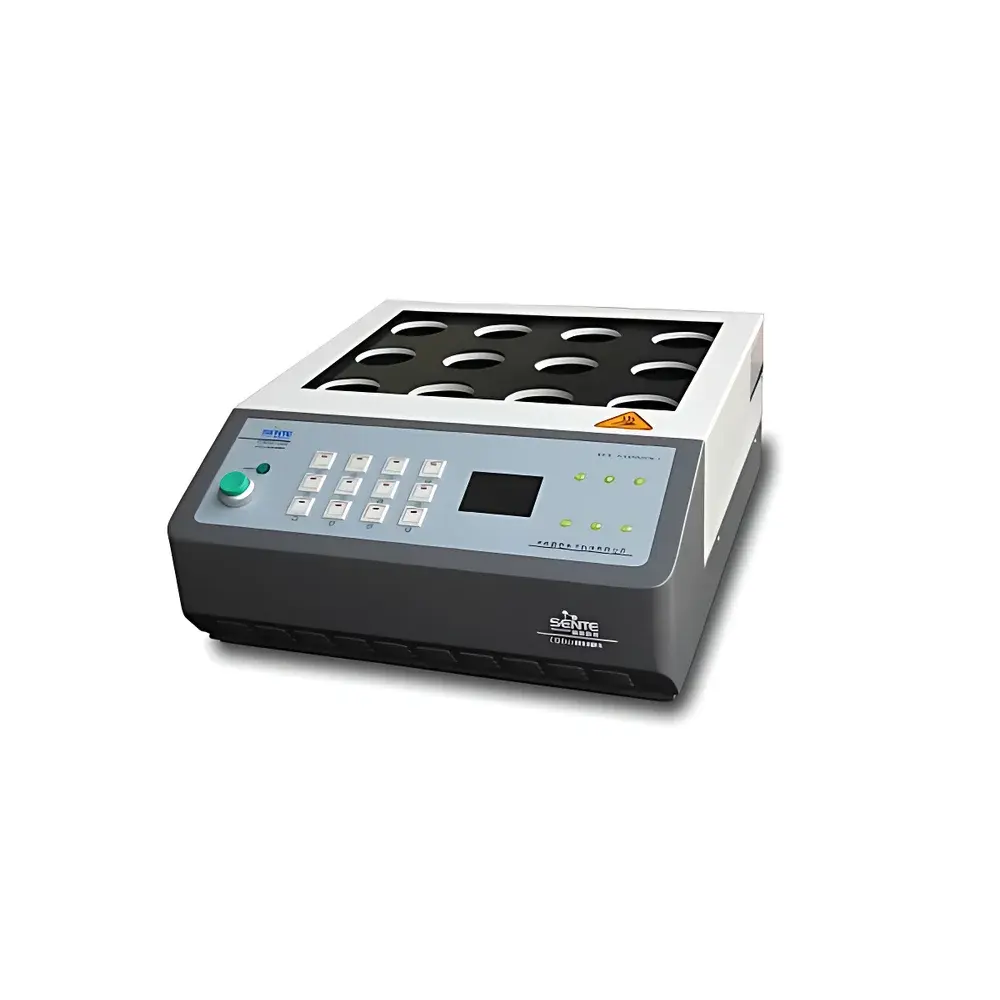
HePu ST106B1 Smart Graphite COD Reflux Digestion System
| Brand | HePu |
|---|---|
| Origin | Shandong, China |
| Model | ST106B1 |
| Digestion Method | Reflux Digestion |
| Heating Module | Dual Independent Graphite Heating Blocks |
| Batch Capacity | 1–12 Samples |
| Temperature Range | 0–300 °C |
| Temperature Accuracy | ±1 °C (per well) |
| Inter-well Temperature Uniformity | ±1 °C |
| Digestion Vessel Capacity | 350 mL |
| Timer Range | 0–150 min (adjustable per well) |
| Timer Accuracy | ±1 min |
| Cooling Method | Forced Air Cooling |
| Power Rating | 2400 W |
| Heating Element | Corrosion-Resistant Graphite Block |
| Display | Color LCD with Real-Time Per-Well Temperature & Time Tracking |
| Dimensions (W×D×H) | 510 × 500 × 210 mm |
| Ramp Time to 150 °C | 15–20 min |
Overview
The HePu ST106B1 Smart Graphite COD Reflux Digestion System is a laboratory-grade, fully automated digestion platform engineered for precise and compliant execution of the HJ 828–2017 “Water Quality – Determination of Chemical Oxygen Demand (COD) – Dichromate Method”. Unlike conventional reflux digesters relying on open electric furnaces and water-cooled condensers, the ST106B1 integrates dual independent graphite heating blocks, PID-driven per-well temperature regulation, and forced-air reflux cooling—enabling stable micro-boiling conditions (typically 150 °C) over the standardized 120-minute digestion period. Its design directly mirrors the thermal and temporal constraints defined in HJ 828–2017, ensuring method fidelity without procedural deviation. The system eliminates manual intervention during digestion, mitigates operator-induced variability, and supports full traceability for GLP/GMP-aligned environmental testing laboratories.
Key Features
- Per-well independent PID temperature control: Each of the 12 digestion wells features a dedicated thermocouple and heating element, enabling ±1 °C accuracy and inter-well uniformity ≤±1 °C—critical for reproducible Cr(VI) reduction kinetics across sample sets.
- Corrosion-resistant graphite digestion block: Engineered from high-density, acid-resistant graphite, the block withstands repeated exposure to concentrated H2SO4, Ag2SO4, and K2Cr2O7 solutions at temperatures up to 300 °C, minimizing thermal drift and extending service life.
- Integrated color LCD interface: Displays real-time temperature and countdown timer for each well simultaneously; supports multi-step programmable protocols (e.g., ramp-hold-cool sequences) with password-protected parameter locking.
- Air-assisted reflux condensation: Replaces traditional tap-water condensers with a low-noise axial fan and optimized vapor path geometry—reducing water consumption by >95%, eliminating risk of condenser flooding, and complying with ISO 15223-1 labeling requirements for water-free operation.
- Direct titration compatibility: Accommodates standard 350 mL round-bottom digestion vials (Ø58 × 200 mm), permitting post-digestion titration without sample transfer—minimizing analyte loss, contamination, or dilution error.
- Automated safety logic: Auto-shutdown upon timer completion, overtemperature cutoff (>310 °C), and open-circuit detection; all events logged with timestamps in non-volatile memory.
Sample Compatibility & Compliance
The ST106B1 is validated for use with domestic wastewater, industrial effluents (including high-chloride matrices when combined with HgSO4 masking), surface water, and leachates per HJ 828–2017. Its thermal profile meets the method’s requirement for sustained reflux at ≥150 °C for 120 min under atmospheric pressure. The instrument conforms to IEC 61010-1:2010 for electrical safety in laboratory equipment and supports audit-ready documentation for ISO/IEC 17025 accreditation. While not FDA 21 CFR Part 11–certified out-of-the-box, its embedded event logging (start/stop times, setpoints, deviations) provides foundational data integrity for regulated environments when paired with lab-specific SOPs and electronic signature workflows.
Software & Data Management
The ST106B1 operates autonomously via its onboard firmware—no PC connection required. All operational parameters (set temperature, dwell time, ramp rate) and runtime logs (actual temperature per well every 10 s, alarm triggers, power-on cycles) are stored in internal flash memory (≥10,000 cycles). Data export is supported via USB-A port using FAT32-formatted drives; exported .CSV files include column headers compatible with LIMS ingestion (e.g., “Well_ID, Timestamp, Set_Temp_C, Actual_Temp_C, Elapsed_Min”). Firmware updates are performed offline via signed binary files, preserving configuration integrity between revisions.
Applications
- Routine COD monitoring in municipal wastewater treatment plants (WWTPs) and industrial pretreatment facilities
- Regulatory compliance testing for discharge permits (e.g., China’s “Discharge Standard of Pollutants for Municipal Wastewater Treatment Plants” GB 18918–2002)
- Method validation and inter-laboratory comparison studies under CNAS-CL01:2018
- Research-scale oxidation kinetics studies requiring tightly controlled thermal profiles
- Training platforms for environmental chemistry curricula emphasizing standard method adherence
FAQ
Does the ST106B1 comply with HJ 828–2017’s reflux duration and temperature specifications?
Yes. It maintains 150 ±2 °C for precisely 120 min per well, verified using NIST-traceable PT100 probes and calibrated stopwatch validation.
Can it process samples with high chloride interference?
The system accommodates standard HJ 828–2017 chloride masking protocols (e.g., 0.4 g HgSO4 per 20 mL sample); graphite block integrity remains unaffected by Hg2+ exposure.
Is external software required for operation or data retrieval?
No. All functions—including programming, monitoring, and data export—are accessible via the front-panel interface and USB drive.
What maintenance is required for long-term reliability?
Annual verification of thermocouple calibration and visual inspection of graphite block surface integrity; no consumables or scheduled part replacements are specified.
How does air cooling compare to water condensation in terms of analytical performance?
Forced-air reflux achieves equivalent condensate return rates (>98% recovery) to water-cooled systems under HJ 828–2017 conditions, as confirmed by gravimetric solvent loss testing and Cr(VI) recovery assays (n = 48, RSD < 1.2%).
Related Products







