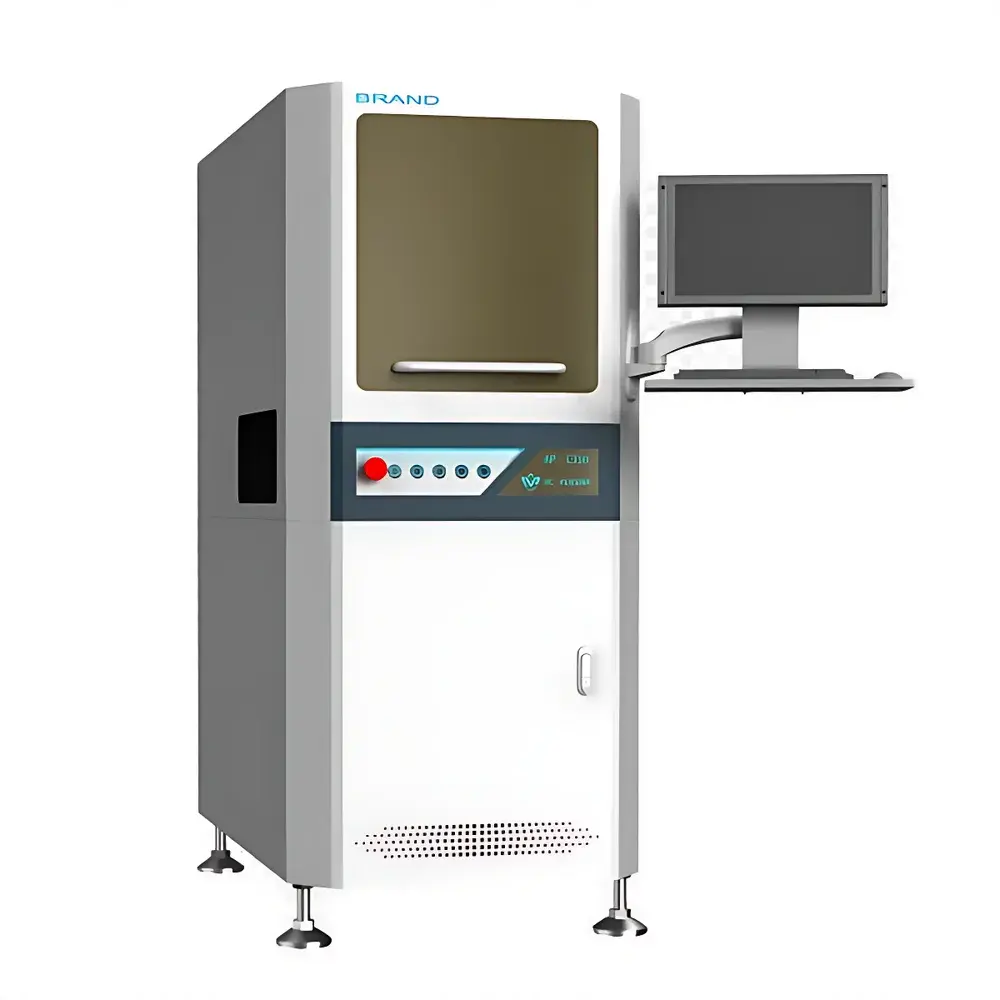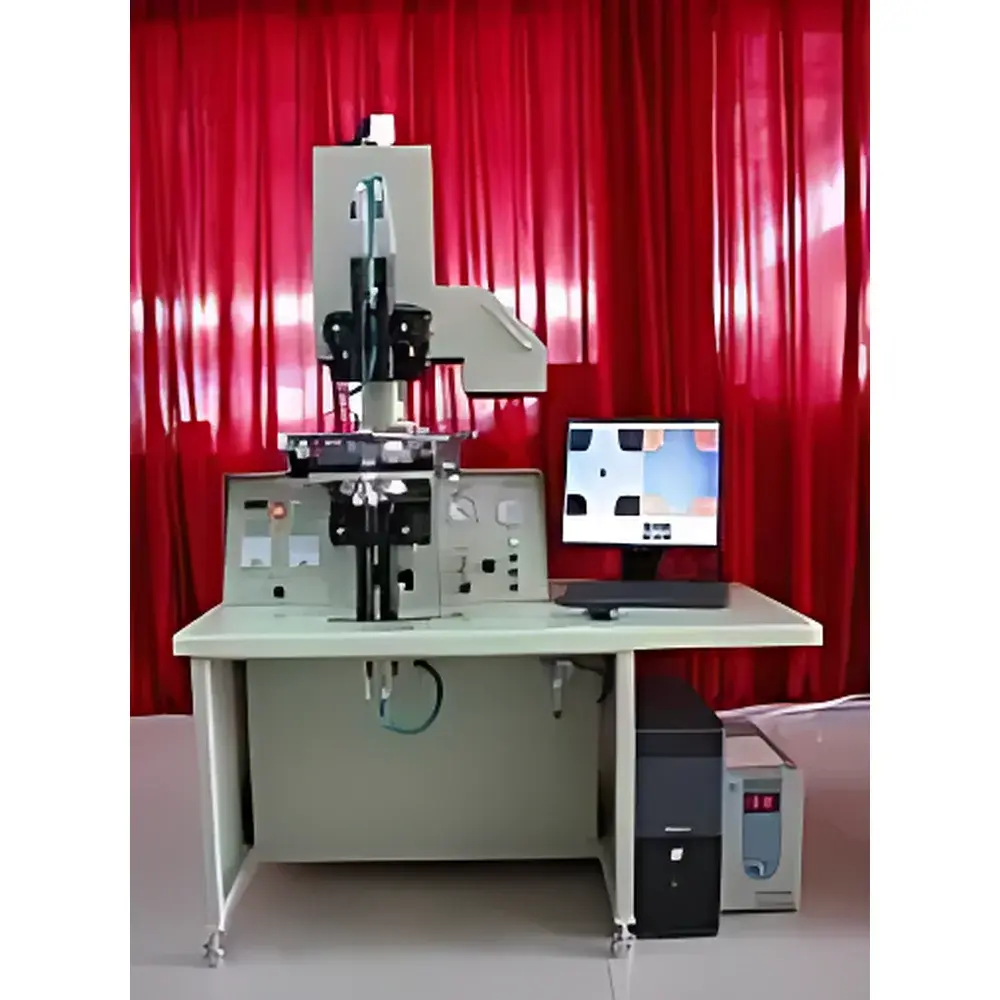
Xinan Guang G-33D4 High-Precision Dual-Side Alignment Direct Write Lithography System
| Origin | Sichuan, China |
|---|---|
| Manufacturer Type | Authorized Distributor |
| Origin Category | Domestic (China) |
| Model | G-33D4 |
| Pricing | Available Upon Request |
| Exposure Mode | Contact Printing |
| Resolution | 1 µm (at 10× line depth ratio) |
| Light Source | High-Stability 365 nm UV LED |
| Illumination Uniformity | ±3% |
| Exposure Area | 110 mm × 110 mm |
| UV Intensity Range | 0–30 mW/cm² (adjustable) |
| Beam Divergence | ≤3° |
| UV Source Lifetime | ≥20,000 hours |
| Operating Surface Temperature | ≤30 °C |
| Alignment Accuracy | ≤1 µm |
| Optical Magnification | 91× to 570× (software-enhanced digital zoom) |
| Control System | 4-inch PLC with OMRON timing relay (0.1–999.9 s exposure) |
| Vacuum System | Direct-coupled vacuum pump with dual-stage anti-vibration isolation |
| Microscopy | Dual-field upright or horizontal stereo microscope with four 1/3″ CCD cameras and real-time imaging memory |
Overview
The Xinan Guang G-33D4 High-Precision Dual-Side Alignment Direct Write Lithography System is an engineered solution for contact-mode photolithography in R&D and low-to-medium volume semiconductor fabrication environments. Unlike projection or stepper-based systems, the G-33D4 employs a high-stability 365 nm UV LED exposure head coupled with mechanical contact alignment—enabling direct transfer of mask patterns onto substrates with minimal diffraction-induced edge blur. Its core architecture supports both single-sided exposure and dual-side alignment verification, making it uniquely suited for fabricating through-silicon vias (TSVs), MEMS devices, optoelectronic hybrids, and hetero-integrated photonics where front-to-back registration fidelity is critical. The system’s mechanical design prioritizes thermal stability and mechanical repeatability: the exposure platen maintains ≤30 °C surface temperature during operation, while its dual-stage anti-vibration base isolates the optical train from floor-borne disturbances. All motion axes—including X/Y/θ alignment stages and Z-axis lift mechanisms—are constructed using zero-backlash linear guides and pneumatic actuation, ensuring sub-micron positional reproducibility across repeated cycles.
Key Features
- Dual-side alignment verification capability—functions as both lithography tool and metrology instrument for measuring front-to-back overlay error in real time
- Contact-mode exposure with ≤1 µm resolution (measured at 10× line depth ratio under standard resist process conditions)
- High-uniformity 365 nm UV LED source delivering 0–30 mW/cm² intensity (adjustable via analog feedback control), with beam divergence ≤3° and illumination non-uniformity ±3%
- Three-layer precision alignment stage (X/Y/θ) using bottom-mounted kinematic design to eliminate gravitational hysteresis and guide rail backlash
- Z-axis separation mechanism incorporating dual flexure springs and pneumatic lift—minimizing lateral drift (<50 nm) during wafer-to-mask contact and separation
- Modular microscope platform supporting either upright or horizontal dual-field stereo configuration, each equipped with two 1.6×–10× continuous zoom objectives and four synchronized 1/3″ CCD sensors
- Real-time digital imaging pipeline: raw sensor data captured and buffered via FPGA-accelerated frame grabber; displayed on 19″ HD LCD with software-based magnification up to 570× (optical × digital)
- Industrial-grade 4″ PLC controller with OMRON programmable timer (0.1–999.9 s resolution), integrated vacuum sequencing logic, and fail-safe interlocks compliant with IEC 61508 SIL2 requirements
Sample Compatibility & Compliance
The G-33D4 accommodates substrates up to 110 mm × 110 mm and ≤5 mm thickness—including non-circular, warped, or brittle wafers such as GaAs, InP, LiNbO₃, and fused silica. Its low-contact-force alignment mechanism (≤0.5 N average normal load) prevents chipping or fracture of fragile III–V compound substrates. Vacuum chucking utilizes distributed micro-channel venting to ensure uniform clamping pressure across irregular topographies. The system meets ISO 14644-1 Class 5 cleanroom compatibility when operated within enclosed laminar flow hoods. All electrical subsystems conform to CE marking directives (EMC 2014/30/EU, LVD 2014/35/EU). While not certified for GMP production lines, its PLC-based audit trail logging, exposure parameter locking, and user-access-level controls support GLP-compliant documentation per ISO/IEC 17025 Annex A.2 for academic and pre-fab development use.
Software & Data Management
The G-33D4 operates via a Windows-based host application that manages exposure recipes, microscope calibration profiles, and alignment log histories. Each exposure event stores timestamped metadata—including lamp intensity, exposure duration, stage coordinates, vacuum pressure trace, and annotated microscope snapshots—with SHA-256 checksum integrity verification. Image buffers are retained for 72 hours by default (configurable up to 30 days); archived datasets export in TIFF+XML format for third-party metrology tools (e.g., KLA-CI, Nanomeasure). No cloud connectivity is embedded; all data remains on local SSD storage unless manually exported via USB 3.0 or Gigabit Ethernet. Firmware updates require signed binary packages authenticated via RSA-2048 key exchange, preventing unauthorized modification.
Applications
- Prototyping of CMOS image sensors requiring precise backside illumination alignment
- Fabrication of diffractive optical elements (DOEs) on fused quartz or CaF₂ substrates
- MEMS packaging processes involving double-sided bonding and etch-through patterning
- Research in plasmonics and metasurfaces where sub-wavelength feature registration across layered stacks is essential
- Low-volume production of hybrid photonic integrated circuits (PICs) integrating III–V gain media with silicon waveguides
- Teaching laboratories for semiconductor processing courses covering photomask alignment, proximity effects, and resist characterization
FAQ
What substrate materials are compatible with the G-33D4?
Silicon, glass, quartz, ceramic, GaAs, InP, sapphire, and polymer films (e.g., PI, PET) up to 5 mm thick and 110 mm × 110 mm in planar dimension.
Is the system qualified for ISO Class 5 cleanroom operation?
Yes—when installed inside a laminar flow enclosure meeting ISO 14644-1 specifications; internal components are non-outgassing and static-dissipative.
Can the exposure parameters be locked to prevent accidental changes during multi-user operation?
Yes—administrator-level password protection enables recipe locking, exposure time constraints, and intensity ceiling enforcement per user group.
Does the system support automated alignment routines?
No—alignment is manual via joystick-controlled stage and real-time video overlay; however, coordinate offsets can be saved and recalled for repeat runs.
What maintenance intervals are recommended for the UV LED source and vacuum pump?
UV LED requires no scheduled replacement within 20,000 hours; vacuum pump oil should be changed every 2,000 operating hours or annually, whichever occurs first.