
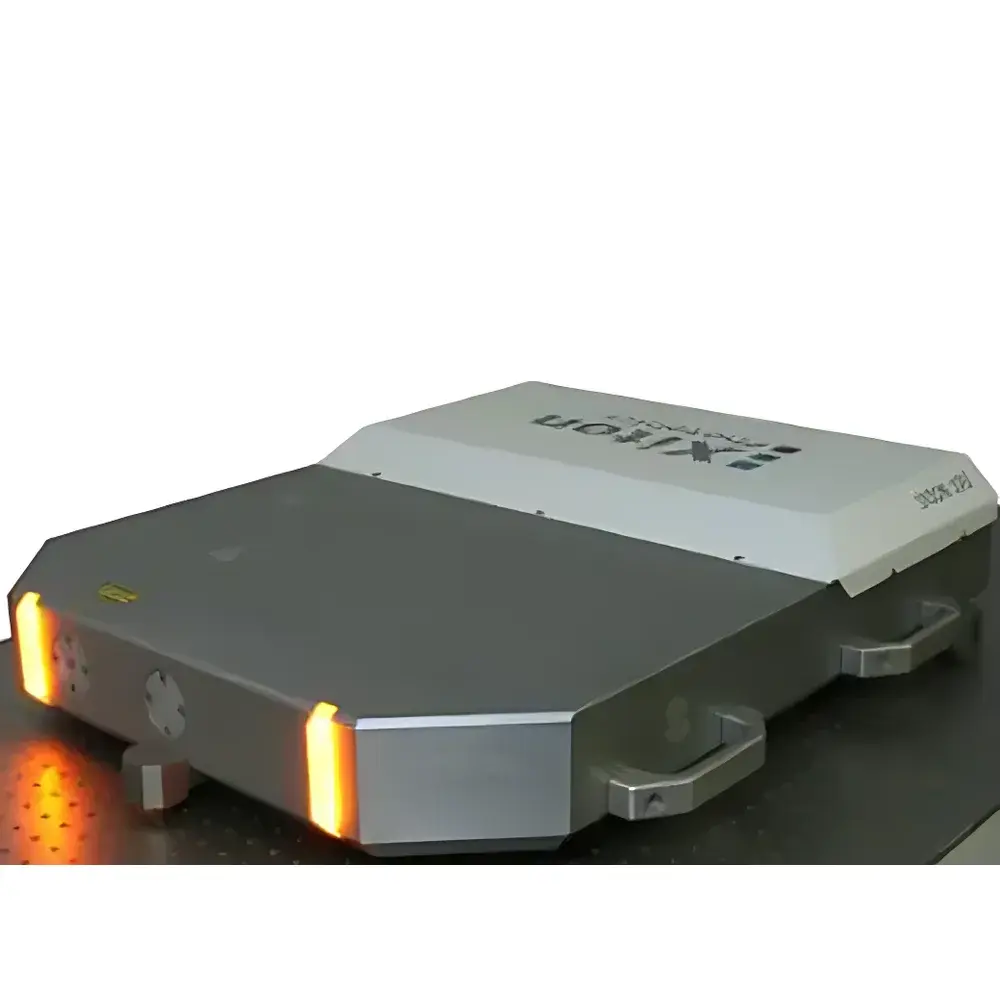
XITON IXION-193 SLM Single-Longitudinal-Mode UV Nanosecond Solid-State Laser
| Brand | XITON |
|---|---|
| Origin | Germany |
| Manufacturer Type | Authorized Distributor |
| Origin Category | Imported |
| Model | IXION-193 SLM |
| Core Configuration | Diode-Pumped All-Solid-State Laser System |
| Wavelength | 193.368 nm (tunable ±2 nm) |
| Average Power | >10 mW |
| Pulse Width | <10 ns |
| Pulse Energy | >1.6 µJ |
| Repetition Rate | 6 kHz |
| Beam Quality (M²) | <1.6 |
| Spectral Linewidth | <120 MHz (<0.015 pm, <0.004 cm⁻¹) |
| Tuning Range | >80 GHz (>10 pm, >2.6 cm⁻¹) |
| Coherence Length | >1 m |
| Long-Term Power Stability | <±0.5% (24 h) |
| Beam Profile | TEM₀₀ |
| Optional Integrated High-Resolution Spectrometer | ±1 pm accuracy |
Overview
The XITON IXION-193 SLM is a diode-pumped, all-solid-state, single-longitudinal-mode (SLM) ultraviolet laser operating at 193.368 nm — a wavelength defined by the ArF excimer transition and widely adopted as a primary reference in photolithography metrology and optical frequency standards. Engineered for precision metrology applications, this laser delivers narrow-linewidth, transform-limited nanosecond pulses via intracavity frequency-doubling of a stabilized 386.736 nm master oscillator, followed by deep-UV generation in nonlinear BBO or CLBO crystals. Its spectral purity—characterized by sub-120 MHz linewidth (<0.015 pm)—enables coherence lengths exceeding 1 meter, making it suitable for interferometric calibration, high-resolution spectroscopy, and seed injection into high-energy ArF excimer amplifiers where bandwidth control directly impacts spectral irradiance homogeneity and exposure dose fidelity.
Key Features
- Industrial-grade, hermetically sealed UV frequency-conversion architecture with active thermal stabilization and TE-cooled crystal mounts
- Slot-mounted pump diode module ensuring long-term alignment stability and minimal thermal drift
- Diffraction-limited TEM00 output beam (M² < 1.6) with near-perfect spatial mode profile for optimal coupling into fiber-based interferometers or scanning optics
- Low pulse-to-pulse energy fluctuation (<±1.5% RMS over 10⁴ shots), validated under continuous operation at 6 kHz repetition rate
- Integrated LabVIEW-compatible driver suite supporting remote TTL/RS-232/Ethernet control of pulse timing, repetition rate, and safety interlocks
- Optional built-in high-finesse scanning Fabry–Pérot spectrometer (resolution ≤1 pm) for real-time wavelength monitoring and closed-loop tuning feedback
Sample Compatibility & Compliance
The IXION-193 SLM is designed for integration into ISO/IEC 17025-accredited metrology laboratories and semiconductor process development environments. Its mechanical design conforms to DIN 40050-9 (IP54 equivalent) for dust and splash resistance. Optical output meets IEC 60825-1:2014 Class 4 laser safety requirements, with integrated key-switch interlock, emission indicator, and shutter control compliant with EN 61511 functional safety standards. The system supports traceable wavelength calibration against NIST-traceable iodine absorption lines near 193 nm, enabling direct compliance with ASTM E2589 (Standard Practice for Calibration of UV Spectrophotometers) and ISO 17025 clause 6.5.2 on measurement traceability. No consumables or gas supplies are required—fully solid-state operation ensures GMP-aligned maintenance logs and audit-ready operational history.
Software & Data Management
Control and data acquisition are managed through XITON’s proprietary LaserControl Suite v3.2, compatible with Windows 10/11 (64-bit) and offering native LabVIEW VIs, Python API (via PyVISA), and MATLAB instrument drivers. All wavelength tuning events, power readings, temperature logs, and spectrometer spectra are timestamped and stored in HDF5 format with embedded metadata (including operator ID, environmental sensor readings, and calibration certificate IDs). Audit trail functionality complies with FDA 21 CFR Part 11 requirements, including electronic signatures, immutable event logging, and role-based access control. Raw spectral data export supports NIST-compatible .spc and .jdx formats for third-party analysis in tools such as Igor Pro or OPUS.
Applications
- Primary wavelength standard for 193 nm photomask and reticle inspection systems
- Calibration source for high-resolution UV spectrometers (e.g., echelle or FT-UV instruments)
- Reference beam generator in heterodyne and white-light interferometry for EUV mask flatness verification
- Injection seeding of high-power ArF excimer lasers to suppress amplified spontaneous emission (ASE) and improve spectral brightness
- Time-resolved photoelectron spectroscopy requiring picosecond-synchronized UV pulses
- Fundamental studies of UV-induced photochemical reaction kinetics in atmospheric chemistry simulation chambers
FAQ
What is the guaranteed wavelength stability over 8 hours of continuous operation?
The IXION-193 SLM maintains wavelength drift ≤±0.5 pm (RMS) over 8 hours when operated within ambient temperature fluctuations of ±1°C, verified per ISO 10110-10 Annex B test protocol.
Can the laser be integrated into an automated metrology platform with SECS/GEM compliance?
Yes — optional SECS/GEM v2.0-compliant communication interface (SEMI E30/E37) is available upon request, enabling full factory automation integration with MES systems.
Is the internal spectrometer NIST-traceably calibrated?
Each integrated spectrometer is supplied with a manufacturer’s calibration certificate traceable to PTB (Physikalisch-Technische Bundesanstalt) reference standards, valid for 12 months from shipment.
Does the system support external cavity length locking for extended coherence applications?
Yes — the laser features dual piezoelectric transducer (PZT) actuation ports (one for cavity length, one for grating angle) and includes analog modulation inputs (±10 V, 100 kHz bandwidth) for active feedback loops using external interferometers or wavemeters.
What is the expected lifetime of the nonlinear crystals under nominal operating conditions?
BBO and CLBO crystals are rated for ≥2 × 10⁹ shots at specified pulse energy and repetition rate; degradation is monitored via real-time SHG conversion efficiency tracking in the control software.




