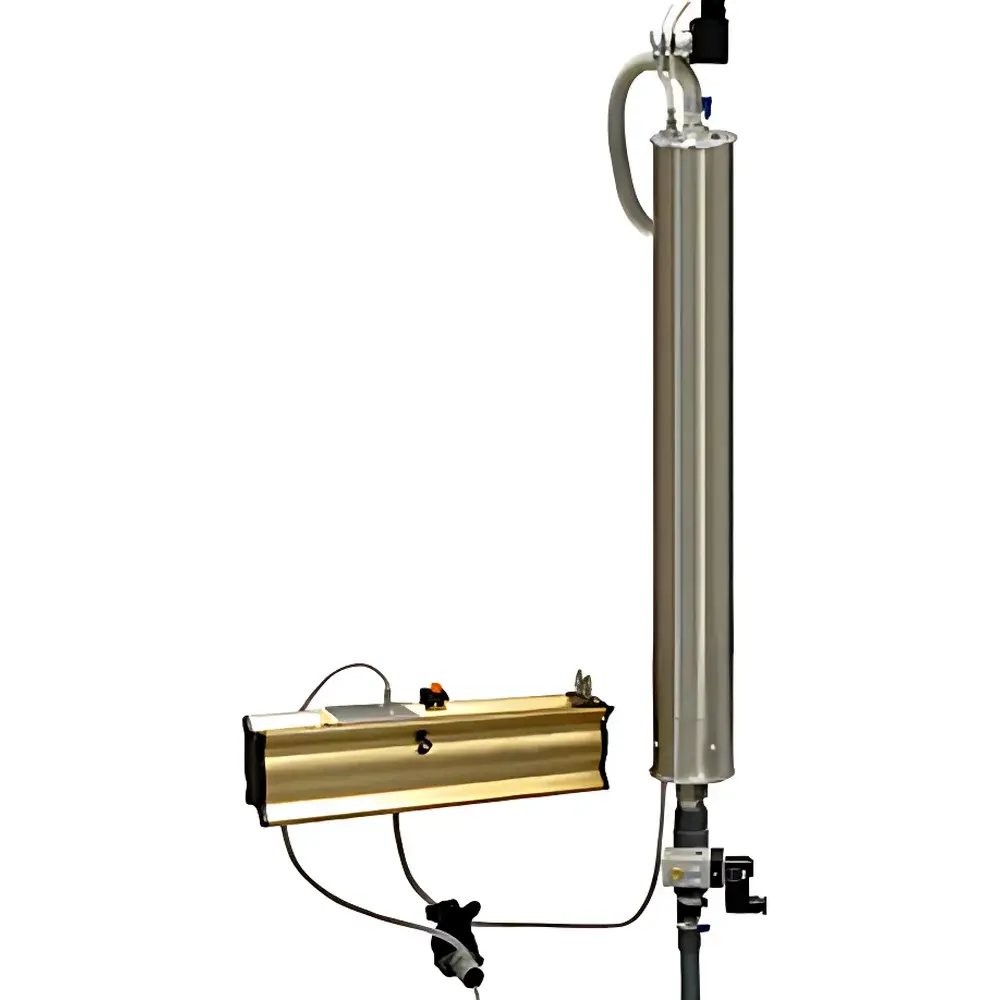
XOPTIX Online Wet-Process Laser Diffraction Particle Size Analyzer
| Brand | XOPTIX |
|---|---|
| Origin | United Kingdom |
| Model | XOPTIX (Wet Dispersion) |
| Particle Size Range | 0.1–1100 µm |
| Dilution Ratio | 2–>10,000:1 |
| Compliance | ISO 13320 |
| Installation Type | In-line, Non-invasive |
| Sample Return Capability | Yes |
| Maintenance | Tool-free optical path access, no intrusive components |
Overview
The XOPTIX Online Wet-Process Laser Diffraction Particle Size Analyzer is an industrial-grade, in-line particle characterization system engineered for continuous, real-time monitoring of particle size distribution (PSD) in liquid-phase process streams. Leveraging the ISO 13320-compliant laser diffraction principle, the instrument measures angular scattering intensity patterns generated when a collimated laser beam interacts with suspended particles in a flowing slurry or suspension. The resulting diffraction data are processed via Mie theory and Fraunhofer approximation to deliver volumetric PSD across a dynamic range of 0.1–1100 µm—enabling quantitative tracking of median diameter (D50), span, fines content (100 µm), and distribution shape parameters. Designed for 24/7 operation in demanding manufacturing environments—including wet milling, crystallization, pigment dispersion, pharmaceutical suspension processing, and mineral slurries—the XOPTIX system integrates directly into existing pipework without flow interruption or sample extraction, eliminating offline sampling bias and analytical delay.
Key Features
- True in-line, non-invasive measurement: No probe insertion, no moving parts in contact with process fluid, ensuring zero risk of clogging or contamination.
- Adaptive wet dispersion module: Programmable dilution ratio from 2:1 up to >10,000:1, enabling stable optical transmission across highly concentrated or optically dense suspensions.
- Integrated sample return loop: Conditioned, analyzed slurry is returned directly to the main process line—preserving mass balance and avoiding waste or regulatory complications associated with discard streams.
- Robust optical architecture: Sealed, temperature-stabilized laser and detector array; self-aligning optics with active drift compensation—eliminating manual refocusing and reducing maintenance frequency by >70% versus legacy in-line systems.
- Compact, IP65-rated enclosure: Designed for mounting on pipe supports or skids in Zone 2 hazardous areas; compatible with CIP/SIP protocols via optional stainless-steel wetted materials.
- Real-time analytics engine: Onboard calculation of D10, D50, D90, span, relative width, and cumulative undersize curves at ≤2-second update intervals.
Sample Compatibility & Compliance
The XOPTIX analyzer supports aqueous and organic suspensions with solid concentrations ranging from 0.01% w/w to 40% w/w (dependent on particle refractive index and density). It accommodates Newtonian and mildly shear-thinning fluids, with maximum allowable viscosity ≤500 mPa·s at measurement point. All wetted components (flow cell, dilution manifold, return lines) are constructed from 316L stainless steel or chemically resistant PEEK, meeting FDA-compliant surface finish requirements (Ra ≤ 0.8 µm). System validation documentation includes IQ/OQ protocols aligned with ASTM E2921 and ISO 13320 Annex B. Data integrity complies with FDA 21 CFR Part 11 requirements when deployed with optional audit-trail-enabled software modules.
Software & Data Management
The XOPTIX Control Suite provides OPC UA and Modbus TCP interfaces for seamless integration into DCS, MES, and SCADA platforms (e.g., Siemens PCS7, Emerson DeltaV, Rockwell FactoryTalk). Historical PSD data are stored in timestamped HDF5 format with embedded metadata (temperature, pressure, flow rate, dilution factor). Trend visualization includes overlay of multiple D-values, statistical control charts (X-bar/R), and deviation alerts triggered by user-defined thresholds. Batch export supports ASTM E2921-compliant reporting templates and CSV/Excel interchange. Optional cloud synchronization enables remote diagnostics, predictive maintenance scheduling, and cross-site benchmarking.
Applications
- Pharmaceutical: Real-time monitoring of micronized API suspensions during wet milling and nanosuspension formulation; critical quality attribute (CQA) control per ICH Q5A and Q8(R2).
- Chemicals: Tracking crystal growth kinetics in anti-solvent crystallization reactors; detecting agglomeration onset during polymer latex synthesis.
- Minerals & Pigments: Ensuring consistent grind fineness in ball mill circuits; optimizing dispersant dosing in TiO₂ and carbon black slurries.
- Food & Beverage: Verifying particle stability in chocolate milk emulsions and functional ingredient dispersions (e.g., calcium phosphate, dietary fibers).
- Water Treatment: Monitoring flocculant efficiency and floc size evolution in clarifier influent streams.
FAQ
Does the XOPTIX system require periodic calibration with reference standards?
Yes—annual verification using NIST-traceable polystyrene latex (PSL) standards is recommended; however, the optical path stability minimizes drift, and factory calibration remains valid for ≥18 months under typical operating conditions.
Can the analyzer handle abrasive slurries such as silica or alumina?
Yes, provided the flow velocity is maintained below 3 m/s and the particle hardness does not exceed Mohs 7; optional sapphire windows and tungsten-carbide flow cell liners extend service life in high-wear applications.
Is it possible to retrofit the XOPTIX onto existing pipelines without process shutdown?
Yes—hot-tap installation kits and flanged bypass configurations allow commissioning during scheduled maintenance windows, with typical mechanical integration completed in <8 labor-hours.
How is data security managed in networked deployments?
All communication channels support TLS 1.2 encryption; role-based access control (RBAC) enforces operator, engineer, and administrator privilege tiers; audit logs record all configuration changes and report exports per ISO/IEC 27001 guidelines.