
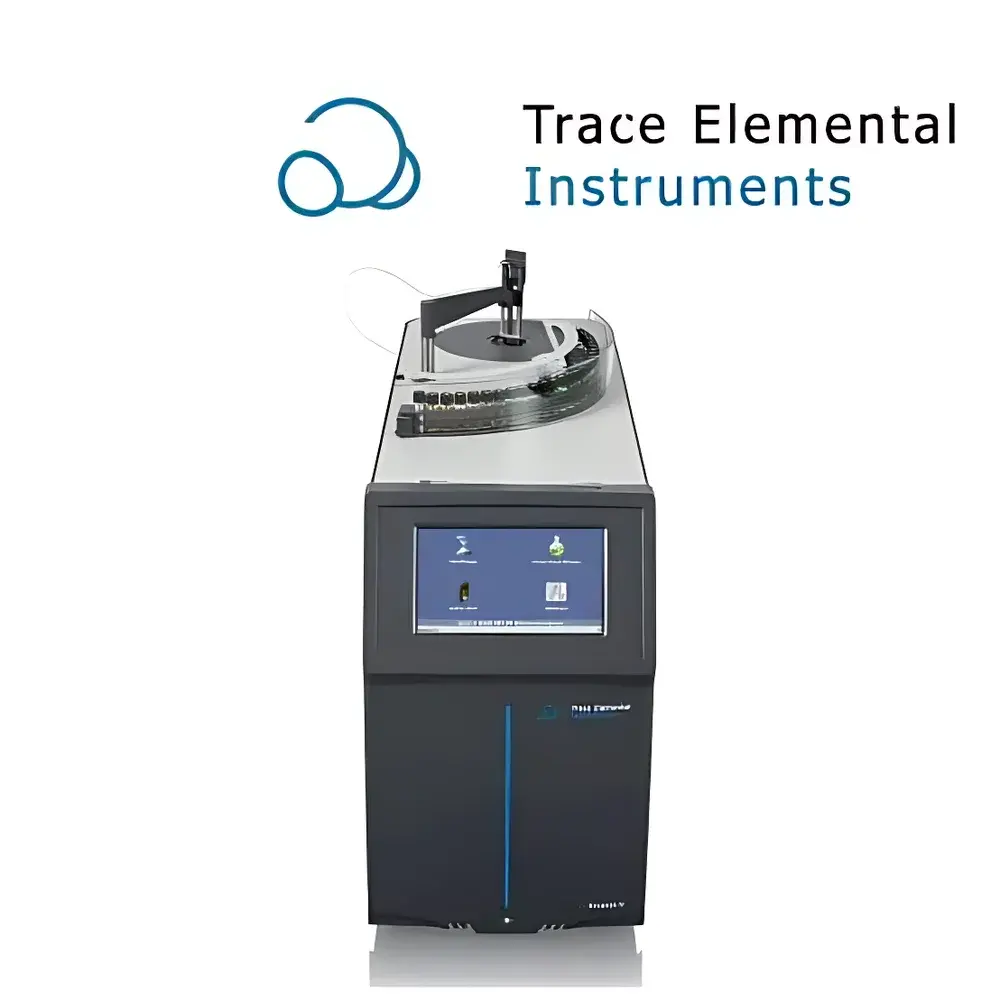
XPLORER-V Total Sulfur and Nitrogen Analyzer by TE (Trace Elemental Instruments)
| Brand | TE / Trace Elemental Instruments |
|---|---|
| Origin | Netherlands |
| Model | XPLORER-V with XLS-26 Liquid Autosampler |
| Detection Principle | UV Fluorescence (S) / Chemiluminescence (N) |
| Portability | Benchtop (Non-portable) |
| Analyte Types | Total Sulfur and Total Nitrogen |
| Measurement Range | 20 ppb – 10,000 ppm |
| Analysis Time | 2–6 minutes per sample |
| LOD | 10 ppb (S and N) |
| Accuracy | ±2% of reading |
Overview
The XPLORER-V Total Sulfur and Nitrogen Analyzer, engineered by TE (Trace Elemental Instruments) in the Netherlands, is a high-performance, benchtop combustion-based elemental analyzer designed for precise quantification of total sulfur and total nitrogen in petroleum matrices. It operates on dual detection principles: ultraviolet fluorescence (UVF) for sulfur and chemiluminescence (CLD) for nitrogen—both compliant with internationally recognized standard methods including ASTM D5453, D7183, D7039, ISO 20846, and UOP 979. The instrument features a vertically oriented high-temperature quartz combustion furnace (up to 1100 °C), enabling complete oxidative decomposition of complex hydrocarbon samples—including crude oil, gasoline, diesel, jet fuel, lubricants, liquefied petroleum gas (LPG), and natural gas condensates—into SO₂ and NOₓ species prior to selective detection. Its vertical architecture minimizes thermal gradient effects and improves residence time control in the oxidation zone, contributing to enhanced reproducibility and reduced memory effects.
Key Features
- Compact vertical furnace design reduces footprint by >30% versus conventional horizontal configurations—ideal for space-constrained QC laboratories.
- Integrated XLS-26 liquid autosampler with programmable syringe-driven aspiration, variable-speed injection (0.5–5 µL/s), on-the-fly dilution capability (1:2 to 1:100), and multi-stage rinse cycles using solvent and air purge to eliminate carryover.
- Modular gas sampling options: ambient-pressure gas inlet for natural gas or refinery off-gas; high-pressure gas module (up to 10 bar) with pressure-regulated flow control for LPG and vapor-phase samples.
- Patented self-cleaning quartz combustion tube with periodic oxygen-rich purge cycles—prevents carbon buildup and maintains stoichiometric oxidation efficiency over extended operation.
- Multi-stage gas conditioning: membrane-based water removal (Nafion®-type permeation dryer), particulate filtration (<0.1 µm), and catalytic CO conversion to ensure only dry, particle-free, CO₂-free carrier gas reaches detectors.
- Proprietary NO correction algorithm compensates for spectral interference from elevated NOₓ concentrations during UVF sulfur measurement—critical for high-nitrogen fuels such as marine distillates and bio-blends.
Sample Compatibility & Compliance
The XPLORER-V accommodates liquid (neat or diluted), gaseous, and liquefied samples without matrix-specific hardware reconfiguration. It meets regulatory requirements for sulfur and nitrogen reporting under EPA Method 1664B (petroleum products), EN 15967 (automotive fuels), and China GB/T 17040–2019. All calibration protocols support traceability to NIST-traceable SRMs (e.g., NIST SRM 2724c for sulfur, SRM 2725a for nitrogen). Data integrity complies with FDA 21 CFR Part 11 when operated with optional audit-trail-enabled software; system suitability tests (SST), blank monitoring, and recalibration triggers are configurable per GLP/GMP workflows.
Software & Data Management
Control and data acquisition are managed via TE’s proprietary XplorerSuite v4.x software—Windows-based, multi-user capable, and supporting role-based access control (RBAC). Real-time chromatogram visualization, peak integration with baseline subtraction algorithms, and automated report generation (PDF/CSV/XLSX) are standard. Raw data files include full metadata (operator ID, method version, calibration history, instrument status logs). Optional modules enable electronic signature support, instrument qualification templates (IQ/OQ/PQ), and integration with LIMS via ASTM E1384-compliant XML export.
Applications
- Refinery process stream monitoring (crude assay, hydrotreater feed/product, FCC slurry)
- Finished fuel certification (ULSD, Euro 5/6, Jet A-1, marine gasoil)
- Alternative fuel characterization (biodiesel, renewable diesel, e-fuels)
- Research-grade speciation support (correlation studies with GC-SCD or IC-MS)
- Contract laboratory compliance testing for ISO/IEC 17025-accredited services
FAQ
What detection technologies does the XPLORER-V use for sulfur and nitrogen?
UV fluorescence detection (ASTM D5453) for sulfur and chemiluminescent detection (ASTM D7183) for nitrogen—both performed sequentially in a single combustion event.
Can the XPLORER-V analyze solid or viscous samples?
Not natively; solids require prior dissolution in suitable solvents (e.g., xylene, chloroform), and highly viscous samples (>500 cSt) must be pre-diluted to ensure consistent aspiration and combustion.
Is method validation documentation provided?
Yes—TE supplies a comprehensive Validation Guide aligned with ICH Q2(R2), including linearity (R² ≥ 0.999), repeatability (RSD ≤ 1.5%), intermediate precision, and robustness assessment protocols.
How often does the combustion tube require maintenance?
Under typical operation (≤20 samples/day), the patented auto-clean cycle extends service intervals to ≥6 months; visual inspection and quartz tube replacement are recommended annually or after 2,000 analyses.
Does the system support remote diagnostics?
Yes—the embedded Ethernet interface enables secure remote access via TE’s authorized service portal for firmware updates, log review, and real-time performance diagnostics (with customer consent and IT policy compliance).







