
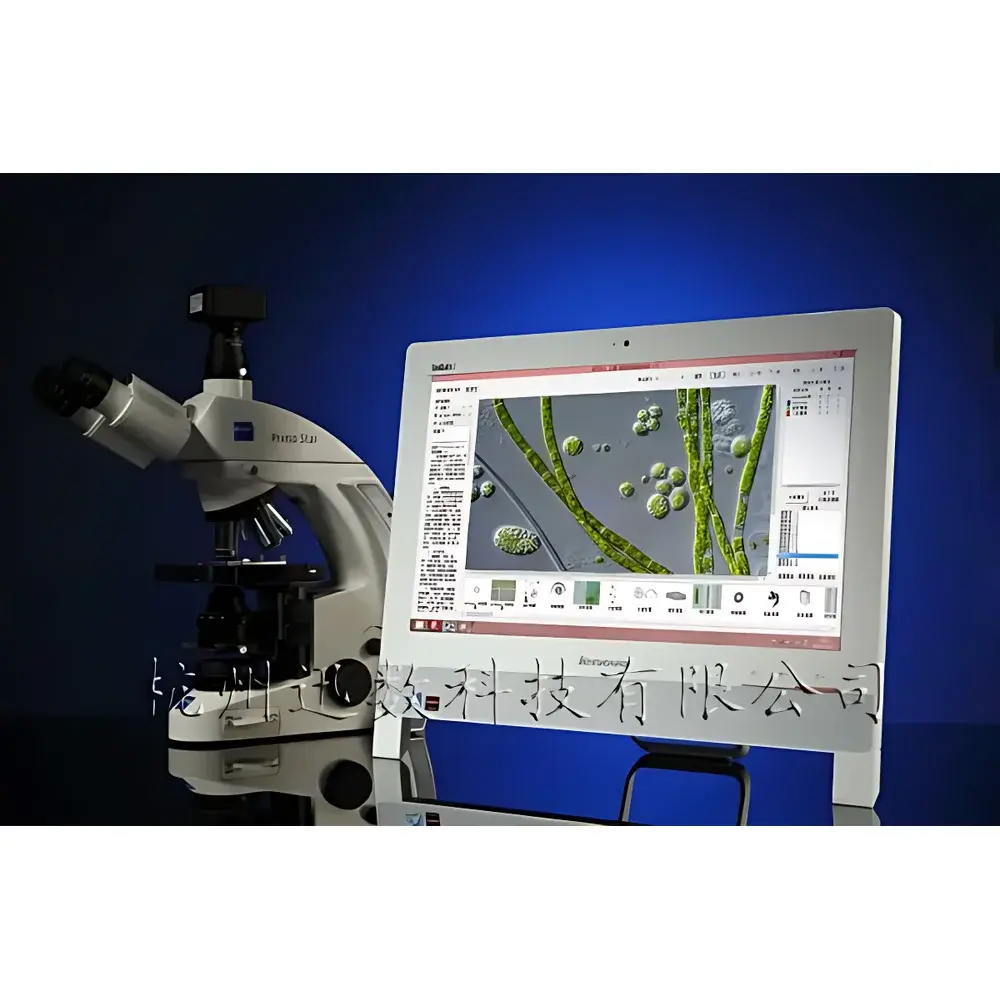
Xunshu Algacount F200 Plankton and Algal Image Analysis System
| Brand | Xunshu |
|---|---|
| Origin | Zhejiang, China |
| Manufacturer Type | Original Equipment Manufacturer (OEM) |
| Product Category | Domestic |
| Model | Algacount F200 |
| Instrument Type | Algal and Plankton Counter |
| Key Imaging Sensor | Scientific-grade Color CCD (2580 × 1944 pixels) |
| Core Software Modules | Bio-similarity–enhanced Algal Identification, Chaotic Intelligent Classification Counting, Pigment-body Localization & Quantification, Depth-of-field Fusion Imaging, Ultra-wide Field Mosaic Stitching, Microalgal Biomass Estimation, Colonial & Filamentous Algal Cell Parsing |
| Database Scope | 11 Phyla, 862 Genera, 8093 Algal Species (Marine: 270 genera / 2818 species |
| Freshwater | 622 genera / 5275 species) |
| Compliance Support | GLP-compliant audit trail logging, ISO/IEC 17025-aligned data traceability framework, USP <1119>–compatible image metadata embedding |
Overview
The Xunshu Algacount F200 is a high-precision, image-based plankton and algal analysis system engineered for environmental monitoring laboratories conducting routine water quality assessment, harmful algal bloom (HAB) surveillance, and ecological status evaluation in freshwater, estuarine, and marine ecosystems. It operates on the principle of digital microscopic image acquisition coupled with supervised machine learning–driven morphological and spectral feature extraction. Unlike conventional manual counting methods or basic threshold-based image segmentation tools, the Algacount F200 integrates multi-layered biological priors—including taxon-specific geometric models, pigment absorption profiles, and phylogenetic morphology constraints—into its analytical pipeline. This enables robust discrimination among morphologically overlapping taxa (e.g., *Microcystis* vs. *Anabaena*, *Thalassiosira* vs. *Coscinodiscus*) under variable lighting, staining, and focus conditions. The system is designed to support standardized protocols aligned with ISO 14442 (water quality — determination of phytoplankton — identification and enumeration), ASTM D5905 (standard practice for microscopic examination of waterborne microorganisms), and national guidelines for eutrophication monitoring.
Key Features
- Chaotic Intelligent Classification Counting: A proprietary algorithmic framework that applies non-linear decision boundaries to classify mixed algal assemblages based on combined morphometric, textural, and chromatic features—enabling reliable separation of co-occurring taxa with divergent size, shape, and pigment composition.
- Pigment-Feature Rapid Selection Tool: Enables automated detection, localization, and pixel-intensity–based quantification of chlorophyll-a–rich organelles (chloroplasts), phycobilisomes (in cyanobacteria), and fucoxanthin-containing plastids (in diatoms and brown algae), supporting semi-quantitative physiological inference.
- Depth-of-Field Fusion Imaging: Compensates for limited optical sectioning at high magnifications (≥40×) by capturing z-stacks and computationally fusing in-focus regions across focal planes—critical for accurate cell boundary delineation in vertically stratified samples.
- Ultra-Wide Field Mosaic Stitching: Seamlessly combines ≥16 adjacent high-resolution fields into a single composite image (up to 120 mm²), facilitating uninterrupted analysis of filamentous taxa (*Oscillatoria*, *Lyngbya*), colonial forms (*Gloeocapsa*, *Coelosphaerium*), and chain-forming diatoms (*Asterionella*, *Fragilaria*).
- Biomass Estimation Engine: Integrates user-selected geometric models (spheres, cylinders, prolate spheroids, frustules) with calibrated pixel-to-micron scaling to compute biovolume per cell; converts volume to carbon mass using taxon-specific conversion factors from literature (e.g., Menden-Deuer & Lessard, 2000).
- Colonial & Filament Parsing Algorithms: Specifically optimized for gelatinous colonies (*Microcystis aeruginosa* mucilage matrices) and linear chains (*Melosira*, *Stephanodiscus*), automatically resolving individual cells within shared envelopes or intercalated linkages without over-segmentation artifacts.
Sample Compatibility & Compliance
The Algacount F200 accepts standard Utermöhl sedimentation chambers (10–50 mL), membrane-filtered preparations (0.45 µm pore size), and Lugol’s-fixed or glutaraldehyde-preserved samples mounted on glass slides. It supports both brightfield and phase contrast imaging modes. All image metadata—including objective magnification, camera exposure time, timestamp, operator ID, and calibration parameters—is embedded in EXIF and stored with raw TIFF sequences in accordance with ISO/IEC 17025 requirements for measurement traceability. Audit logs record every annotation, classification edit, and database query event with immutable timestamps and user attribution—meeting GLP documentation standards for regulatory submissions. The software architecture permits configuration lock-down for validated workflows and supports electronic signature implementation compliant with FDA 21 CFR Part 11 when deployed on domain-authenticated Windows environments.
Software & Data Management
The Algacount F200 runs on a dedicated Windows-based workstation preloaded with Xunshu’s proprietary analysis suite. The software provides full DICOM-compatible image management, hierarchical taxonomy navigation (phylum → class → order → family → genus → species), and dual-language (Latin + vernacular) zooplankton nomenclature referencing. Statistical outputs include species richness (S), Shannon–Wiener diversity (H′), Pielou evenness (J′), dominance index (λ), and relative abundance histograms. All reports are exportable in PDF, CSV, and Excel formats—with direct integration into LIMS via ODBC drivers. Custom report templates allow inclusion of site metadata, sampling protocol references, QA/QC flags, and regulatory compliance statements. Raw image archives are stored in lossless TIFF format with embedded scale bars and metadata tags ensuring long-term interpretability.
Applications
- Regulatory monitoring of nutrient enrichment indicators in lakes, reservoirs, and coastal zones per EPA Method 445.0 and EU WFD Annex V.
- Early warning detection of toxigenic cyanobacteria (*Microcystis*, *Dolichospermum*, *Planktothrix*) during drinking water source surveillance.
- Ecological risk assessment of ballast water discharge under IMO G8 guidelines and USCG Type Approval testing.
- Research on microalgal biotechnology feedstocks—supporting cell density tracking in photobioreactors and fermentation tanks.
- Long-term trend analysis in national biodiversity observation networks (e.g., GBIF-aligned data submission).
- Training and proficiency testing for taxonomic competency in aquatic ecology education programs.
FAQ
Does the Algacount F200 require a specific microscope model?
No—it interfaces with any research-grade compound microscope equipped with a C-mount port and motorized stage (optional). Standard adapters are provided for Olympus, Nikon, Zeiss, and Leica systems.
Can users expand the reference database with local isolates?
Yes. The software allows import of user-captured micrographs, annotated morphological descriptors, and associated geo-referenced occurrence records—fully version-controlled and searchable alongside the core library.
Is pigment quantification calibrated against spectrophotometric standards?
The pigment-body localization module identifies and segments pigment-rich regions but does not replace quantitative HPLC or fluorometric assays; it serves as a rapid screening tool for spatial pigment distribution and relative abundance trends.
How is measurement uncertainty addressed in biomass calculations?
Uncertainty propagation is implemented per ISO/IEC Guide 98-3:2019—accounting for pixel resolution error, stage calibration drift, model selection bias, and operator-defined region-of-interest variability—yielding expanded uncertainty intervals (k=2) for all biovolume estimates.
What cybersecurity protocols are implemented for networked deployment?
The software supports Active Directory authentication, TLS 1.2–encrypted remote data sync, and configurable firewall rules for segmented lab network integration—aligned with NIST SP 800-53 Rev. 5 controls for scientific IT infrastructure.
Related Products







