
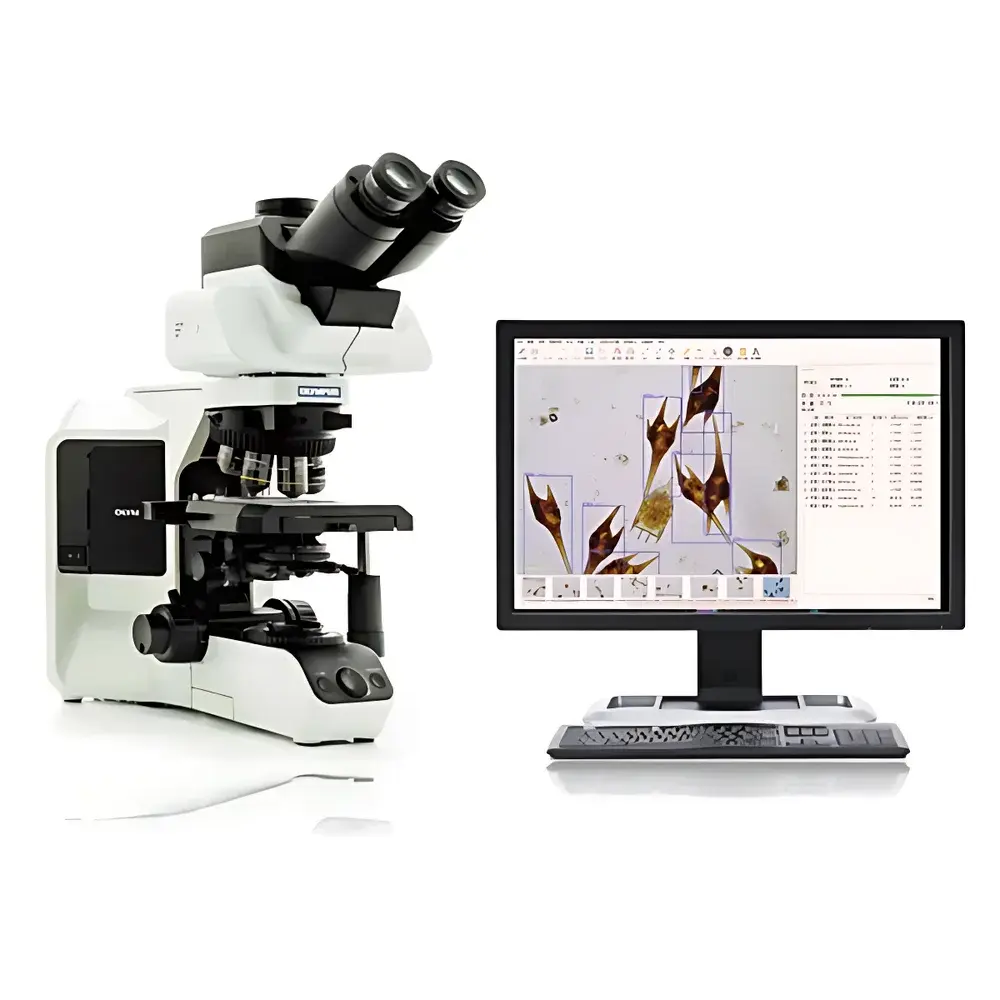
Xunshu AlgaeAI 500 Planktonic Algae Intelligent Monitoring System
| Brand | Xunshu |
|---|---|
| Origin | Zhejiang, China |
| Manufacturer Type | OEM Manufacturer |
| Country of Origin | China |
| Model | Xunshu AlgaeAI 500 |
| Pricing | Upon Request |
Overview
The Xunshu AlgaeAI 500 Planktonic Algae Intelligent Monitoring System is a fully integrated digital microscopy and artificial intelligence platform engineered for standardized, reproducible, and audit-ready phytoplankton analysis in freshwater, estuarine, and marine environments. At its core lies a rigorous morphometric workflow grounded in ISO/IEC 17025-aligned laboratory practices: high-fidelity image acquisition via an Olympus BX53 research-grade upright microscope, coupled with real-time AI-driven classification, enumeration, and biometric quantification using a deep learning model trained on >200,000 manually annotated algal images. Unlike conventional manual or semi-automated counting methods, the AlgaeAI 500 implements a deterministic convolutional neural network (CNN) architecture optimized for low-contrast, overlapping, fragmented, and out-of-focus microscopical features—common challenges in natural plankton samples. The system operates strictly within the analytical framework defined by HJ 1215–2021, HJ 1216–2021, SL 733–2016, GB 17378–2007, and the *Methods for the Examination of Water and Wastewater* (4th Edition), ensuring regulatory traceability for environmental monitoring programs, water utility compliance reporting, and ecological assessment studies.
Key Features
- End-to-end automated phytoplankton analysis: from raw image capture to taxonomic enumeration, density calculation (cells/L), biomass estimation (pg C/L or µg Chl-a/L equivalent), and ecological indices (Shannon diversity, Pielou evenness, dominance index)
- Olympus BX53 UIS2 infinity-corrected optical platform with six-position objective turret, precision mechanical stage (25 mm vertical travel, 1 µm fine focus resolution), and LED Köhler illumination with intensity preset buttons and real-time LED display
- Dedicated 1-inch global-shutter CMOS camera (Sony IMX sensor) enabling motion-artifact-free imaging during rapid slide scanning—critical for maintaining morphological fidelity at 40× and 100× oil immersion
- Deep learning model trained on 85 taxonomically validated species across eight phyla (Cyanophyta, Chlorophyta, Bacillariophyta, Cryptophyta, Dinophyta, Xanthophyta, Chrysophyta, Euglenophyta), covering size ranges from 3 µm to 1000 µm
- Robust handling of image complexity: intelligent overlap separation algorithms and partial-cell inference logic enable accurate detection of fragmented, edge-truncated, or densely clustered cells without dilution or manual pre-processing
- Fully transparent, auditable analysis pipeline: every recognition event is visually annotated in real time; users can inspect, accept, reject, or reclassify individual detections via intuitive mouse interaction
- Regulatory-grade data integrity: all raw images, metadata (date/time, operator ID, magnification, exposure settings), and intermediate analysis layers are cryptographically timestamped and stored in immutable binary format compliant with GLP/GMP electronic record retention requirements
Sample Compatibility & Compliance
The AlgaeAI 500 supports standard sample preparation protocols per HJ 1215–2021 (membrane filtration) and HJ 1216–2021 (0.1 mL settling chamber). It accommodates both preserved (Lugol’s iodine, formalin) and live samples, with no requirement for staining or centrifugal concentration. The system validates compliance through built-in method verification workflows—including reference slide calibration, repeatability checks (CV ≤ 8% across replicate fields), and inter-operator concordance testing. All analytical outputs conform to the structural reporting templates mandated by national water quality monitoring networks and align with ISO 14001 environmental management system documentation requirements. Data export formats include CSV, PDF (with embedded image thumbnails), and XML for LIMS integration.
Software & Data Management
AlgaeAI software v5.2 runs on a dedicated Windows 10 Pro workstation (Intel Core i9-12900, 32 GB RAM, NVIDIA RTX A2000 GPU, dual-storage architecture: 512 GB NVMe + 4 TB HDD). The application enforces role-based access control (RBAC), full audit trail logging (per FDA 21 CFR Part 11 Annex 11 principles), and automatic backup to network-attached storage. Each analysis session generates a self-contained project file containing raw TIFFs, segmentation masks, confidence scores per detection, and full statistical summaries—including cell-level morphometrics (length, width, area, volume), population-level metrics (abundance, dominance, diversity), and derived parameters (biovolume, carbon biomass). Reports are exportable in bilingual (English/Chinese) formats with customizable headers, institutional logos, and digital signature fields.
Applications
- Real-time cyanobacterial bloom surveillance in reservoirs, lakes, and drinking water intakes
- Long-term ecological trend analysis under national aquatic biodiversity monitoring programs
- Regulatory compliance reporting for wastewater discharge permits and surface water quality standards (e.g., China’s Class III–V criteria)
- Research-grade phytoplankton community dynamics in limnological and oceanographic field studies
- Method validation and inter-laboratory comparison exercises coordinated by provincial environmental monitoring centers
- Educational use in university limnology and aquatic ecology laboratories requiring standardized, repeatable teaching datasets
FAQ
Does the AlgaeAI 500 require specialized biological training to operate?
No. The system eliminates dependency on taxonomic expertise through its pre-trained CNN model. Operators need only basic microscopy proficiency and familiarity with digital image navigation.
Can the AI model be extended to recognize additional algal taxa beyond the current 85 species?
Yes. The underlying architecture supports transfer learning; custom model retraining is available under NDA with Xunshu’s bioinformatics team using client-provided ground-truth image sets.
How does the system handle samples with extremely high cell densities (>150 cells per FOV)?
It applies adaptive local contrast enhancement and hierarchical instance segmentation to resolve tightly aggregated colonies and filamentous forms without manual dilution—maintaining quantitative accuracy across the full dynamic range (9.2 × 10² to 10¹¹ cells/L).
Is raw image data export supported for third-party reanalysis?
Yes. Unprocessed 16-bit TIFF stacks, along with JSON-formatted annotation files containing bounding boxes, class IDs, and confidence scores, are fully exportable for external validation or meta-analysis.
What hardware maintenance is required for long-term operational stability?
The Olympus BX53 platform requires annual optical alignment verification and LED source calibration; the AI workstation undergoes quarterly GPU driver and CUDA library updates—both services included in Xunshu’s Platinum Support Agreement.







