
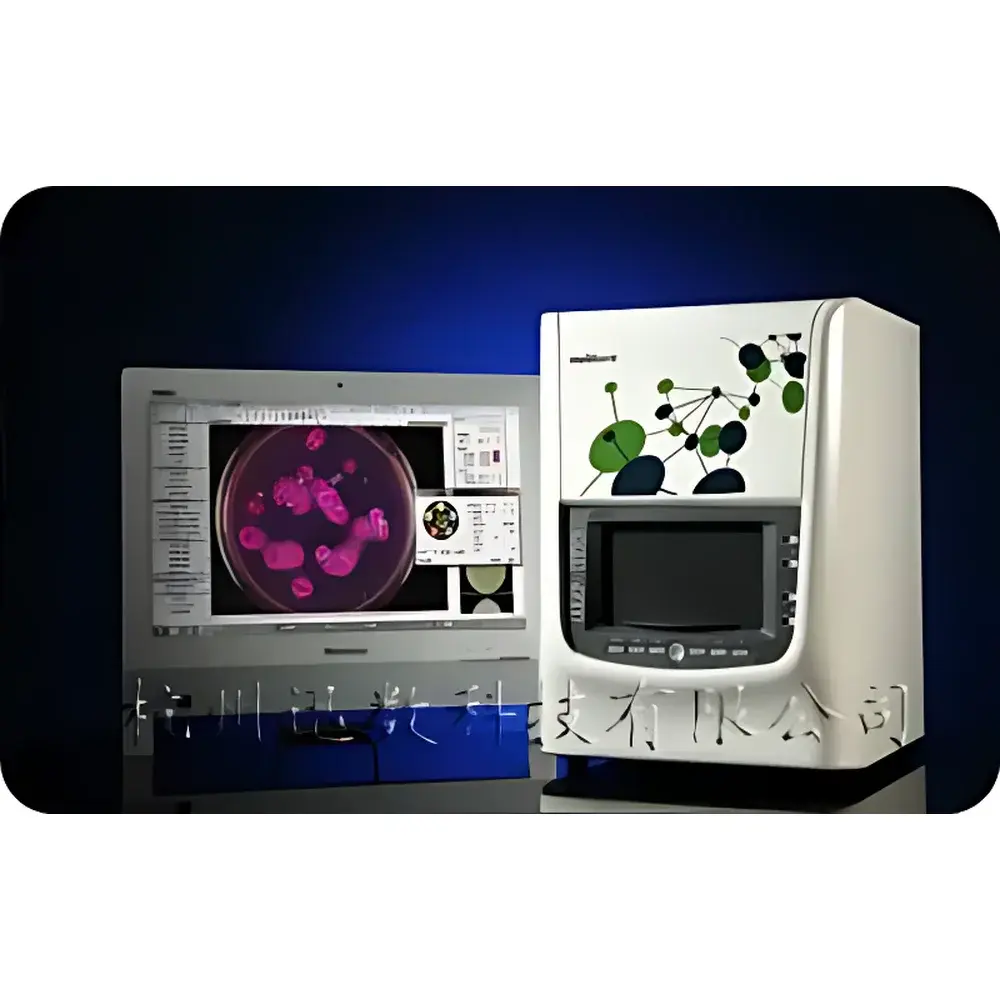
Xunshu Czone5F Automated Colony Counter and Antibiotic Zone-of-Inhibition Analyzer
| Brand | Xunshu |
|---|---|
| Origin | Zhejiang, China |
| Manufacturer Type | Direct Manufacturer |
| Instrument Type | Fully Automated Colony Counter |
| Sample Types | Liquid media, solid media (pour plate, spread plate, membrane filtration, spiral plate, 3M Petrifilm™) |
| Petri Dish Capacity | 35–150 mm diameter |
| Counting Speed | 20,000 colonies/sec |
| Resolution | 0.03 mm |
| Imaging System | 10 MP, 1/2.3" CMOS sensor, USB 3.0 interface |
| Included Software | Colony analysis module, zone-of-inhibition measurement module, β-lactamase detection module (Shubactam-sensitive) |
| Configuration | Main unit, dedicated analysis software suite, brand-name business-grade LCD computer |
Overview
The Xunshu Czone5F is a fourth-generation automated colony counter and antibiotic zone-of-inhibition analyzer engineered for high-throughput, regulatory-compliant microbiological testing in food safety, environmental monitoring, water quality assessment, antimicrobial efficacy evaluation, and industrial hygiene laboratories. It integrates dual-illumination optical architecture—top-mounted 360° diffuse multi-spectral LED lighting and bottom-mounted “CrystalSharp” suspended dark-field illumination—to deliver consistent, artifact-free digital imaging under controlled photometric conditions. Its core measurement principle relies on high-resolution digital image acquisition coupled with adaptive segmentation algorithms rooted in level-set theory, morphological constraints, and multi-model contour optimization. The system supports both standard colony enumeration per ISO 4833-1:2013, ISO 7218:2017, and FDA BAM Chapter 3, as well as quantitative zone-of-inhibition analysis aligned with CLSI M02-A12 and EUCAST guidelines. All optical components—including UV sources at 254 nm (for chamber sterilization and mutagenesis) and dual 366 nm LEDs (for fluorescence excitation of E. coli, coliforms, and GFP-expressing strains)—are factory-aligned and thermally stabilized to ensure long-term photometric repeatability.
Key Features
- Triple-wavelength illumination system: High-CRI trichromatic visible LED array (eliminates blue-shift artifacts common in white LED systems), 254 nm germicidal UV, and dual-side 366 nm UV for uniform fluorescence excitation.
- Optically isolated dark chamber with ergonomic viewport door: Eliminates ambient light interference and suppresses refractive halos from Petri dish meniscus effects.
- 10-megapixel industrial CMOS imaging system with fixed-focus telecentric lens: Delivers sub-30 µm spatial resolution and pixel-level reproducibility across the full 35–150 mm dish range.
- Adaptive illumination control: Independent intensity adjustment for top, bottom, dual, and UV modes; real-time switching between bright-field, dark-field, and fluorescent imaging protocols.
- Background flexibility: Automatic selection between suspended dark-field (optimized for translucent or low-contrast colonies) and user-switchable white background (enhances contrast for pigmented or dark colonies).
- Modular software architecture: Pre-validated modules for standard colony counting, spiral plate analysis (FDA-compliant), 3M Petrifilm™ processing, mold/yeast differentiation (per GB 4789.15), coliform/E. coli enumeration (VRBA/EC-MUG), and Staphylococcus aureus quantification on Baird-Parker agar.
Sample Compatibility & Compliance
The Czone5F accommodates all standard microbiological sample formats: pour plates, spread plates, membrane filters (including black-grid nitrocellulose and polycarbonate), spiral inoculated plates (compatible with SBI, IUL, and other OEM inoculators), and commercial chromogenic test films (3M Petrifilm™ Total Aerobic Count, S. aureus, Coliform, and E. coli/Coliform variants). Its image processing engine complies with ISO/IEC 17025:2017 requirements for method validation, supporting documented traceability of algorithm parameters, calibration records, and operator-defined thresholds. For regulated environments, audit trails include timestamped log entries for software launches, parameter changes, manual corrections, and report exports—meeting GLP and GMP documentation expectations. The system supports 21 CFR Part 11–compliant user authentication via three-tier password protection (application launch, database access, administrator privileges).
Software & Data Management
The integrated software suite employs a modular, non-proprietary data architecture. Colony counts, morphometric measurements (equivalent diameter, area, perimeter, circularity), and zone diameters are stored in an embedded SQL database with field-level encryption. All statistical outputs—including dilution-adjusted CFU/mL/g calculations, size-classified distributions (25-bin histogram), and confidence-interval-based deviation estimates—are exportable to Excel (.xlsx) without loss of metadata or formatting fidelity. The β-lactamase detection module implements CLSI-recommended Shubactam inhibition assay logic: automatic validation of control zones (A/B/D), parallel-sample averaging, and binary result classification (positive/negative) with configurable tolerance thresholds (e.g., D−C ≥ 3 mm, B−A ≤ 3 mm). Audit logs capture every user action, including manual edits, region exclusions, and grid-background removal operations—ensuring full data integrity for regulatory review.
Applications
The Czone5F serves validated workflows across multiple sectors: food safety labs performing AOAC 990.12 and ISO 6887-1 compliant testing; pharmaceutical QC units verifying bioburden in non-sterile products per USP ; environmental agencies quantifying heterotrophic plate counts in drinking water (EPA 1603); and R&D teams evaluating antifungal performance of polymer materials per ASTM G21. Its fluorescence capability enables rapid enumeration of E. coli on CHROMagar™ ECC or EC-MUG media, while the anti-adhesion segmentation algorithms resolve complex morphologies—such as filamentous molds on DRBC agar or mucoid Klebsiella colonies—without user intervention. Spiral plate analysis adheres to SN/T 0701.1–2019 and FDA BAM Chapter 3 protocols, providing statistically robust CFU estimates from single-dilution inoculations.
FAQ
Does the Czone5F support regulatory submissions under FDA or EU MDR requirements?
Yes—the system generates ALCOA+ compliant data (Attributable, Legible, Contemporaneous, Original, Accurate) with full audit trail functionality, electronic signatures, and version-controlled software modules.
Can the instrument distinguish between mold and yeast colonies on the same plate?
Yes—using morphology-driven clustering and multi-threshold segmentation, it classifies colonies by texture, edge complexity, and pigment diffusion patterns per ISO 21527-1.
Is calibration traceable to NIST or equivalent national standards?
Instrument calibration uses certified stage micrometers; software includes built-in reference verification routines with user-editable correction factors.
How does the system handle overlapping or chain-forming colonies?
It applies context-aware splitting using eight-chain-code contour tracking and randomized Hough circle detection, with optional manual refinement tools for ambiguous cases.
What level of technical support and software updates are included post-purchase?
Xunshu provides lifetime firmware updates, annual algorithm validation packages, and remote diagnostic support under the standard warranty period.




