
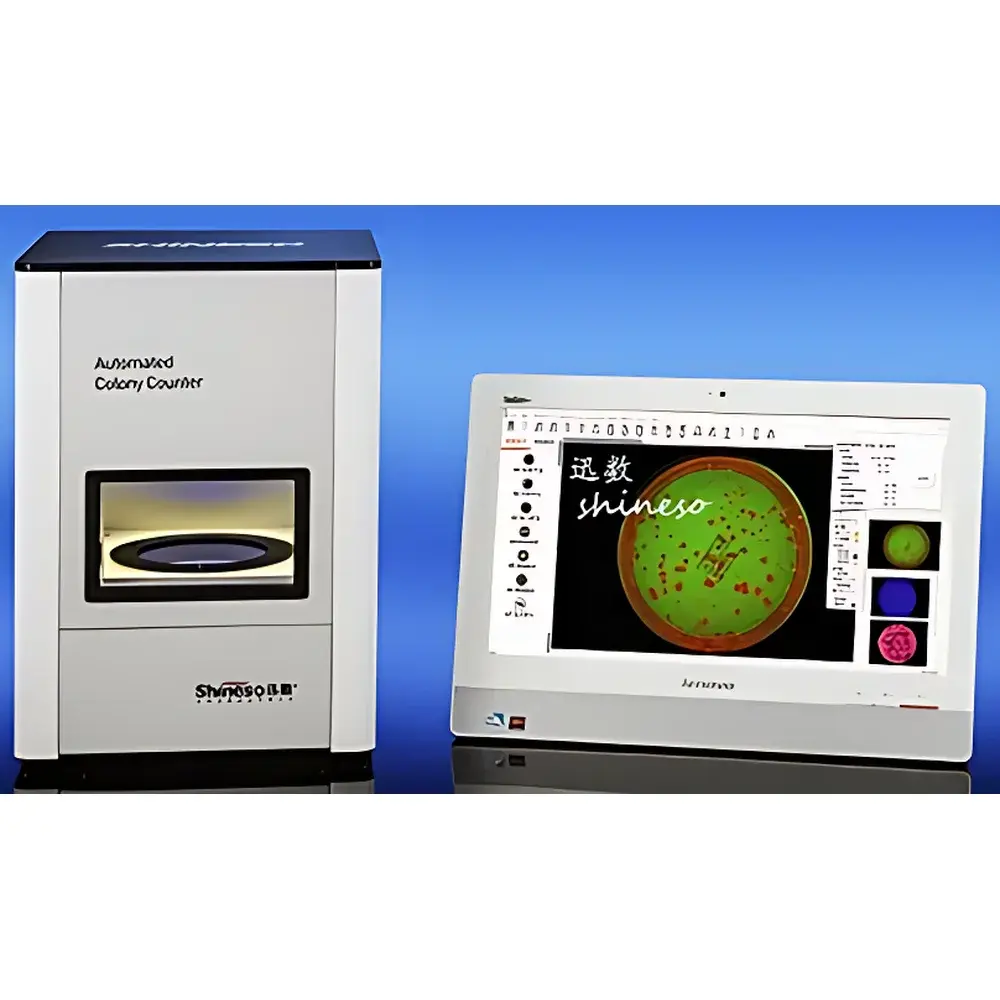
Xunshu Supcre G10 (AI) Integrated Colony Counter, Screening & Zone-of-Inhibition Analyzer
| Brand | Xunshu |
|---|---|
| Origin | Zhejiang, China |
| Manufacturer Type | Direct Manufacturer |
| Product Category | Domestic Instrument |
| Model | Supcre G10 |
| Instrument Type | Fully Automated Colony Counter |
| Sample Types | Liquid media, solid media (pour plate, spread plate, membrane filtration, spiral plate, ready-to-use test plates) |
| Petri Dish Capacity | 35–150 mm diameter |
| Counting Speed | 0.8 sec per plate |
| Counting Accuracy | ≥98% for standard reference strains |
| Imaging Performance | 16 mm fixed-focus lens, 10 MP resolution, 200 lp/mm optical resolution, Sony 1″ color CMOS sensor, 20-megapixel effective resolution |
Overview
The Xunshu Supcre G10 (AI) Integrated Colony Counter, Screening & Zone-of-Inhibition Analyzer is a research-grade, fully automated digital microbiology workstation engineered for precision, reproducibility, and regulatory compliance in pharmaceutical, clinical, food safety, and academic laboratories. It combines high-fidelity digital imaging, AI-powered image segmentation, and quantitative morphometric analysis into a single platform capable of simultaneous colony enumeration, phenotypic screening, and antimicrobial susceptibility assessment. The system operates on a dual-principle foundation: (1) high-contrast, multi-spectral illumination physics—leveraging suspended dark-field, tunable chromatic trans-illumination, and omnidirectional diffuse reflection—to maximize contrast between microbial colonies and heterogeneous culture substrates; and (2) deep learning–based computer vision architecture trained on over two decades of annotated colony imagery, enabling robust detection across variable growth morphologies, lighting conditions, and substrate interferences (e.g., condensation, label artifacts, agar opacity gradients). Designed to meet GLP/GMP-aligned workflows, the G10 (AI) supports full audit trail capture, role-based access control, and electronic record integrity per FDA 21 CFR Part 11 and ISO/IEC 17025 requirements.
Key Features
- Fully sealed aluminum alloy chassis (32 × 34 × 46 cm) with light-tight petri dish loading chamber and UV-blocking sliding partition window
- 12-channel programmable chromatic trans-illumination system using uniform LED array backlighting (3100–5800 K CCT, 50–7000 lux, >90% illuminance uniformity)
- Triple-mode illumination engine: suspended dark-field (blue/white LED broadband inverse illumination), nano-diffused omnidirectional reflectance (96-LED + nano-reflector), and tunable spectral trans-illumination
- High-resolution optical path: 16 mm f/1.8–f/22 C-mount fixed-focus lens paired with Sony 1″ color CMOS sensor (20 MP effective resolution, 2.4 × 2.4 µm pixel pitch, 462 mV sensitivity @ 1/30 s)
- Integrated UVC-LED sterilization module (265 nm, ozone-free, instant-on, >20,000 h lifetime)
- Intelligent AI colony analysis engine trained on >10⁶ annotated colony images; supports one-click batch processing of 300 plates in ≤240 seconds
- Dual-mode zone-of-inhibition measurement: automatic edge detection, circular approximation fitting, and manual three-point circle definition
- Comprehensive software suite compliant with USP /, CLSI M100 Ed. 33, and Chinese Pharmacopoeia 2025 (ChP) for antibiotic potency assay (single-, double-, and triple-dose methods)
Sample Compatibility & Compliance
The Supcre G10 (AI) accommodates all standard microbiological sample formats: pour plates, spread plates, membrane filters (including nitrocellulose and mixed ester), spiral plates (compatible with SBI and IUL inoculators), contact plates, and commercial test kits (e.g., 3M Petrifilm™). Its adaptive illumination and AI model generalize across diverse media types—including blood agar, MacConkey, Sabouraud dextrose, chromogenic formulations, and opaque or pigmented substrates—without manual parameter tuning. Regulatory alignment includes built-in validation protocols for repeatability (≤0.002 mm intra-unit measurement error), uniformity (≤0.1% relative error), and inter-unit consistency (≤0.2% variation). All electronic records maintain ALCOA+ principles: attributable, legible, contemporaneous, original, accurate, complete, consistent, enduring, and available—fully traceable via immutable audit trails meeting FDA 21 CFR Part 11, EU Annex 11, and ISO 13485 requirements.
Software & Data Management
The integrated software platform implements a four-tier user permission architecture: System Administrator, Data Reviewer, Test Operator, and Data Auditor—each with strictly defined read/write/execute privileges. All actions—including image acquisition, analysis initiation, result modification, report generation, and system configuration—are timestamped, user-attributed, and cryptographically logged in an unalterable audit trail. Engineering files encapsulate raw images, metadata (sample ID, dilution factor, operator, date/time), processed statistics (CFU counts, zone diameters, area ratios), and PDF/Excel export-ready reports. Data encryption at rest and in transit ensures confidentiality; external backup support includes SHA-256–verified export to NAS, USB, or cloud storage. Software modules are validated per ICH Q5A and ISO/IEC 17025 Annex A.3, with version-controlled updates traceable to CLSI M100 Ed. 33 and ChP 2025 revisions.
Applications
- Quantitative microbial enumeration in pharmaceutical sterility testing, environmental monitoring, and water quality assessment
- High-throughput screening of enzyme-producing, organic acid–secreting, surfactant-synthesizing, or hydrocarbon-degrading mutants via dual-zone ratio analysis (e.g., halo-to-colony diameter or area ratio)
- Antibiotic potency determination using USP-compliant single-dose and ChP-compliant double/triple-dose assays
- CLSI-guided disk diffusion susceptibility testing (SDD/I/R/S classification) with automated zone measurement under both reflective and dark-field trans-illumination
- Morphotype-based classification of mixed cultures using unsupervised color clustering (up to 24 hues) and supervised single-color filtering
- Plaque assay quantification (bacteriophage, viral cytopathic effect) leveraging enhanced edge contrast and sub-pixel interpolation
- OPKA/SBA assays and multi-well plate colony counting via region-of-interest (ROI) segmentation
- Fungal growth kinetics analysis using automated perimeter, area, major/minor axis, and circularity metrics
FAQ
Does the G10 (AI) support regulatory submissions for FDA or EMA filings?
Yes—the system satisfies 21 CFR Part 11 requirements through electronic signature enforcement, audit trail immutability, and role-based data governance. Validation documentation aligns with ICH M7 and ISO/IEC 17025.
Can the AI model be retrained on proprietary strain libraries?
No—the neural network is embedded and pre-validated; however, users may define custom color thresholds, size filters, and morphology masks within the existing inference framework.
What calibration standards are included for traceable measurements?
NIST-traceable stage micrometer and certified zone-of-inhibition calibration disks are supplied; automated self-calibration routines verify lens focus, illumination uniformity, and pixel-to-mm mapping before each session.
Is remote operation or LIMS integration supported?
Yes—RESTful API enables bidirectional data exchange with major LIMS platforms (e.g., LabWare, STARLIMS); remote desktop access is permitted via TLS-encrypted VNC with two-factor authentication.
How is background interference from condensation or labeling handled during analysis?
The AI model incorporates noise-resilient feature extraction layers trained explicitly on images containing water droplets, marker ink, agar cracks, and uneven thickness—enabling robust segmentation without manual preprocessing.





