
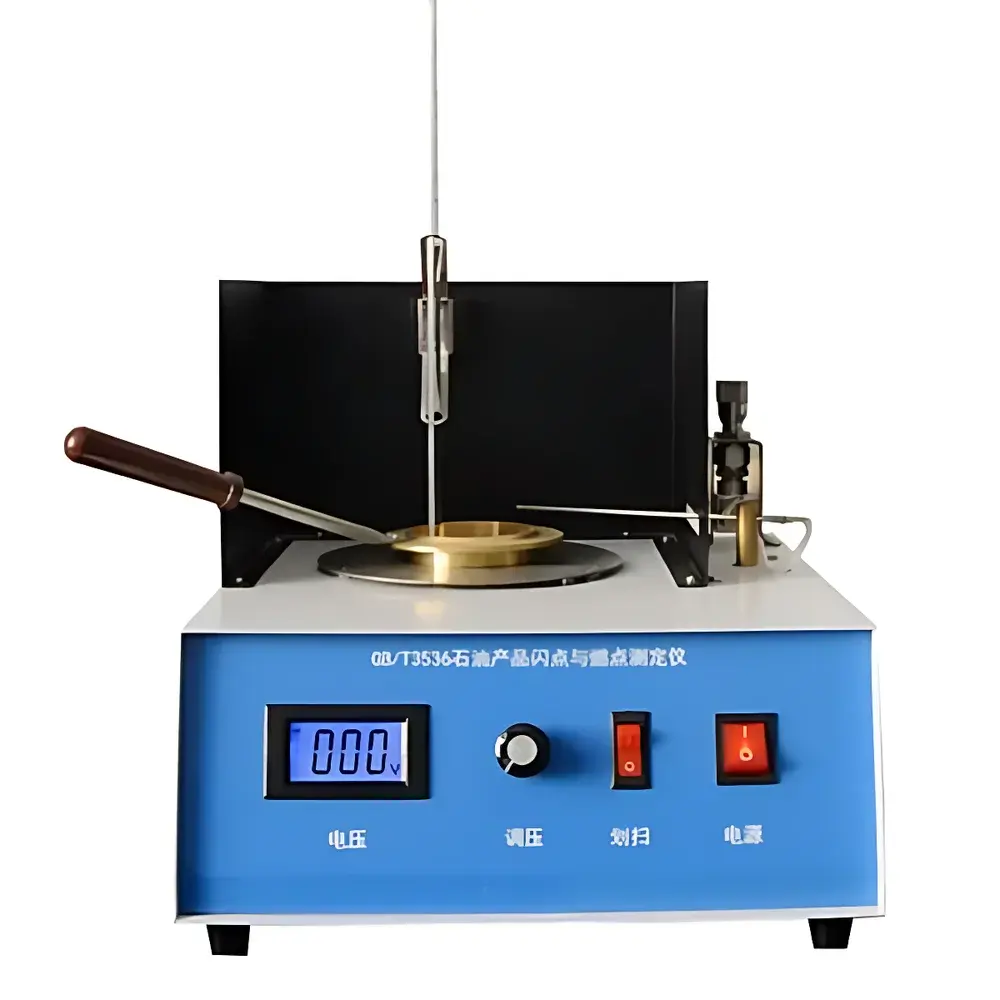
Xuxin Instrument ST-1501 Cleveland Open Cup Flash Point Tester
| Brand | Xuxin Instrument |
|---|---|
| Origin | Beijing, China |
| Manufacturer Type | Manufacturer |
| Product Origin | Domestic (China) |
| Model | ST-1501 |
| Detection Method | Cleveland Open Cup (COC) |
| Operation Mode | Manual |
| Temperature Range | Ambient to 400 °C |
| Ignition Source | Adjustable Gas Flame |
| Repeatability | ≤4 °C |
| Compliant Standard | GB/T 3536-2008 |
| Accuracy | ±2 °C |
| Resolution | 1 °C |
| Heating Power | ≤600 W |
| Dimensions | 300 × 245 × 250 mm |
| Ambient Operating Conditions | 5–45 °C, 10–80% RH |
| Power Supply | 220 V ±10%, 50 Hz |
Overview
The Xuxin Instrument ST-1501 Cleveland Open Cup Flash Point Tester is a precision-engineered laboratory instrument designed for the determination of flash point and fire point of petroleum products and related hydrocarbon-based fluids in accordance with the internationally recognized Cleveland Open Cup (COC) method. It operates on the principle of controlled thermal ramping of a standardized oil sample in an open test cup, followed by systematic application of a calibrated gas flame at defined intervals. The lowest temperature at which the vapor-air mixture above the sample surface ignites momentarily upon exposure to the flame is recorded as the flash point — a critical safety and quality parameter in refining, transportation, storage, and regulatory compliance workflows. This instrument implements the full procedural requirements of GB/T 3536–2008, which aligns closely with ASTM D92 and ISO 2592 in methodology and apparatus specifications, ensuring cross-standard comparability for global laboratories engaged in petrochemical QA/QC.
Key Features
- Full compliance with GB/T 3536–2008, including dimensional and material specifications for the Cleveland open test cup (stainless steel construction, defined depth and diameter)
- Manually adjustable heating rate via continuously variable power control (0–600 W), enabling precise adherence to standard-specified升温 profiles (e.g., 5–6 °C/min during final approach)
- Integrated gas flame ignition system with manual flame positioning and height adjustment; flame size and stability are optimized for reproducible ignition detection
- Digital temperature display with 1 °C resolution and ±2 °C accuracy across the full 0–400 °C operating range, validated against traceable NIST-traceable reference thermometers
- Compact benchtop architecture (300 × 245 × 250 mm) featuring corrosion-resistant stainless steel work surface and thermally insulated heating mantle
- Designed for stable operation under ambient conditions of 5–45 °C and 10–80% relative humidity, suitable for routine use in QC labs, refinery onsite testing facilities, and academic teaching laboratories
Sample Compatibility & Compliance
The ST-1501 is validated for use with a broad spectrum of petroleum-derived samples including lubricating oils, residual fuels, bitumens, biodiesel blends, and industrial solvents — provided they exhibit sufficient volatility to generate measurable vapor pressure within the specified temperature range. It is not intended for low-flash liquids (e.g., gasoline, acetone) or highly viscous materials requiring pre-heating beyond instrument capability. All mechanical and thermal components conform to GB/T 3536–2008 dimensional tolerances and material requirements. While GB/T 3536 is the primary referenced standard, results generated using this instrument demonstrate strong correlation with ASTM D92 and ISO 2592 when operated under equivalent procedural controls, supporting multi-jurisdictional reporting needs. The device supports GLP-aligned documentation practices through operator-recorded parameters (initial temperature, heating rate, observed flash point, atmospheric pressure correction if applied).
Software & Data Management
The ST-1501 is a manually operated analog-digital hybrid instrument and does not incorporate embedded microprocessor control or digital data logging. Temperature readings are displayed on a high-contrast LED panel; all test parameters — including start time, flame application intervals, observed flash event, and final reported value — are documented manually by the analyst in accordance with internal SOPs or regulatory recordkeeping requirements (e.g., ISO/IEC 17025, CNAS-CL01). For laboratories requiring electronic audit trails, integration with external data acquisition systems (e.g., USB-connected thermocouple loggers or LIMS interfaces) is feasible via analog output options (available upon request). The absence of firmware eliminates validation complexity associated with FDA 21 CFR Part 11 compliance, making it particularly suitable for environments where paper-based records remain the primary evidentiary format.
Applications
- Quality assurance testing of base oils and finished lubricants prior to shipment
- Refinery process monitoring of distillation fractions and cut-point verification
- Regulatory submission support for customs clearance and hazardous goods classification (UN TDG, GHS Category 3/4 flammability assessment)
- Educational demonstrations of flammability principles and standardized test methodology in chemical engineering and petroleum technology curricula
- Field-deployable verification of fuel specification compliance in power generation and marine fuel supply chains
- Research into thermal stability and oxidative degradation onset temperatures of alternative fuels and bio-oil formulations
FAQ
What standards does the ST-1501 comply with?
It fully conforms to GB/T 3536–2008 and is functionally compatible with ASTM D92 and ISO 2592 test protocols.
Is the instrument suitable for automated unattended operation?
No — the ST-1501 requires continuous manual observation and flame application per standard procedure; it is not equipped with auto-ignition detection or endpoint recognition.
Can it be used for flash point testing of diesel fuel?
Yes, provided the sample meets the viscosity and volatility criteria outlined in GB/T 3536; typical diesel fuels fall within its operational scope.
Does the unit include calibration certification?
Factory calibration is performed using reference thermometers traceable to national metrology institutes; a calibration report is available upon request at time of purchase.
What maintenance is required for long-term reliability?
Routine cleaning of the test cup and flame nozzle, periodic verification of thermocouple response, and inspection of gas line integrity are recommended per quarterly preventive maintenance schedules.




