
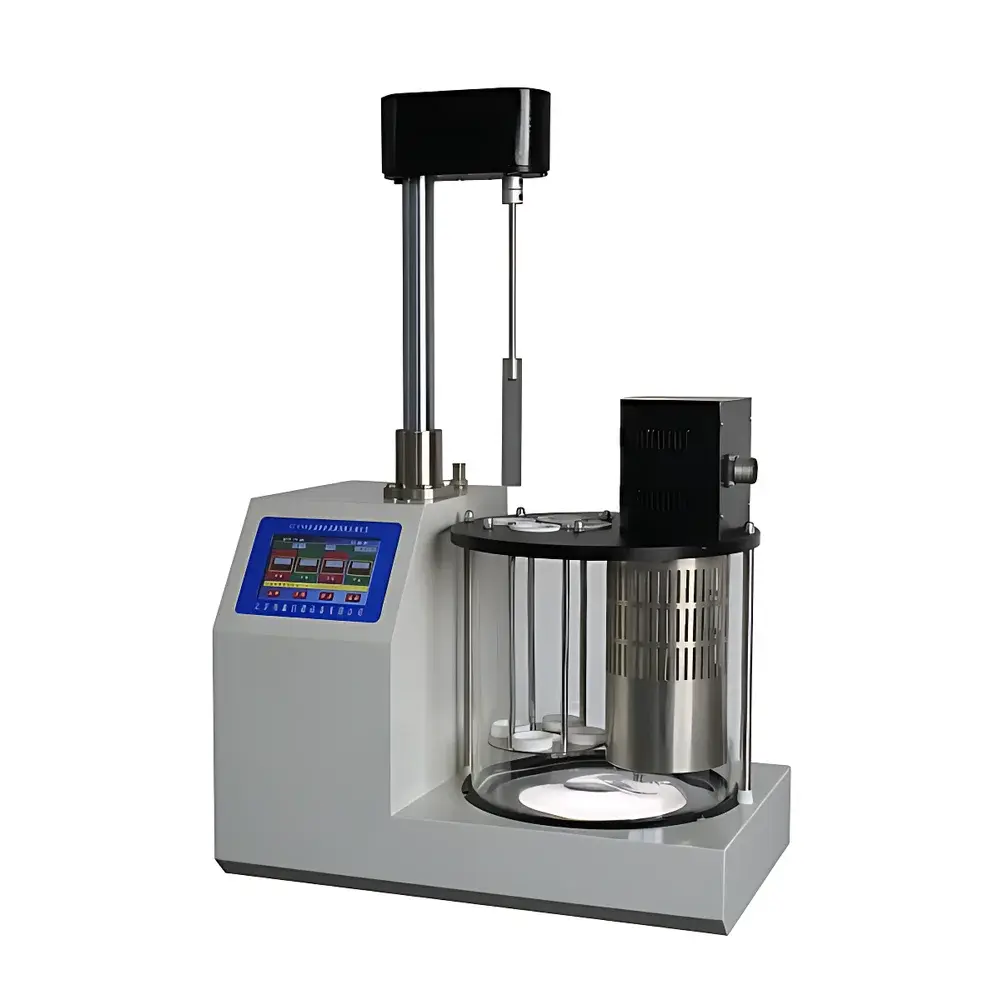
Xuxin Instrument ST-1542 Petroleum Demulsibility Tester
| Brand | Xuxin Instrument |
|---|---|
| Origin | Beijing, China |
| Manufacturer Type | Direct Manufacturer |
| Country of Origin | China |
| Model | ST-1542 |
| Pricing | Upon Request |
| Standards Compliance | GB/T 7605, GB/T 7305, ASTM D1401 |
| Temperature Control Range | Ambient to 100 °C |
| Temperature Accuracy | ±0.1 °C |
| Temperature Resolution | 0.01 °C |
| Sample Capacity | 4 independent test cells |
| Stirring Speed | 1500 ±15 rpm |
| Temperature Sensor | Imported Class A PT100 platinum resistance thermometer |
| Power Consumption | ≤800 W |
| Input Voltage | AC 220 V ±10%, 50 Hz ±5% |
| Operating Environment | 5–40 °C, 10–80% RH |
| Dimensions (W×D×H) | 535 × 385 × 585 mm |
| Display | 5-inch high-definition color touchscreen |
| Control System | Microcomputer-based PID auto-tuning temperature control |
| Automation Features | Motorized stirrer lift/lower, automatic stirring initiation/termination, auto-switch to timed separation phase, bilingual UI (Chinese/English) |
Overview
The Xuxin Instrument ST-1542 Petroleum Demulsibility Tester is a precision-engineered laboratory instrument designed to quantitatively assess the demulsification behavior of petroleum products and synthetic lubricants when mixed with water. It operates in strict accordance with internationally recognized standard test methods—including ASTM D1401 (Standard Test Method for Determining the Separability of Oil and Water by Heating), GB/T 7305 (Petroleum Products and Synthetic Fluids — Determination of Demulsibility), and GB/T 7605 (Turbine Oils — Determination of Demulsibility). The instrument employs a controlled thermal environment combined with standardized mechanical agitation to simulate real-world conditions under which oil-water emulsions form and break—critical for evaluating the performance of turbine oils, hydraulic fluids, transformer oils, and other industrial lubricants where water ingress poses risks to equipment integrity and operational reliability.
Key Features
- Four independent, thermally isolated test cells enable parallel evaluation of up to four samples per run—significantly improving throughput for QC laboratories and R&D facilities.
- High-precision microcomputer-controlled PID temperature regulation system ensures stable bath temperature within ±0.1 °C across the full operating range (ambient to 100 °C), with resolution down to 0.01 °C.
- Imported Class A PT100 platinum resistance thermometer provides traceable, NIST-compatible temperature measurement with long-term stability and low drift.
- Automated stirring mechanism delivers consistent 1500 ±15 rpm agitation via a low-noise, maintenance-free geared motor; stirrer height is motorized for precise immersion depth control.
- Integrated sequence logic initiates timed separation immediately upon cessation of stirring—eliminating manual timing errors and ensuring repeatability between operators and shifts.
- 5-inch capacitive color touchscreen interface supports both Chinese and English language modes, with intuitive icon-driven navigation and real-time parameter monitoring.
- Rugged stainless-steel bath construction and sealed electronic housing ensure durability in demanding industrial lab environments, including those subject to periodic cleaning or humidity fluctuations.
Sample Compatibility & Compliance
The ST-1542 accommodates standard ASTM D1401-compliant glass test vessels (40 mL capacity) and accepts a broad range of hydrocarbon-based and synthetic base stocks—including mineral oils, polyalphaolefins (PAOs), phosphate esters, and diesters—as well as formulated products such as turbine oils, compressor oils, and fire-resistant hydraulic fluids. All operational protocols align with ISO/IEC 17025 requirements for test method validation, and the instrument’s automated timing and temperature logging support GLP and GMP documentation workflows. Data outputs are compatible with LIMS integration via RS232 or optional USB export, facilitating audit-ready record retention per FDA 21 CFR Part 11 guidelines when paired with validated software configurations.
Software & Data Management
While the ST-1542 operates as a standalone benchtop unit with embedded firmware, its internal controller logs timestamped temperature profiles, stirring duration, and separation start/stop events for each cell. Exportable CSV files contain chronological data points at user-defined intervals (default: 10-second sampling), enabling post-test analysis in Excel or statistical process control (SPC) platforms. Optional PC-based companion software (Xuxin LabLink v3.x) provides enhanced visualization, comparative trend analysis across batches, and customizable report generation—including compliance statements referencing ASTM D1401 Section 7.2 (timing tolerance), Annex A1 (bath calibration verification), and Clause 9 (reporting format requirements).
Applications
This instrument serves critical functions across multiple sectors: in power generation, it verifies demulsibility performance of turbine oils per IEC 60296 and ASTM D4378 specifications; in petrochemical refining, it supports formulation development for crude demulsifier screening and additive package optimization; in third-party testing labs accredited to ISO/IEC 17025, it fulfills mandatory interlaboratory comparison (ILC) requirements for proficiency testing programs; and in academic research, it enables mechanistic studies on surfactant-assisted phase separation kinetics under controlled thermal gradients.
FAQ
What standards does the ST-1542 explicitly support?
ASTM D1401, GB/T 7305, and GB/T 7605—all verified during factory calibration and documented in the supplied Certificate of Conformance.
Can the instrument be used for non-petroleum fluids such as bio-lubricants or glycol-based coolants?
Yes, provided the fluid exhibits measurable phase separation under the specified test conditions; users must validate method suitability per ASTM D1401 Annex A2 for non-standard materials.
Is external calibration required before first use?
No—each unit ships with a NIST-traceable PT100 sensor and pre-validated temperature uniformity mapping; however, annual verification against certified reference thermometers is recommended per ISO/IEC 17025 Clause 6.4.
Does the system support remote monitoring or network connectivity?
Not natively; however, optional RS232-to-Ethernet gateways enable integration into centralized lab monitoring systems when deployed with appropriate middleware.
How is bath temperature uniformity ensured across all four cells?
Through proprietary baffle design, forced-circulation heating elements, and individual cell-position calibration—verified to maintain ≤0.3 °C spatial deviation at 82 °C per ASTM D1401 Section 6.3.




