
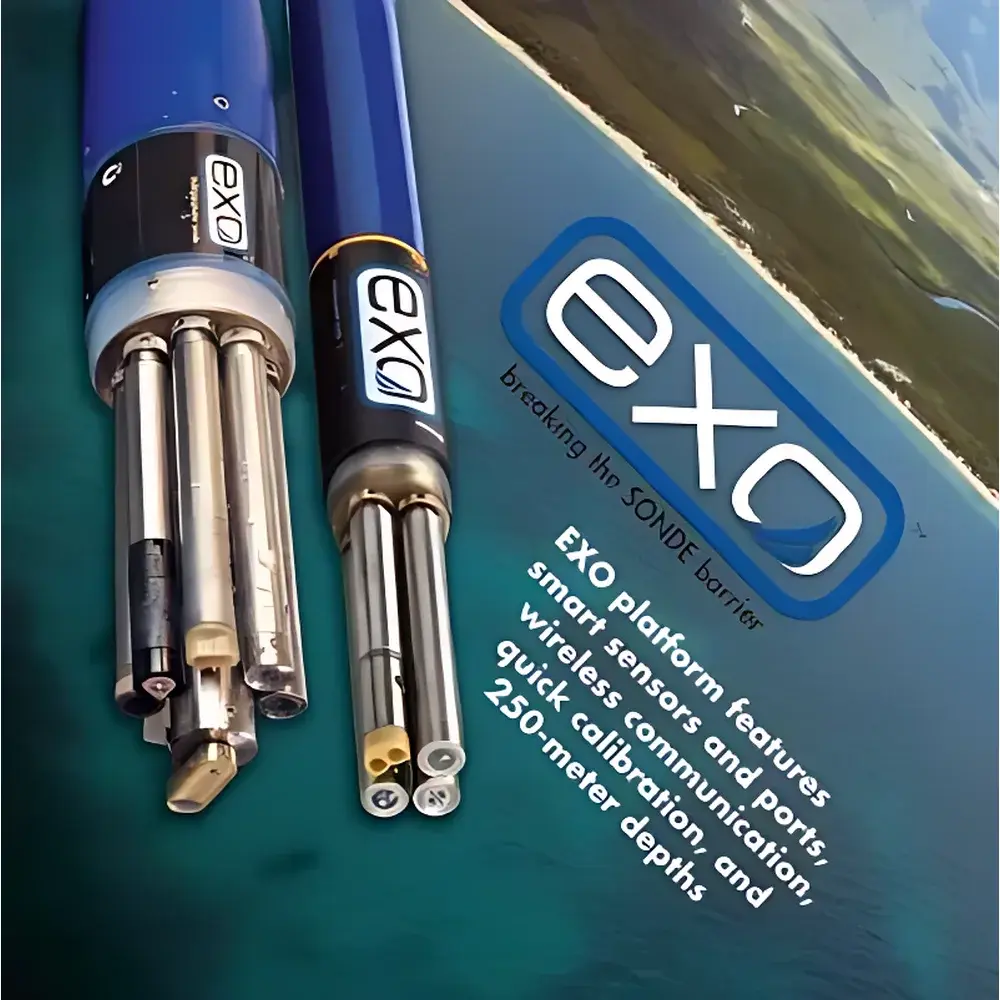
Xylem EXO Multi-Parameter Water Quality Monitoring Platform
| Brand | Xylem |
|---|---|
| Origin | USA |
| Model | EXO |
| Instrument Type | Online Multi-Parameter Water Quality Analyzer |
| Detection Capability | Simultaneous Measurement of pH, ORP, Conductivity, TDS, Salinity, Specific Conductance, Dissolved Oxygen (Optical & Electrochemical), Turbidity, Chlorophyll-a, Phycocyanin, CDOM/FDOM, Depth, Temperature, Total Alkalinity (via titration module interface) |
| Operating Temperature | –5 to +50 °C |
| Storage Temperature | –20 to +80 °C |
| Communication Interfaces | Bluetooth 4.0, USB 2.0, RS-232, RS-485, SDI-12 |
| Power Supply | External 9–16.5 V DC or Internal 4× D-cell Alkaline Batteries |
| Dimensions (D × L) | 7.62 cm × 71.10 cm |
| Weight | 3.60 kg (with batteries and standard sensor suite) |
| Data Storage | 512 MB onboard flash memory (supports >1,000,000 data records) |
| Certifications | CE, UL 61010-1, RoHS, WEEE |
| Housing Material | Titanium sensor bodies, sapphire optical windows, wet-mateable connectors |
| Sensor Interface | Proprietary Smart Sensor Interface with embedded microprocessors on all sensors, host, and communication modules |
Overview
The Xylem EXO Multi-Parameter Water Quality Monitoring Platform is an intelligent, field-deployable environmental sensing system engineered for high-reliability, long-term in-situ monitoring across diverse aquatic environments—including rivers, lakes, estuaries, coastal marine zones, groundwater wells, and wastewater treatment infrastructure. Built upon a modular architecture rooted in Couette-flow hydrodynamics (for turbidity and particle scattering analysis), optical fluorescence spectroscopy (for chlorophyll-a, phycocyanin, and CDOM), and galvanic/electrochemical principles (for dissolved oxygen and redox potential), the EXO platform delivers traceable, NIST-traceable measurements under dynamic field conditions. Its core design philosophy centers on operational resilience, calibration integrity, and future-proof adaptability—enabling deployment in both discrete profiling missions and unattended, multi-year continuous monitoring networks.
Key Features
- Smart Sensor Architecture: Each sensor, data logger, and communication module contains an onboard microprocessor enabling automatic handshake, firmware validation, and self-identification during connection—eliminating manual configuration errors.
- Multi-Sensor Calibration Efficiency: Up to seven identical sensors (e.g., dissolved oxygen or pH probes) can be calibrated simultaneously in a single reagent vial, reducing calibration time, reagent consumption, and field exposure risk.
- Tool-Free Field Maintenance: Sensors are pre-calibrated in-lab by technicians and field-swappable by non-specialized personnel—no tools, no software dongles, no firmware re-flashing required.
- Ruggedized Construction: Titanium sensor housings resist biofouling and corrosion in saline, brackish, and polluted matrices; sapphire optical windows maintain transmission stability over extended deployments; IP68-rated wet-mateable connectors ensure reliable underwater mating without desiccant or O-ring maintenance.
- Flexible Deployment Modes: Supports discrete vertical profiling (via integrated depth sensor and winch-compatible mounting), fixed-point mooring, buoy-based telemetry integration, and portable handheld operation.
- Integrated Wireless & Wired Connectivity: Bluetooth 4.0 enables rapid local setup and real-time QA/QC verification; RS-232/RS-485 and SDI-12 interfaces support integration into SCADA, telemetry gateways, and legacy environmental control systems.
Sample Compatibility & Compliance
The EXO platform is validated for use in freshwater, seawater, hypersaline lagoons, treated effluent, and anaerobic groundwater—with sensor-specific pressure ratings up to 300 m (EXO2 variant). All electrochemical and optical sensors comply with ASTM D888 (dissolved oxygen), ISO 5815-1 (BOD-related DO), EPA Method 180.1 (turbidity), and ISO 7027 (nephelometric turbidity). The system’s firmware and data logging architecture conform to GLP and GMP data integrity requirements, supporting audit trails, electronic signatures (via KOR software), and secure user-role management aligned with FDA 21 CFR Part 11 principles where deployed in regulated water utility or pharmaceutical process water applications.
Software & Data Management
KOR Software (v5.x and later) serves as the primary configuration, calibration, visualization, and export environment for EXO data. It supports automated calibration curve generation using certified reference standards, batch processing of profile datasets, time-series interpolation, and export to CSV, Excel, and NetCDF formats. KOR implements encrypted local storage, configurable alarm thresholds with email/SMS notification via gateway integration, and metadata tagging per sampling event (location, operator ID, sensor serial, calibration date). Raw binary logs include timestamped sensor diagnostics (e.g., signal-to-noise ratio, lamp intensity decay, membrane health index), enabling predictive maintenance scheduling without physical retrieval.
Applications
- Regulatory compliance monitoring for NPDES permits and EU WFD reporting
- Real-time eutrophication assessment via synchronized chlorophyll-a, phycocyanin, and nutrient proxy metrics
- Marine carbonate system characterization through co-located pH, temperature, conductivity, and dissolved oxygen
- Wastewater treatment plant influent/effluent quality assurance and process optimization
- Groundwater plume tracking using redox-sensitive parameters (ORP, DO, H₂S) alongside ionic tracers
- Climate-driven hypoxia studies requiring high-temporal-resolution dissolved oxygen profiling
- Acid mine drainage monitoring with simultaneous heavy metal proxy detection (via conductivity anomaly and pH hysteresis analysis)
FAQ
Can EXO sensors be recalibrated in the field without returning to the lab?
Yes—field recalibration is supported for pH, ORP, conductivity, and dissolved oxygen using portable standard solutions and KOR’s guided calibration workflow. Optical sensors (chlorophyll-a, turbidity) require factory or certified lab recalibration at recommended intervals (typically annually).
Is the EXO platform compatible with third-party telemetry systems (e.g., Campbell Scientific CR1000, Sierra Wireless AirLink)?
Yes—via RS-232/RS-485 or SDI-12 output modes, EXO can transmit ASCII-formatted sensor data packets at user-defined intervals, fully interoperable with industry-standard dataloggers and cellular/Iridium gateways.
Does EXO meet regulatory requirements for drinking water source monitoring under USEPA or WHO guidelines?
While EXO itself is not a certified drinking water analyzer per 40 CFR Part 141, its measurement methodologies align with EPA-approved methods (e.g., Method 180.1 for turbidity, Method 360.1 for conductivity), and it is widely deployed by utilities for early-warning source water surveillance and watershed risk assessment.
How does the EXO handle biofouling in long-term deployments?
Titanium sensor bodies minimize electrochemical fouling; optional mechanical wipers (for turbidity and optical sensors) and copper-alloy anti-fouling sleeves are available. KOR software includes fouling-detection algorithms that flag signal drift trends exceeding ISO 17025-defined uncertainty thresholds.
What is the expected service life of the internal alkaline battery pack under continuous logging mode?
At 15-minute logging intervals and ambient 20 °C, four D-cell alkaline batteries provide ≥90 days of operation. For multi-year deployments, external solar-charged lithium battery packs or AC-powered configurations are recommended.
Related Products







