Xylem RiverSurveyor S5/M9 Acoustic Doppler Current Profiler (ADCP)
| Brand | Xylem |
|---|---|
| Origin | USA |
| Model | RiverSurveyor S5/M9 |
| Velocity Measurement Range | ±20 m/s |
| Velocity Resolution | 0.001 m/s |
| Velocity Accuracy | ±0.25% of measured velocity or ±0.002 m/s (whichever is greater) |
| Depth Measurement Range (S5) | 0.2–15 m |
| Depth Measurement Range (M9) | 0.2–80 m |
| Depth Resolution | 0.001 m |
| Depth Accuracy | ±1% of measured depth |
| Cell Size Range | 0.02–4 m |
| Number of Cells | up to 128 |
| Transducer Configuration | S5 — five transducers (four 3.0 MHz at 25° tilt, one 1.0 MHz vertical) |
| Temperature Sensor Accuracy | ±0.1 °C |
| Compass/Tilt Accuracy | Heading ±2°, Roll/Pitch ±1° |
| Memory | 8 GB non-volatile |
| Operating Voltage | 12–18 V DC |
| Battery Life | 8 h (4 h with RTK GPS enabled) |
| Max Output Rate | 2 Hz |
| Internal Sampling Rate | up to 70 Hz |
| Communication | RS232, Bluetooth (60 m to smartphone / 200 m to laptop), spread-spectrum radio (2000 m) |
| GPS Accuracy | sub-meter (GGA/VTG), RTK GPS accuracy: 0.03 m |
| Operating Temperature | –5 °C to +45 °C |
| Storage Temperature | –10 °C to +70 °C |
| S5 Dimensions | Ø6.1 cm (top diameter), Ø12.7 cm (bottom diameter), 25.4 cm height |
| S5 Weight | 1.1 kg (air), –0.3 kg (buoyant in water) |
| M9 Dimensions | Ø12.8 cm, 25.2 cm height |
| M9 Weight | 2.3 kg (air), –0.6 kg (buoyant in water) |
Overview
The Xylem RiverSurveyor S5/M9 Acoustic Doppler Current Profiler (ADCP) is a field-deployable, vessel-mounted instrument engineered for high-accuracy, real-time river discharge measurement under variable hydraulic conditions. It operates on the principle of pulsed coherent acoustic Doppler velocimetry, transmitting multiple frequency beams—3.0 MHz, 1.0 MHz, and 0.5 MHz—to resolve water column velocity profiles across a wide range of depths and flow regimes. Unlike fixed-frequency ADCPs, the S5/M9 employs adaptive multi-frequency transducer architecture: it automatically selects optimal beam frequency, cell size, ping rate, and pulse-coherent processing mode based on real-time signal-to-noise ratio and bottom detection. This enables seamless transition from shallow (80 m) operation without manual reconfiguration—making it uniquely suited for regulatory-grade hydrological surveys, flood forecasting, sediment transport studies, and long-term gauging station support.
Key Features
- Multi-frequency transducer array: S5 integrates five transducers (four slanted 3.0 MHz + one vertical 1.0 MHz); M9 expands to nine (four 3.0 MHz + four 1.0 MHz + one 0.5 MHz vertical), enabling dynamic optimization of resolution vs. penetration depth.
- Vertical beam echosounder: The dedicated low-frequency vertical beam provides direct, high-resolution bathymetric profiling independent of horizontal motion—critical for accurate cross-sectional area computation in braided or vegetated channels.
- Onboard flow computation engine: All discharge calculations—including velocity-area integration, edge extrapolation, and uncertainty propagation per ISO 748 and ASTM D5388—are performed internally using calibrated coefficients and validated algorithms; no external software dependency is required for field validation.
- Pulse-coherent sampling mode: Automatically engaged in shallow water (<1.5 m), this mode enhances velocity resolution to 0.001 m/s while maintaining ±0.25% accuracy—meeting USGS Water Resources Mission Area (WRMA) Field Office Technical Directive (FOTD) requirements for low-flow calibration.
- Integrated RTK-GNSS positioning: Sub-3-cm horizontal positional accuracy (0.03 m RMS) eliminates reliance on bottom tracking in highly mobile or sediment-laden rivers where bed coherence degrades. Supports NTRIP correction streams and dual-frequency L1/L2 reception for robust signal integrity in forested or urban canyon environments.
- RiverSurveyor Live software platform: A cross-platform application (Windows, macOS, iOS, Android) supporting real-time telemetry, post-processed quality control, QA/QC flagging per ISO 5725, and export to standardized formats including CSV, XML, and USGS NWIS-compatible files.
Sample Compatibility & Compliance
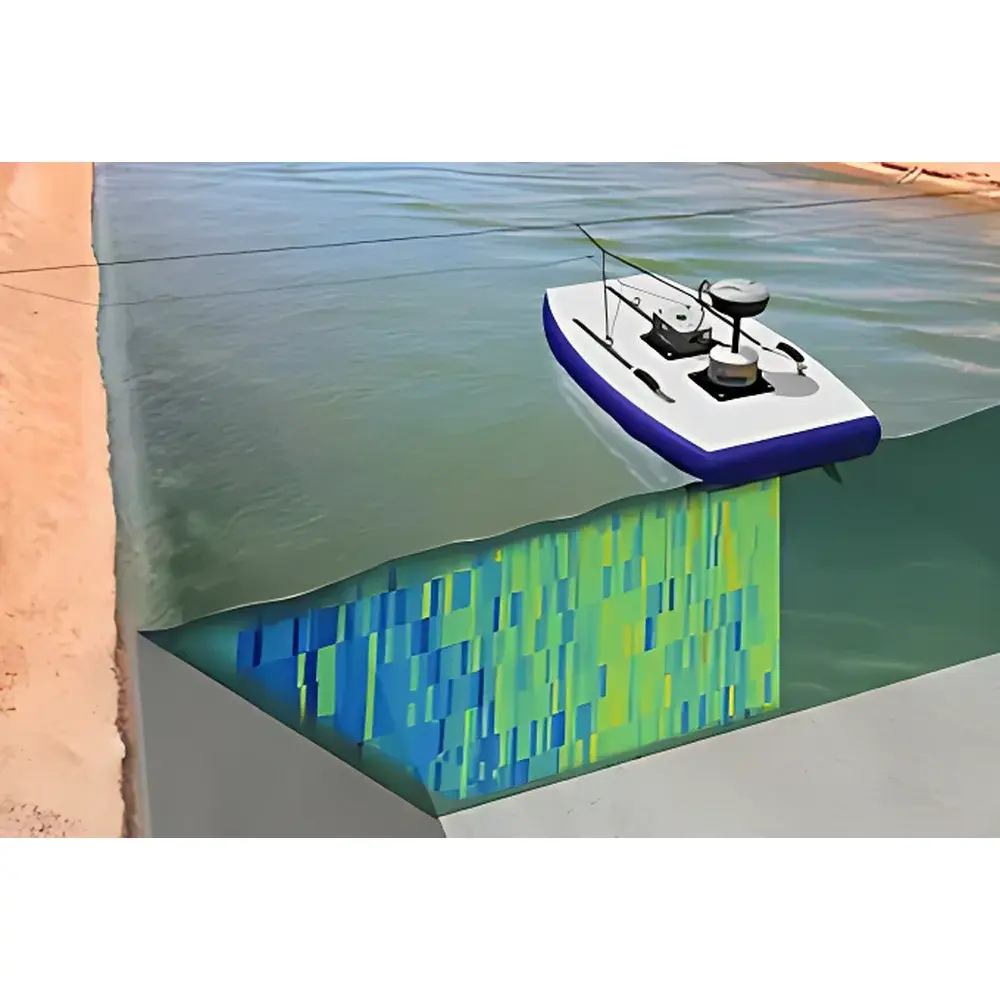
The RiverSurveyor S5/M9 is designed for deployment on manned vessels, autonomous surface vehicles (ASVs), or fixed-mount platforms in natural rivers, canals, estuaries, and regulated reservoir outflows. Its buoyant design (-0.3 kg to -0.6 kg net underwater weight) ensures stable orientation across turbulent flows and variable draft conditions. The system complies with IEC 60529 IP68 ingress protection rating and meets MIL-STD-810G environmental stress screening for shock, vibration, and thermal cycling. For regulatory reporting, raw and processed data meet traceability requirements under ISO/IEC 17025:2017 for testing laboratories, and metadata logging satisfies FDA 21 CFR Part 11 audit trail provisions when used in federally funded water resource assessments. Calibration certificates are traceable to NIST standards via Xylem’s accredited metrology lab (A2LA #2322.01).
Software & Data Management
RiverSurveyor Live implements a secure, version-controlled data workflow with built-in GLP/GMP-compliant features: automatic timestamping with UTC synchronization, operator ID authentication, digital signature for final reports, and immutable audit logs recording all parameter changes, file exports, and QA flagging events. Raw binary .rsv files are encrypted at rest and support AES-256 encryption during wireless transmission. The software includes automated uncertainty estimation per ISO/TR 20927, incorporating sensor-specific error budgets for velocity, depth, heading, and GNSS position. Export modules generate compliant outputs for integration with HEC-RAS, QGIS, and EPA WQX platforms. All firmware updates are digitally signed and verified prior to installation to ensure integrity and regulatory compliance.
Applications
- Regulatory discharge monitoring per USGS Techniques and Methods Book 3, Chapter A22 and Environment Agency (UK) Flow Gauging Manual.
- Floodplain modeling input generation, including time-series velocity profiles for unsteady flow boundary conditions.
- Sediment flux quantification via coupled turbidity sensor integration (via RS232 or analog inputs).
- Validation of stage-discharge rating curves during extreme events using rapid-response deployment protocols.
- Long-term hydrometric network augmentation where traditional infrastructure is impractical (e.g., remote Arctic watersheds or conflict-affected regions).
- Academic research in open-channel turbulence, secondary flow structures, and near-bed momentum transfer.
FAQ
How does the S5/M9 handle low-SNR conditions in turbid or aerated flows?
It applies adaptive pulse-coherent processing with variable lag selection and spectral noise floor estimation—reducing velocity bias by up to 40% compared to conventional broadband modes under high suspended sediment loads.
Can the instrument operate without GPS or bottom tracking?
Yes—when integrated with inertial navigation systems (INS) or pre-surveyed control points, the system supports dead-reckoning discharge computation with position drift compensation up to 2% per kilometer traveled.
Is firmware update capability available over-the-air?
No—updates require physical USB connection or microSD card loading to maintain air-gap security for critical infrastructure deployments.
What QA/QC tools are embedded in RiverSurveyor Live?
Real-time signal strength mapping, beam-to-beam correlation thresholds, vertical beam SNR diagnostics, and automated outlier rejection using modified Thompson Tau test at α = 0.01.
Does the system support integration with SCADA or telemetry networks?
Yes—via optional Modbus TCP or DNP3 protocol gateways for direct ingestion into utility-level supervisory control systems compliant with IEEE 1815-2012.