
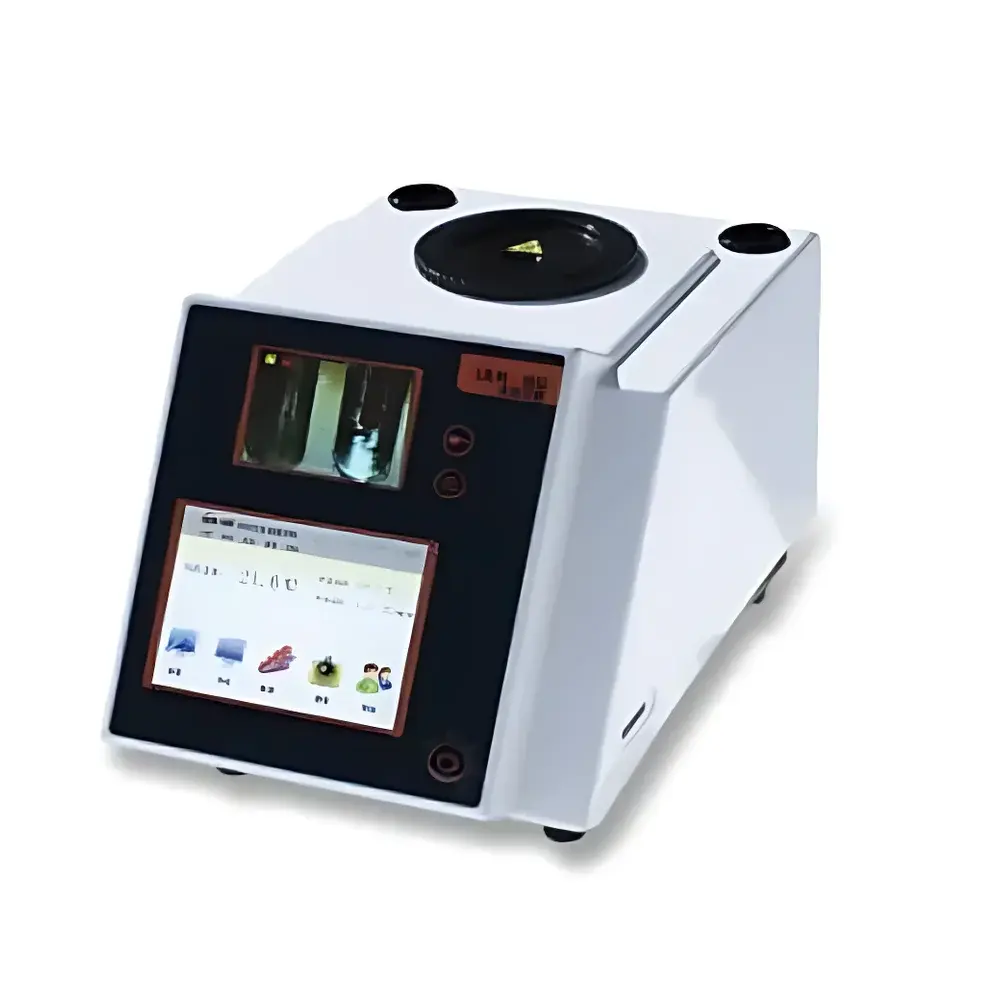
Y50 Fully Automated Video Fat Melting Point Apparatus
| Origin | Shanghai, China |
|---|---|
| Manufacturer Type | Authorized Distributor |
| Origin Category | Domestic (China) |
| Model | Y50 |
| Price Range | USD 7,000–14,000 |
| Temperature Range | 0–100 °C |
| Heating Rate | 0.1–10 °C/min |
| Temperature Repeatability | ±0.1 °C (at 0.1 °C/min) |
| Temperature Accuracy | ±0.3 °C (at ~100 °C) |
| Capillary Dimensions | OD 1.4 mm, ID 1.0 mm, L 100 mm (dual-open) |
| Sample Capacity | 2 samples per run |
| Temperature Resolution | 0.1 °C |
| Cooling Method | Forced-air convection |
| Display | 7-inch TFT high-definition color screen |
| Data Storage | 8 GB internal + microSD card (up to 128 GB) |
| Connectivity | USB 2.0, RS-232, Ethernet |
| User Accounts | 8 configurable roles with password protection |
| Compliance Standards | SNT 0801.5–1999, GB/T 24892–2010, GB/T 12766–2008 |
Overview
The Y50 Fully Automated Video Fat Melting Point Apparatus is a precision thermal analysis instrument engineered for the objective, reproducible determination of melting onset and range in edible fats, oils, waxes, and lipid-based formulations. Unlike classical capillary tube methods relying on visual endpoint detection, the Y50 integrates real-time digital video capture with algorithm-driven phase transition recognition—leveraging optical contrast changes between solid and liquid phases under controlled heating. The system employs a thermostatically regulated glass-jacketed water bath, heated via a platinum resistance thermometer (Pt100) feedback loop, ensuring stable thermal gradients across the sample zone. Its operational temperature envelope spans 0–100 °C, with programmable ramp rates from 0.1 to 10 °C/min and a certified accuracy of ±0.3 °C at upper-range conditions. Designed for compliance-driven laboratories, the Y50 supports audit-ready workflows through time-stamped video logging, electronic user authentication, and traceable parameter configuration.
Key Features
- Fully automated melting point detection using synchronized high-resolution video imaging and adaptive threshold-based image analysis—eliminating observer bias and inter-operator variability.
- Dual-sample capacity with independent capillary positioning; enables parallel testing while maintaining thermal uniformity across both channels.
- Pt100-sensor-controlled water bath with glass-lined immersion chamber—resists scaling and corrosion, ensures long-term calibration stability, and simplifies routine maintenance.
- Programmable heating profiles with ramp rate resolution of 0.1 °C/min; rapid pre-heating to user-defined start temperatures minimizes cycle time.
- Onboard 7-inch TFT display with intuitive touch interface; full system control without external PC dependency.
- Comprehensive data integrity architecture: encrypted user accounts (8 roles), timestamped SD-card video archives (H.264), automatic report generation (PDF/CSV), and configurable auto-delete policies for storage management.
Sample Compatibility & Compliance
The Y50 accommodates standard dual-open capillaries (OD 1.4 mm, ID 1.0 mm, length 100 mm), compatible with ASTM D3104, ISO 6321, and AOAC 920.148 methodologies when adapted via procedural validation. It meets national regulatory requirements specified in SNT 0801.5–1999 (Inspection of Imported/Exported Animal and Vegetable Fats and Oils), GB/T 24892–2010 (Determination of Melting Point of Edible Fats), and GB/T 12766–2008 (Vegetable Oil Specifications). While not intrinsically 21 CFR Part 11-compliant, its audit trail features—including immutable video logs, user session records, and parameter change history—support GLP and GMP-aligned documentation practices when deployed within validated laboratory information management systems (LIMS).
Software & Data Management
The embedded firmware and optional PC software provide seamless integration into quality control environments. All experiments are automatically recorded as time-synchronized video streams with overlaid temperature/time metadata. Playback functionality includes variable-speed review (0.25× to 4×), frame-by-frame navigation, and manual annotation. Reports include raw temperature vs. time curves, detected melt onset/endpoints, operator ID, date/time stamps, and instrument serial number—exportable in PDF (print-ready) and CSV (for statistical process control or trend analysis). Data retention complies with internal SOPs: 8 GB internal memory stores >400 full-cycle sessions; microSD expansion supports archival continuity. Network connectivity (Ethernet/RS-232/USB) enables remote monitoring, centralized backup, and scheduled firmware updates.
Applications
- Quality assurance of palm oil, cocoa butter, coconut oil, lard, and hydrogenated vegetable shortenings in food manufacturing.
- Batch release testing for pharmaceutical excipients such as glycerol monostearate and polyethylene glycols.
- R&D characterization of fat crystallization behavior during product reformulation or shelf-life studies.
- Regulatory submission support for nutritional labeling (e.g., solid fat content profiling via sequential melting point mapping).
- Educational use in food science and analytical chemistry curricula where visual demonstration of polymorphic transitions is pedagogically essential.
FAQ
What capillary specifications are required for optimal performance?
Standard dual-open capillaries with outer diameter 1.4 mm, inner diameter 1.0 mm, and length 100 mm are recommended. Use only borosilicate glass capillaries free of surface defects or residual moisture.
Can the Y50 be used for non-fat materials such as polymers or pharmaceutical APIs?
While calibrated and validated for lipid matrices per GB/T 24892–2010, the instrument may be operationally extended to other low-melting organic solids after method verification—including linearity assessment, repeatability testing, and correlation against reference standards.
Is video recording mandatory, or can it be disabled to conserve storage?
Video capture is enabled by default but can be toggled off per test protocol. Disabling video retains all thermal data, metadata, and automated melt detection—only visual archival is omitted.
How often does the system require recalibration?
Annual calibration against NIST-traceable reference materials (e.g., pure stearic acid, palmitic acid) is recommended. Internal diagnostics verify Pt100 linearity and optical sensor response prior to each run.
Does the Y50 support LIMS integration?
Yes—via RS-232 or Ethernet interfaces using ASCII-based command protocols. Custom API wrappers are available upon request for direct HL7 or ASTM E1384-compliant data ingestion.



