
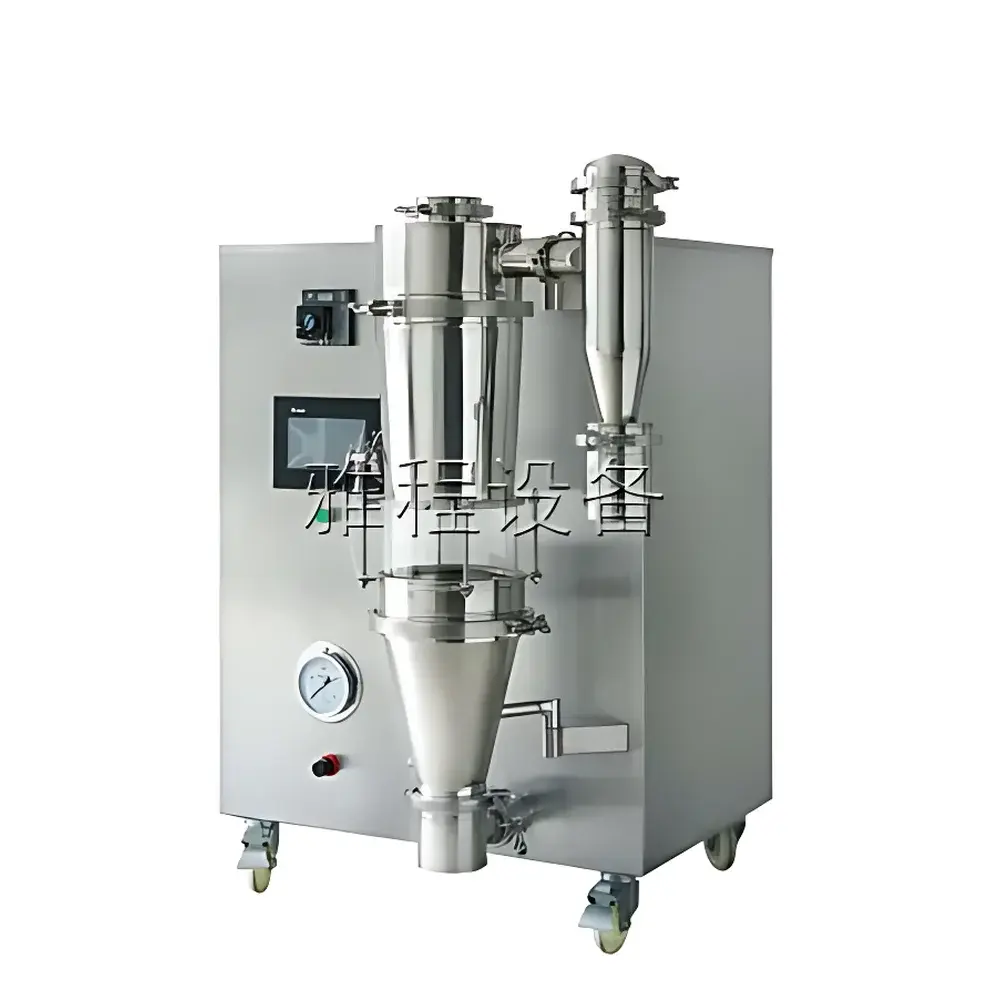
YaCheng PILOTECH YC-1800 Benchtop Low-Temperature Spray Dryer for Juice and Thermosensitive Extracts
| Brand | YaCheng / PILOTECH |
|---|---|
| Origin | Shanghai, China |
| Manufacturer Type | Direct Manufacturer |
| Country of Origin | China |
| Model | YC-1800 |
| Price | Upon Request |
| Max Feed Rate | 1800 mL/h |
| Minimum Sample Volume | 50 mL |
| Drying Inlet Temperature Range | 110–150 °C |
| Temperature Control Accuracy | ±1 °C (PID) |
| Nozzle Orifice Options | 0.5, 0.7, 1.0, 1.5, 2.0 mm |
| Power Supply | 4 kW / 380 V AC |
| Construction | Full 316L Stainless Steel |
| Atomization | Dual-Fluid Pneumatic Nozzle |
| Noise Level | <65 dB(A) |
| Particle Flowability | High (Narrow Normal Size Distribution) |
Overview
The YaCheng PILOTECH YC-1800 Benchtop Low-Temperature Spray Dryer is an engineered solution for the gentle, reproducible conversion of heat-labile liquid feeds—particularly high-sugar fruit juices, herbal extracts, natural product concentrates, and biopolymer solutions—into free-flowing, amorphous or microcrystalline powders. Unlike conventional laboratory spray dryers relying on inlet air temperatures ≥160 °C, the YC-1800 operates with precise inlet temperature control down to 110 °C, enabling rapid solvent evaporation while minimizing thermal degradation, Maillard reactions, caramelization, and wall deposition caused by molten saccharide adhesion. Its core principle leverages dual-fluid (air-assisted) pneumatic atomization coupled with optimized residence time and thermal mass management in a compact, self-contained drying chamber. This architecture ensures uniform droplet formation, controlled desolvation kinetics, and minimal particle agglomeration—critical for preserving bioactive integrity in botanicals, enzymes, probiotics, and labile phytochemicals.
Key Features
- Low-temperature operation (110–150 °C inlet air) specifically validated for sugar-rich matrices including citrus, apple, pomegranate, and berry juice concentrates
- Full 316L stainless steel construction compliant with ISO 8573-1 Class 3 compressed air purity requirements for pharmaceutical-grade processing
- Dual-fluid nozzle system with five interchangeable orifice sizes (0.5–2.0 mm) to tune droplet Sauter mean diameter (SMD) and match viscosity/solids content (5–60% w/w)
- Integrated auto-clearing needle mechanism with adaptive frequency adjustment to prevent nozzle clogging during extended runs with viscous or particulate-laden feeds
- PID-controlled heating system with ±1 °C stability across full operating range, certified per ASTM E2251-22 for thermal calibration traceability
- 7-inch color LCD touchscreen interface with bilingual (English/Chinese) GUI; supports both fully automated protocols and real-time manual override of feed rate, temperature, and airflow
- Noise emission <65 dB(A) at 1 m distance—meets ISO 7779 and EU Directive 2000/14/EC for laboratory acoustic safety
Sample Compatibility & Compliance
The YC-1800 accommodates aqueous, ethanolic, and glycerol-aqueous extracts with total dissolved solids (TDS) from 5% to 60%, including polysaccharide-rich botanical decoctions (e.g., Glycyrrhiza uralensis, Rehmannia glutinosa), anthocyanin-rich fruit pulps, and enzyme-containing fermentation broths. It supports GLP-compliant documentation via timestamped parameter logging and user-accessible audit trails. While not a GMP-certified production unit, its design aligns with key elements of USP <797>, FDA 21 CFR Part 11 (when paired with validated data export workflows), and ISO 22000 prerequisite programs for R&D-scale powder development. All wetted surfaces meet ASME BPE-2022 surface finish standards (Ra ≤ 0.6 µm).
Software & Data Management
The embedded control firmware records all critical process parameters—including inlet/outlet temperature, feed rate, atomizing air pressure, chamber differential pressure, and runtime—at 1-second intervals. Data exports in CSV format via USB port for integration into LIMS or statistical analysis platforms (e.g., JMP, Python Pandas). Optional Ethernet module enables remote monitoring and alarm notification via SNMP traps. System logs retain ≥10,000 cycles with tamper-resistant timestamps, satisfying basic ALCOA+ principles (Attributable, Legible, Contemporaneous, Original, Accurate, Complete, Consistent, Enduring, Available) for preclinical formulation studies.
Applications
- Rapid screening of excipient-free drying conditions for juice-based nutraceuticals without starch or cyclodextrin carriers
- Stabilization of thermolabile polyphenols (e.g., epigallocatechin gallate, resveratrol) and volatile terpenes (e.g., limonene, β-caryophyllene)
- Development of inhalable dry powder formulations from aqueous herbal nebulizer solutions
- Production of reference standards for HPLC and LC-MS quantification of unstable metabolites
- Process mapping for scale-up to pilot-scale (e.g., Niro Mobile Minor or Buchi B-290) using dimensionless numbers (De, Re, We) derived from YC-1800 operational data
FAQ
What is the minimum sample volume required for a valid run?
Typical minimum is 50 mL, though reproducibility improves significantly above 100 mL depending on solids concentration and viscosity.
Can the YC-1800 handle feeds containing suspended insoluble particles?
Yes—up to 50 µm median particle size is compatible when using ≥1.0 mm nozzles and pre-filtering through 100 µm mesh; continuous needle cleaning prevents sediment accumulation.
Is outlet temperature monitored and logged?
Yes—the system measures and records both inlet and outlet air temperatures continuously, enabling calculation of enthalpy change and moisture removal efficiency.
Does the unit comply with electrical safety standards for international labs?
It meets IEC 61010-1:2010 for laboratory equipment, CE-marked per EMC Directive 2014/30/EU and Low Voltage Directive 2014/35/EU, with 380 V three-phase input configuration standard.
How is method transfer supported between YC-1800 and industrial spray dryers?
Dimensionless scaling parameters (e.g., dimensionless residence time τ*, Weber number We) are calculable from logged data; YaCheng provides a technical white paper on geometric and dynamic similarity guidelines for scale-up.
Related Products



