
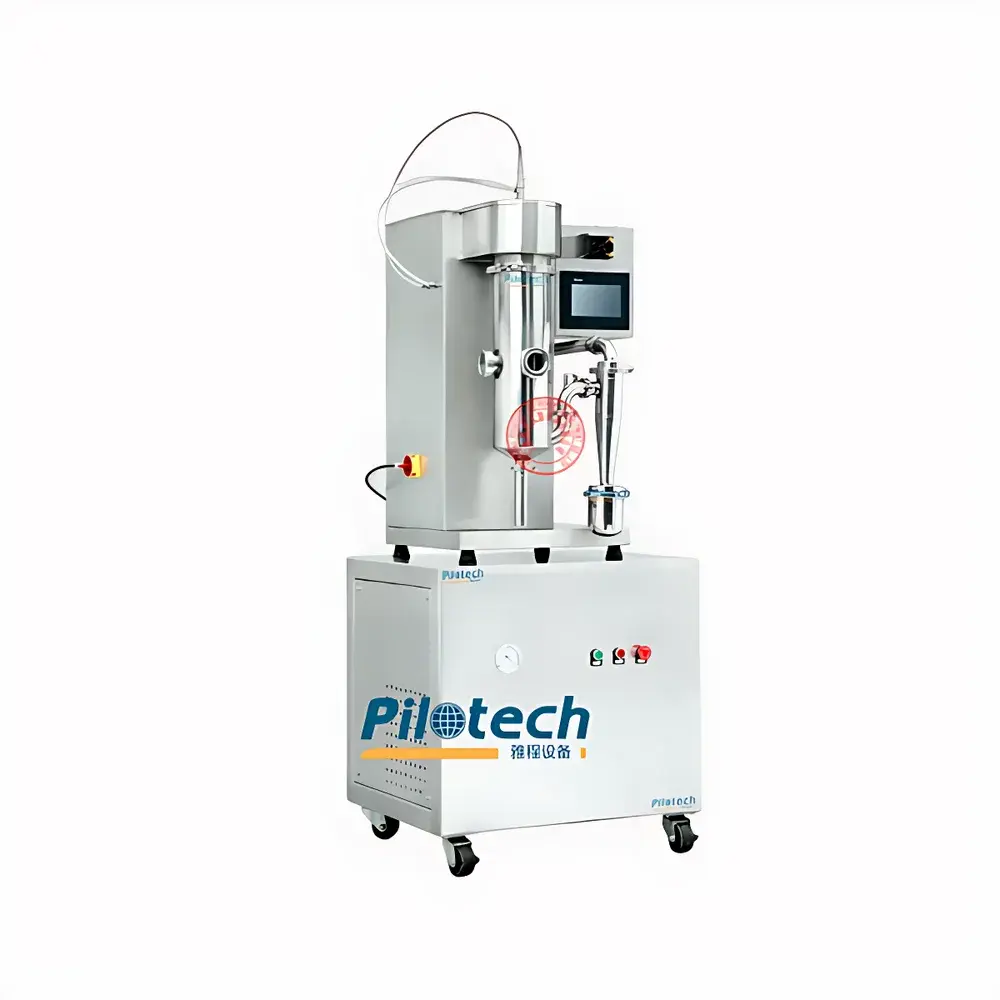
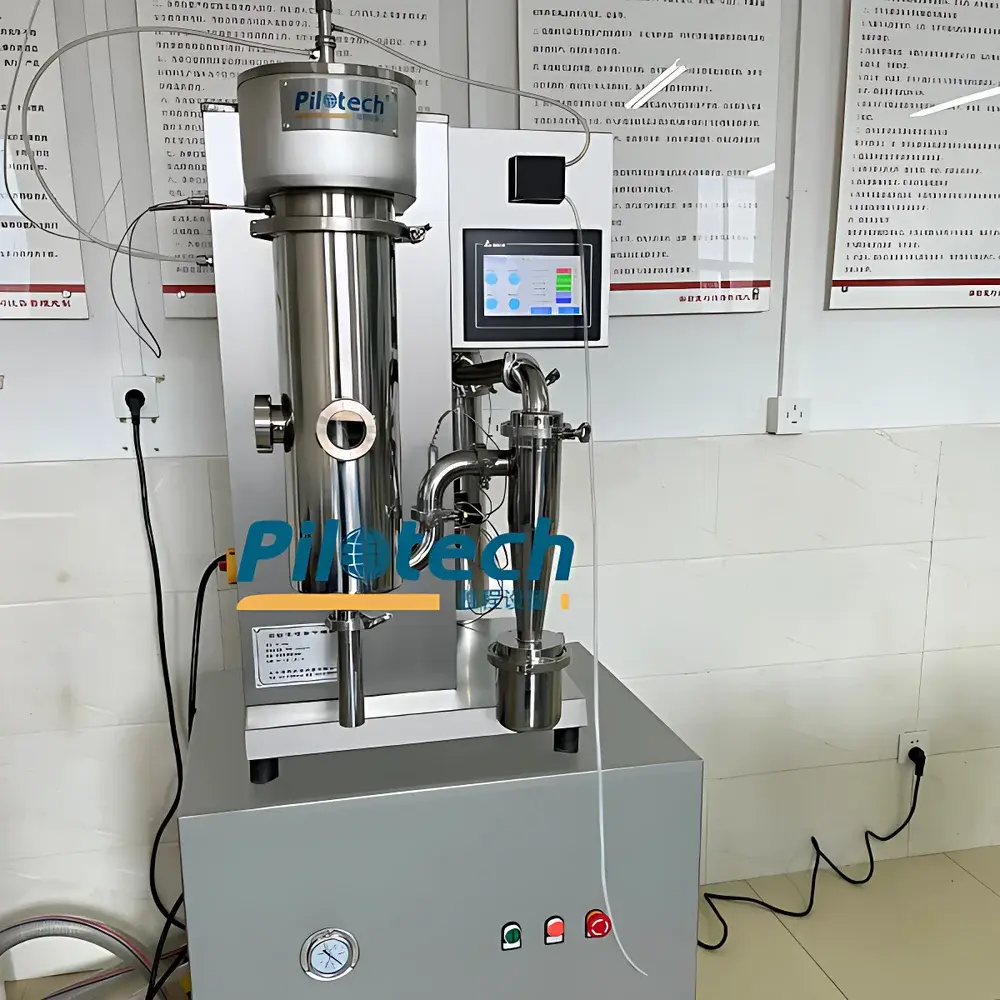
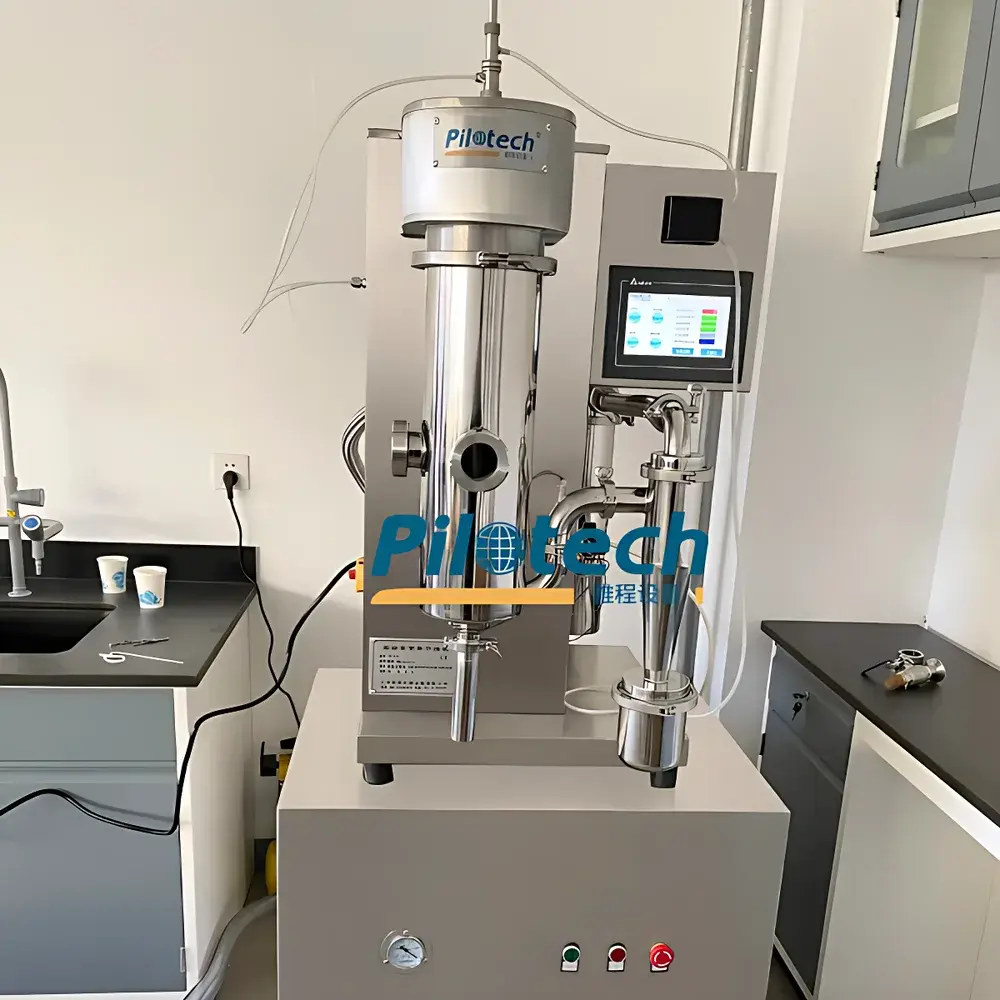
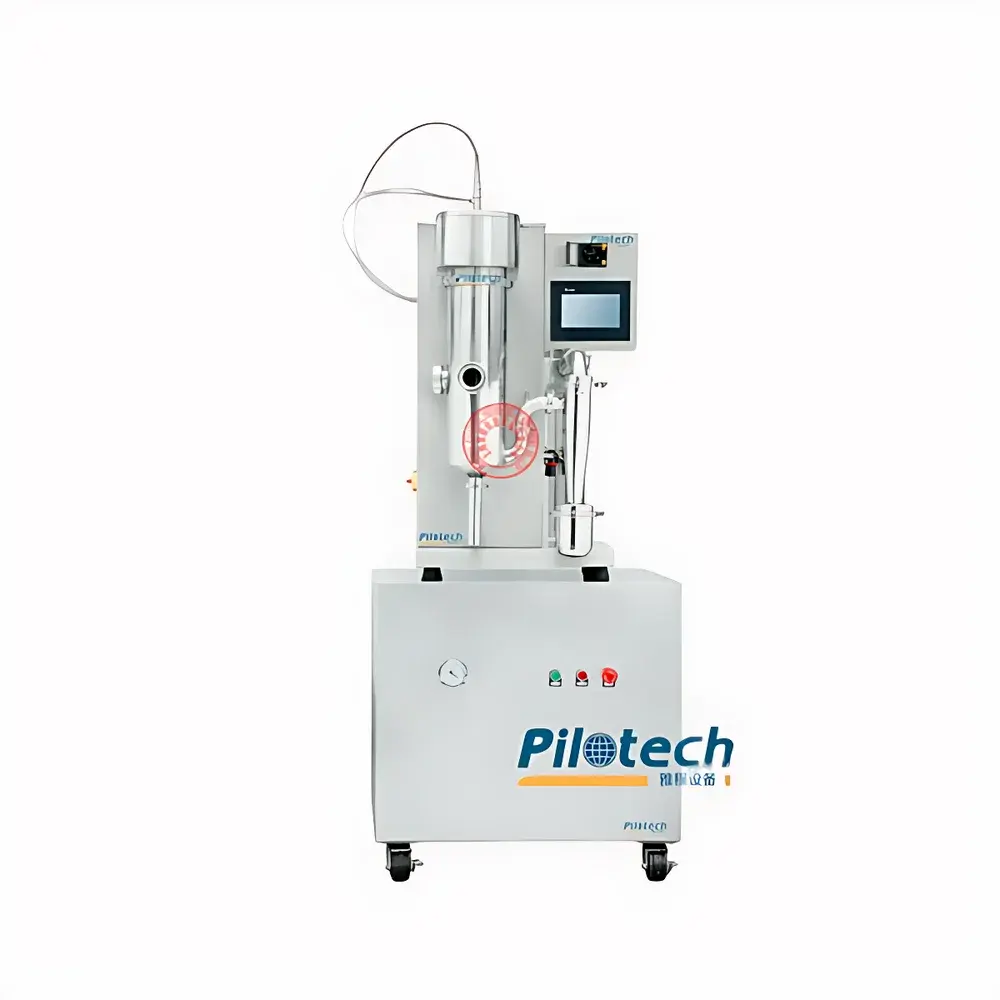
YaCheng YC-510 Benchtop Vacuum Low-Temperature Spray Dryer
| Brand | YaCheng / PILOTECH |
|---|---|
| Origin | Shanghai, China |
| Manufacturer Type | OEM Manufacturer |
| Country of Origin | China |
| Model | YC-510 |
| Sample Type | Aqueous solutions only |
| Max Feed Rate | 500 mL/h |
| Inlet Air Temperature Range | 50–200 °C (vacuum-enabled low-temp mode: ≤55 °C) |
| Particle Size Distribution | 1–25 µm |
| Vacuum Level | −0.08 MPa |
| Temperature Control Accuracy | ±1 °C (PID-regulated) |
| Nozzle Orifice | Standard 1.0 mm (optional: 0.5/0.8/1.5/2.0 mm) |
| Minimum Sample Volume | 10–20 mL (dependent on solids content) |
| Final Moisture Content | <1% w/w |
| Construction | Full 316L stainless steel |
| Power Rating | 3.5 kW |
| Display | Color LCD touchscreen with Chinese UI (factory-default) |
Overview
The YaCheng YC-510 Benchtop Vacuum Low-Temperature Spray Dryer is an engineered solution for the gentle, rapid, and scalable drying of thermolabile materials under controlled reduced-pressure conditions. Unlike conventional spray dryers that rely on high inlet air temperatures (typically ≥120 °C), the YC-510 integrates a modular vacuum system that lowers the boiling point of water and volatile solvents—enabling complete solvent removal at inlet air temperatures as low as 50 °C. This operational principle leverages the physical relationship between vapor pressure and ambient pressure: under −0.08 MPa vacuum, aqueous solutions evaporate rapidly even below 60 °C, minimizing thermal degradation pathways such as protein denaturation, enzymatic deactivation, Maillard reactions, or polymer chain scission. The system operates on a two-fluid nozzle atomization principle, where compressed gas (typically nitrogen or filtered air) shears liquid feed into fine droplets within a sealed drying chamber. Drying kinetics are governed by convective mass transfer under sub-atmospheric conditions, ensuring high reproducibility and narrow particle size distribution (1–25 µm). Designed explicitly for laboratory-scale process development, the YC-510 supports formulation screening, stability studies, and pre-GMP batch generation for biologics, natural product extracts, probiotics, and functional polymers.
Key Features
- Modular architecture: Independent benchtop spray dryer unit and detachable vacuum pumping system—enabling seamless transition between standard (200 °C max) and vacuum-assisted low-temperature (50–55 °C) operation modes.
- PID-controlled inlet air temperature regulation with ±1 °C accuracy across the full 50–200 °C range, verified per ASTM E74 for thermal calibration traceability.
- Two-fluid concentric nozzle assembly fabricated from electropolished 316L stainless steel; adjustable vertical positioning to optimize spray trajectory and wall deposition control.
- Integrated peristaltic feed pump with continuously variable speed control (0.1–50 rpm), supporting precise volumetric delivery from 10 mL to 500 mL/h.
- Full 316L stainless steel construction—including drying chamber, cyclone separator, and collection vessel—compliant with ISO 14644-1 Class 7 cleanroom compatibility requirements.
- Color LCD touchscreen interface with real-time logging of inlet temperature, vacuum level, feed rate, and elapsed drying time; data export via USB to CSV format.
Sample Compatibility & Compliance
The YC-510 is validated for aqueous-based feedstocks only, including enzyme suspensions, bacterial cultures (e.g., Lactobacillus spp.), polysaccharide-rich botanical extracts (e.g., ginseng, astragalus), whey protein isolates, chitosan solutions, and PVP/PVA polymer dispersions. It excludes organic solvents, high-viscosity slurries (>500 cP), or particulate-laden feeds without prior filtration (<5 µm). While not certified to IEC 61000-6-3 or UL 61010-1 out-of-the-box, its electrical design conforms to CE safety directives (2014/35/EU) and EMC standards (2014/30/EU). For regulated environments, users may implement supplementary audit trails using external timestamped loggers to satisfy GLP/GMP documentation requirements (e.g., FDA 21 CFR Part 11 Annex 11 alignment). The system supports material traceability when paired with sample ID tagging in exported CSV logs.
Software & Data Management
The embedded firmware provides local parameter configuration, real-time monitoring, and session-based data capture without cloud dependency. All operational parameters—including setpoints, actual readings, and alarm events—are stored in non-volatile memory with automatic timestamping (YYYY-MM-DD HH:MM:SS). Exported CSV files contain column headers compatible with MATLAB, Python pandas, or JMP for statistical analysis of drying efficiency, residual moisture correlation, or particle morphology trends. No proprietary software installation is required; raw data files open natively in Excel. Optional RS-232 or Ethernet interfaces (available upon request) enable integration into centralized lab information management systems (LIMS) for automated metadata ingestion.
Applications
- Stabilization of live biotherapeutics: Lyophilization-alternative drying of lactic acid bacteria, bifidobacteria, and phage preparations while retaining >90% viability (validated per ISO 11133).
- Natural product formulation: Conversion of hydrophilic herbal extracts (e.g., berberine, curcumin glycosides) into free-flowing microparticles with improved dissolution profiles (USP <701>).
- Functional food ingredient development: Encapsulation of omega-3 oils in whey/casein matrices under oxygen-controlled vacuum to limit peroxide value rise (AOCS Cd 12b-92).
- Pharmaceutical excipient screening: Rapid generation of amorphous solid dispersions for solubility enhancement studies (ICH Q5C).
- Materials science prototyping: Synthesis of uniform metal oxide precursors (e.g., ZnO, TiO₂ nanoparticles) from aqueous nitrate solutions without calcination.
FAQ
Can the YC-510 handle organic solvents such as ethanol or acetone?
No. The system is designed exclusively for aqueous feeds. Organic solvents pose explosion risks under vacuum and may degrade seals or contaminate the vacuum pump. Solvent-compatible variants require ATEX-rated components and are available as custom-engineered models.
What is the typical residual moisture content of dried powders?
Under optimized vacuum-low-temperature conditions (55 °C inlet, −0.08 MPa), final moisture levels consistently fall below 1% w/w, as confirmed by Karl Fischer titration (ASTM D6304).
Is the touchscreen interface available in English?
The factory default UI is Chinese. English-language firmware is available upon request and requires reflash via USB—no hardware modification needed.
How is cleaning validation performed between batches?
The fully drainable 316L chamber and quick-release nozzle allow manual CIP with 0.5% NaOH followed by DI water rinse. Residue testing follows USP <1225> verification protocols using swab recovery assays.
Does the system support GMP-compliant electronic records?
While the built-in logger meets ALCOA+ principles (Attributable, Legible, Contemporaneous, Original, Accurate), full 21 CFR Part 11 compliance requires supplemental access controls and digital signature modules—available as an optional upgrade package.



