
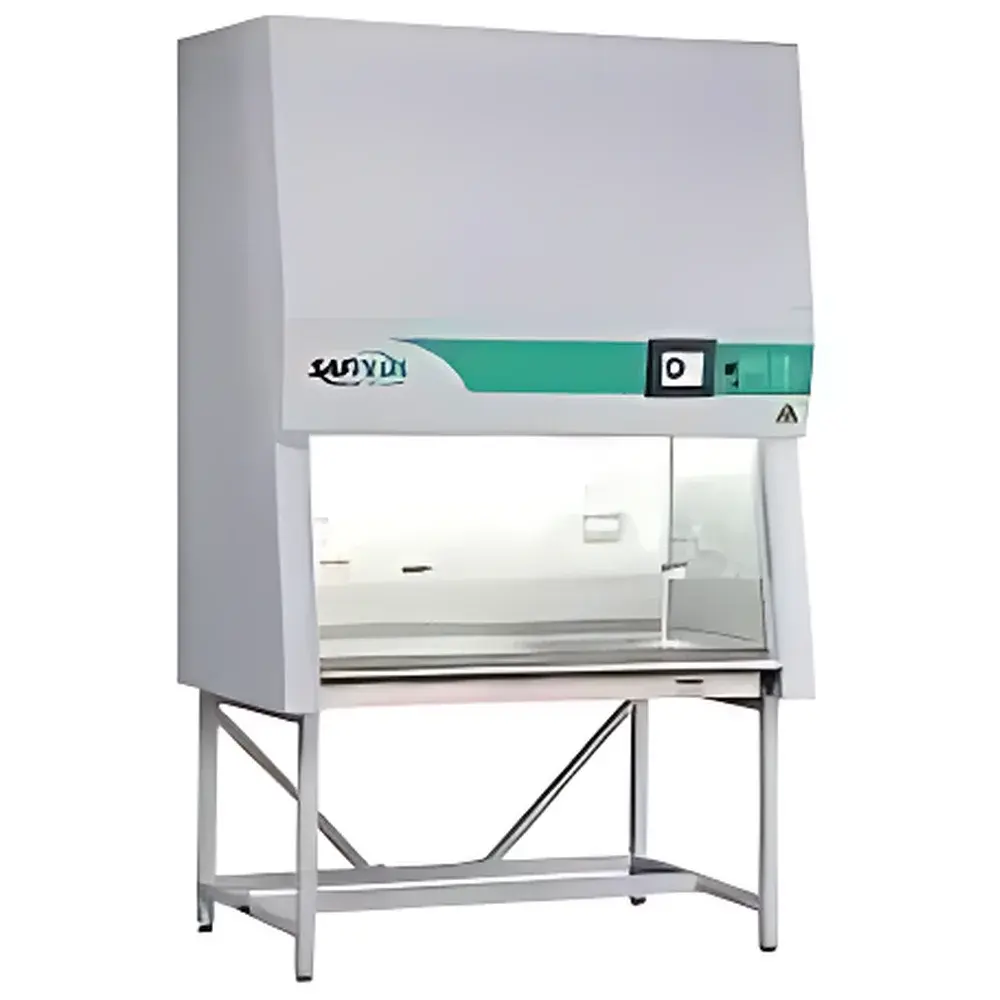
Yakos65 Class II Type A2 Biological Safety Cabinet
| Origin | Taiwan |
|---|---|
| Manufacturer Type | Authorized Distributor |
| Domestic Product Classification | China-Market Compliant |
| Cabinet Class | NSF/EN/YY-Compliant Class II Type A2 |
| Price Range | USD 2,800 – 7,000 (FOB) |
| Instrument Category | Primary Containment Biosafety Cabinet |
| External Dimensions (L×W×H) | 1430 × 887 × 1650 mm |
| Internal Dimensions (L×W×H) | 1245 × 587 × 637 mm |
| HEPA Filtration Efficiency | ≥99.99% @ 0.3 µm (H14 Grade) |
Overview
The Yakos65 Class II Type A2 Biological Safety Cabinet is an NSF 49–, EN 12469–, and YY 0569–certified primary containment device engineered for simultaneous personnel, product, and environmental protection in low- to moderate-risk biosafety level (BSL-2) laboratories. It operates on the principle of laminar airflow with dual HEPA filtration—supply air passes through a pre-filter and a certified H14-grade HEPA filter (≥99.99% efficiency at 0.3 µm), while exhaust air undergoes secondary HEPA filtration prior to partial recirculation (70%) and controlled external discharge (30%). This configuration ensures stable downward laminar flow (average 0.375 m/s) across the work surface and consistent inward inflow (average 0.51 m/s at 20 cm sash height), meeting internationally recognized aerodynamic performance thresholds for operator safety and sterile sample integrity.
Key Features
- Stainless steel Type 304 construction throughout the work chamber, front grille, and inner chassis—corrosion-resistant, non-porous, and compatible with standard laboratory disinfectants including 70% ethanol and sodium hypochlorite solutions.
- Dual-certified H14 HEPA filters (ISO 29463-1:2017; EN 1822-1:2019) for both supply and exhaust streams, validated per IEST-RP-CC001.4 and tested annually per ISO 14644-3 protocols.
- Integrated UV-C germicidal lamp (254 nm, 30 W) with safety interlock that deactivates upon sash movement or door opening—compliant with IEC 62471 photobiological safety requirements.
- T5 fluorescent lighting system (28 W × 2) delivering uniform illumination ≥800 lux across the entire work surface, calibrated per ISO 8596 and verified during factory acceptance testing.
- Acoustically optimized blower assembly achieving <65 dBA at 1 m distance—designed for continuous operation in shared lab environments without compromising auditory comfort or regulatory noise limits.
- Configurable accessory options include CSA-certified gas cocks, six-point IV pole with S-hooks, and ducted exhaust canopy kits compatible with standard 150 mm or 200 mm rigid ducting systems.
Sample Compatibility & Compliance
The Yakos65 accommodates standard BSL-2 microbiological procedures involving non-aerosol-generating techniques, cell culture manipulations, and molecular biology workflows (e.g., plasmid transfection, RNA handling, and recombinant protein expression). It is not intended for use with volatile toxic chemicals, radionuclides, or high-yield aerosol-generating procedures (e.g., centrifugation of open tubes, sonication, or animal inoculation). Certification documentation includes full traceability to NSF/ANSI 49:2022 Edition, EN 12469:2000 + A1:2007, YY 0569–2011 (Chinese national standard), UL 61010-1 / CSA C22.2 No. 61010-1 for electrical safety, and ISO 9001:2015 quality management system registration. All units ship with third-party validation reports covering airflow velocity mapping, filter integrity (DOP/PAO scanning), and alarm response verification.
Software & Data Management
While the Yakos65 operates via an analog-digital hybrid control panel (no embedded OS or network interface), it features real-time LED monitoring of sash position, inflow/exhaust velocity status, UV lamp operational hours, and filter service life estimation. Optional data logging modules (sold separately) support RS-485 Modbus RTU output for integration into centralized facility monitoring systems compliant with FDA 21 CFR Part 11 Annex 11 requirements. Audit trail functionality—including timestamped event logs for sash movement, UV activation/deactivation, and alarm triggers—is available when paired with validated SCADA or LIMS platforms supporting GLP/GMP-aligned electronic record retention.
Applications
- Maintenance of sterile mammalian and insect cell cultures under aseptic conditions.
- Preparation of clinical diagnostic reagents and vaccine intermediates in QA/QC laboratories.
- Handling of genetically modified organisms (GMOs) classified under Risk Group 2 per WHO Laboratory Biosafety Manual (4th ed.).
- Pharmaceutical aseptic processing support—including media fill simulations and component staging—where Class II A2 cabinets are permitted under EU GMP Annex 1 (2022) and PIC/S guidance.
- Teaching laboratory environments requiring robust, standards-compliant containment for undergraduate and graduate biotechnology instruction.
FAQ
What certification standards does the Yakos65 meet?
It complies with NSF/ANSI 49:2022, EN 12469:2000+A1:2007, YY 0569–2011, UL 61010-1, CSA C22.2 No. 61010-1, and ISO 9001:2015.
Is ducted exhaust mandatory for safe operation?
No—Type A2 cabinets may operate in recirculating mode with canopy or hard-ducted exhaust. However, ducted installation is required when working with minute quantities of volatile hazardous chemicals or when local building codes mandate total exhaust.
What is the minimum recommended room ceiling height?
A clear vertical clearance of ≥250 cm is required to accommodate cabinet height (1650 mm), service clearance above the unit, and proper exhaust duct routing.
Can the Yakos65 be used for BSL-3 agents?
No—Class II Type A2 cabinets provide only BSL-2 containment. BSL-3 work requires Class III gloveboxes or dedicated Class II B2 (total exhaust) cabinets with validated negative pressure enclosures and dedicated supply/exhaust HVAC systems.
How often must HEPA filters be replaced?
Filter replacement intervals depend on usage intensity and ambient air quality but are typically scheduled every 3–5 years. Annual integrity testing (via DOP/PAO challenge) is required per ISO 14644-3 and institutional biosafety office policy.



