
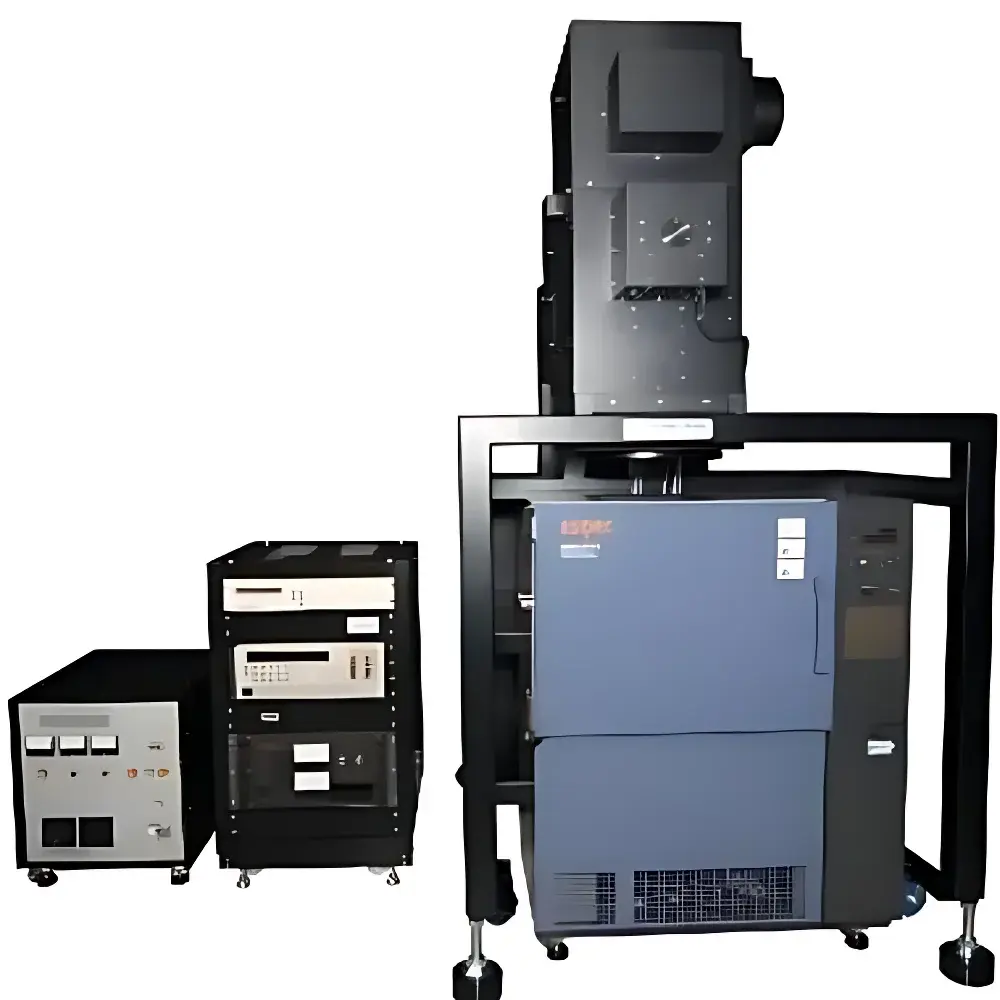
Yamashita YSS-T Series Dual-Source Solar Simulator (AM0/AM1.5G)
| Origin | Japan |
|---|---|
| Manufacturer Type | Authorized Distributor |
| Origin Category | Imported |
| Model | YSS-T Series |
| Price Range | USD 280,000 – 420,000 |
| Light Source Type | Xenon Lamp + Tungsten-Halogen Lamp |
| Illumination Mode | External Irradiation |
| Spectral Range | 300–1800 nm |
| Spectral Match | Class AAA (IEC 60904-9 Ed.2) and Class A+AA+ (IEC 60904-9 Ed.3) |
| Effective Irradiation Area | 50 × 50 mm, 155 × 155 mm, or 210 × 210 mm |
| Irradiance | 100 mW/cm² (1 SUN) |
| Spectral Mismatch | < ±12.5% |
| Spatial Uniformity | < ±2% |
| Temporal Instability | < ±0.5% per hour |
| Xenon Lamp Power | 500 W – 1.6 kW (Avg. Lifetime: 1,000 h) |
| Halogen Lamp Power | 1 kW – 2 kW (Avg. Lifetime: 500–1,000 h) |
Overview
The Yamashita YSS-T Series Dual-Source Solar Simulator is an engineered optical instrumentation platform designed for high-fidelity terrestrial and extraterrestrial solar spectrum replication. It integrates two independently controlled broadband light sources — a high-intensity xenon arc lamp and a stabilized tungsten-halogen lamp — to achieve spectral continuity across the full 300–1800 nm range. Unlike single-source simulators, this dual-lamp architecture enables dynamic spectral tuning: the xenon lamp delivers strong UV–visible output and near-IR emission, while the halogen lamp compensates for spectral deficits in the 700–1800 nm region, particularly critical for evaluating multi-junction photovoltaic devices, perovskite-silicon tandems, and space-grade solar cells under AM0 conditions. The system is calibrated and validated against IEC 60904-9 Ed.2 (Class AAA) and Ed.3 (Class A+AA+), ensuring traceable compliance with international photovoltaic testing standards. Its external irradiation configuration supports integration into vacuum chambers, environmental test enclosures, and custom optomechanical setups without compromising beam collimation or thermal management.
Key Features
- Dual-source spectral synthesis: Independent control of xenon and halogen lamps enables seamless transition between AM0 (extraterrestrial, 1366 W/m²) and AM1.5G (terrestrial, 1000 W/m²) spectral profiles via hardware-switched optical paths.
- Optical stability: Integrated closed-loop power feedback system and precision mechanical iris diaphragm allow irradiance adjustment from 0.1× to 1.5× 1 SUN without spectral shift — maintaining spectral mismatch < ±12.5% across the full operating range.
- High spatial uniformity: Optimized elliptical reflector geometry and secondary diffuser optics deliver < ±2% irradiance variation over active areas up to 210 × 210 mm (defined per IEC 60904-9).
- Long-term temporal stability: Real-time lamp voltage/current monitoring and adaptive power regulation ensure irradiance drift < ±0.5% per hour, meeting stringent requirements for extended-duration IV curve tracing and aging studies.
- Modular lamp architecture: Field-replaceable lamp modules (YSS-T155A, YSS-T210A, YSS-T50A) support rapid maintenance with documented lifetime specifications (500–1000 h), reducing instrument downtime and total cost of ownership.
Sample Compatibility & Compliance
The YSS-T Series accommodates standard photovoltaic test coupons (e.g., 2 cm × 2 cm, 5 cm × 5 cm, 10 cm × 10 cm), mini-modules, and thin-film substrates mounted on temperature-controlled stages. Its external illumination design allows direct coupling with environmental chambers (optional integrated Peltier or liquid-cooled stage), enabling simultaneous control of cell temperature (±0.1 °C) during spectral response measurement. All calibration certificates are NIST-traceable and include full spectral irradiance data (300–1800 nm, 1 nm resolution), spatial uniformity maps, and temporal stability logs. The system complies with IEC 60904-9 (Ed.2 & Ed.3), ASTM E927-19, and JIS C 8912, and supports GLP/GMP-aligned audit trails when paired with optional software modules compliant with FDA 21 CFR Part 11.
Software & Data Management
Control and data acquisition are managed through Yamashita’s proprietary SolarSimPro™ software suite (Windows-based, 64-bit). The interface provides synchronized lamp power sequencing, real-time irradiance monitoring (via integrated reference photodiode), and automated spectral profile switching between AM0 and AM1.5G modes. Raw spectral data (CSV/HDF5), spatial uniformity reports, and time-series stability logs are exportable with embedded metadata (timestamp, lamp hours, ambient temperature/humidity, calibration ID). Optional IV measurement integration supports IEEE 1547-compliant curve fitting, series/shunt resistance extraction, and temperature-corrected efficiency reporting. Audit logging records all user actions, parameter changes, and calibration events — essential for ISO/IEC 17025-accredited laboratories.
Applications
- Calibration and validation of reference solar cells (Si, GaAs, InP, perovskite) per IEC 60904-2 and IEC 60904-4.
- Quantum efficiency (QE) and external quantum efficiency (EQE) mapping of multi-junction PV devices under spectrally matched AM0 and AM1.5G illumination.
- Accelerated light-soaking and degradation testing of emerging photovoltaics (OPV, perovskites) requiring stable, spectrally accurate irradiance over >100-hour cycles.
- Spacecraft solar array qualification per ECSS-E-ST-20-07C and NASA GSFC-STD-7000A, including spectral mismatch correction for flight cell characterization.
- Photoelectrochemical cell (PEC) and photocatalytic reactor performance evaluation under standardized solar spectra.
FAQ
What spectral standards does the YSS-T Series meet?
It satisfies IEC 60904-9 Ed.2 (Class AAA) and Ed.3 (Class A+AA+) for spectral match, spatial uniformity, and temporal stability — verified by third-party accredited laboratories.
Can the system operate in vacuum or inert gas environments?
Yes — the external irradiation design permits optical coupling through quartz viewports; optional vacuum-compatible lamp housings and feedthroughs are available upon request.
Is AM0/AM1.5G switching automated or manual?
Switching is fully automated via motorized filter wheel and lamp power sequencing within SolarSimPro™; transition time is < 90 seconds with recalibration confirmation.
Does the system include radiometric calibration documentation?
Each unit ships with a full NIST-traceable calibration certificate, including spectral irradiance (W/m²/nm), uniformity map, and stability report — valid for 12 months from date of shipment.
Are custom irradiation area sizes supported beyond the standard options?
Yes — bespoke optical designs for 300 × 300 mm and larger uniform fields are available as engineering options, subject to beam homogeneity verification and spectral fidelity validation.



