
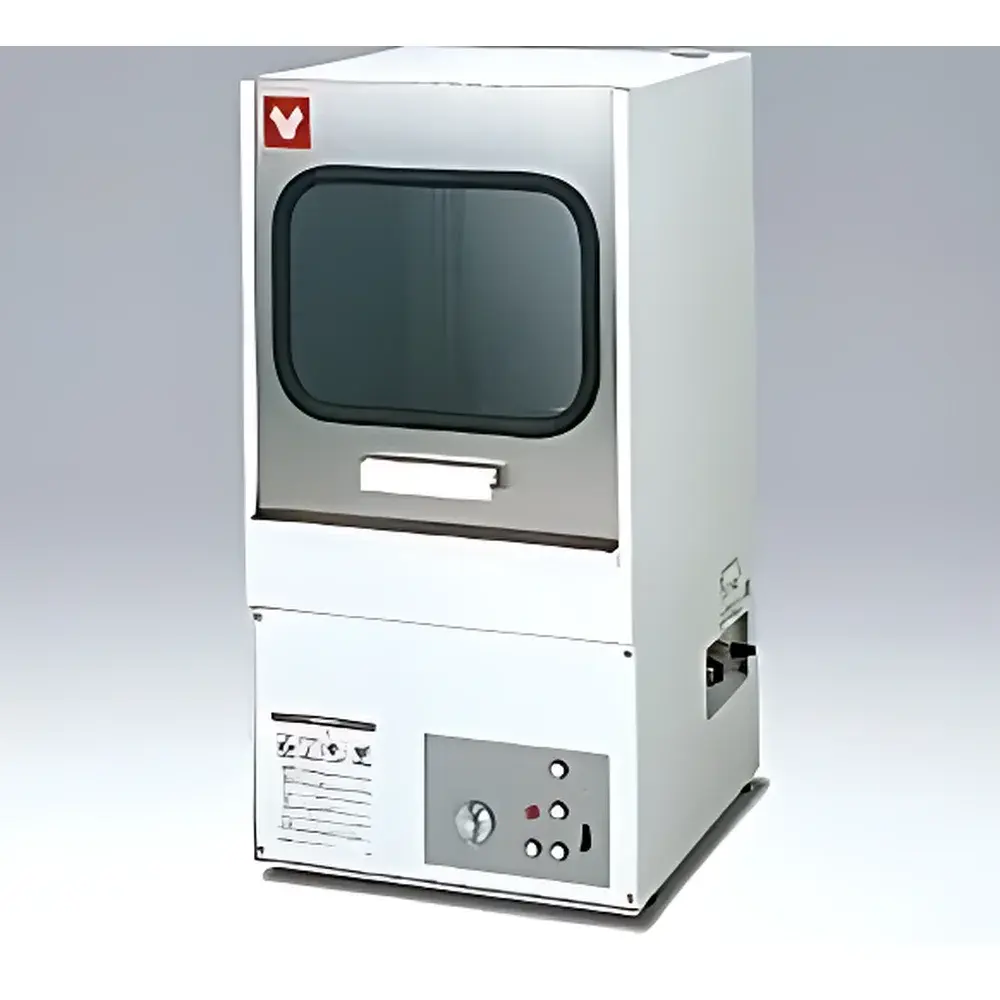
YAMATO AW47 Benchtop Semi-Automatic Laboratory Glassware Washer
| Brand | YAMATO |
|---|---|
| Origin | Japan |
| Model | AW47 |
| Heating Power | 1 kW |
| Water Supply Temperature Range | Ambient to 60 °C |
| Operating Pressure | 0.1–0.3 MPa |
| Interior Tank Dimensions | 420 × 450 × 570 mm (W×D×H) |
| External Dimensions | 450 × 490 × 875 mm (W×D×H) |
| Net Weight | ~43 kg |
| Power Supply | AC 100 V, 50/60 Hz, 15 A |
| Pump Motor | 200 W |
| Rotating Wash Platform Diameter | 420 mm |
| Internal Construction | SUS304 Stainless Steel |
| External Finish | Powder-Coated Steel |
| Drain Method | Gravity Drain |
| Inlet Control | Solenoid Valve |
| Standard Accessories | 2 m Inlet Hose w/ Fitting, 1.5 m Drain Hose (ID 25.4 mm), PE Protective Cover, 1 kg Phosphate-Free Detergent (w/ 50 mL Measuring Cup), Water Inlet Assembly |
Overview
The YAMATO AW47 is a compact, benchtop semi-automatic laboratory glassware washer engineered for precision cleaning of reusable labware in low-to-medium throughput environments. Designed and manufactured in Japan, it employs a dual-directional high-pressure spray system—featuring both top-down and bottom-up nozzles—that rotates synchronously during operation to ensure complete surface coverage of flasks, beakers, graduated cylinders, and other standard laboratory vessels. Unlike fully automated tunnel washers, the AW47 offers simplified operation: users set the wash duration via an intuitive timer and initiate the cycle with a single press—eliminating complex programming while retaining reproducible cleaning performance. Its integrated 1 kW water heater enables on-demand heating up to 60 °C without external hot water infrastructure, reducing installation complexity and energy loss associated with remote boiler systems. The chamber’s SUS304 stainless steel construction ensures long-term corrosion resistance against alkaline detergents and repeated thermal cycling, supporting compliance with ISO 15883-1 (washer-disinfectors for medical devices) and GLP-aligned lab maintenance protocols.
Key Features
- Dual-axis rotating spray manifold: Simultaneous top and bottom nozzle rotation ensures uniform impingement force across all vessel surfaces—including concave bases and narrow necks—minimizing residual particulate and organic film formation.
- Onboard thermostatic heating: Integrated 1 kW heater maintains precise temperature control (ambient to 60 °C), critical for hydrolytic removal of proteins, lipids, and polymer residues without thermal degradation of heat-sensitive glassware.
- Gravity-based drainage system: Eliminates need for vacuum pumps or lift pumps; compliant with standard lab floor drain specifications and reduces mechanical failure points.
- Modular accessory compatibility: Supports optional rotating spray racks (AW47N series) and tube-specific holders for test tubes, culture tubes, and HPLC vials—enabling configuration adaptability across diverse sample preparation workflows.
- Phosphate-free detergent integration: Supplied with 1 kg of validated, low-foaming, residue-free cleaning agent formulated to meet ASTM D4169 and USP <1051> compatibility requirements for analytical and pharmaceutical applications.
- Electromechanical safety architecture: Includes overtemperature cutoff, door interlock switch, and pressure-sensing inlet valve to prevent dry-run operation and uncontrolled thermal excursion.
Sample Compatibility & Compliance
The AW47 accommodates standard borosilicate glassware (e.g., Pyrex®, Duran®) and autoclavable polypropylene containers up to 1 L volume, provided they are placed securely on the rotating platform or compatible rack. It is routinely deployed in QC laboratories performing method validation under ICH Q5C and USP <1229>, where consistent cleaning efficacy must be demonstrated per defined soil challenges (e.g., bovine serum albumin, yeast extract). While not classified as a medical device washer per ISO 15883-2, its construction materials, thermal stability, and repeatability support alignment with Annex 1 (EU GMP) expectations for equipment used in sterile product manufacturing support areas. All wetted components comply with FDA 21 CFR 177.2420 for indirect food contact polymers.
Software & Data Management
As a semi-automatic unit, the AW47 does not incorporate digital controllers or data logging firmware. Operation is governed by electromechanical timers and analog temperature regulation—ensuring deterministic behavior, immunity to software obsolescence, and full auditability of cycle parameters via manual logbook entry. For labs requiring electronic record retention, integration with external environmental monitoring systems (e.g., Vaisala, DeltaTRAK) is achievable via dry-contact relay outputs (optional add-on). All cleaning cycles satisfy ALCOA+ principles when documented with operator ID, lot number of detergent used, load composition, and observed visual cleanliness—supporting 21 CFR Part 11-compliant review pathways when paired with validated paper-based SOPs.
Applications
- Pre-analytical cleaning of volumetric glassware prior to titration, spectrophotometry, or ICP-MS analysis.
- Routine decontamination of cell culture flasks and Petri dishes in academic and biotech research labs.
- Removal of PCR inhibitors from reusable reaction tubes in molecular diagnostics core facilities.
- Residue clearance from HPLC autosampler vials and LC-MS injection syringes to prevent carryover artifacts.
- Validation-grade cleaning of reference standard storage containers in metrology labs adhering to ISO/IEC 17025:2017 clause 6.4.7.
FAQ
Is the AW47 suitable for cleaning plastic labware such as polycarbonate centrifuge bottles?
Yes—provided the plastic is rated for continuous exposure to 60 °C and alkaline detergents. Verify material compatibility with the manufacturer’s chemical resistance chart before routine use.
Can the AW47 be connected to a centralized hot water supply instead of using the built-in heater?
No—the internal heating element and temperature sensor are calibrated exclusively for closed-loop operation; external hot water feed may cause uncontrolled thermal stress and void warranty.
What is the recommended maintenance frequency for the spray nozzles and pump?
Inspect nozzles weekly for clogging; clean with ultrasonic bath and 0.1 M HCl if mineral deposits are present. Pump oil replacement is not required—the motor is sealed and induction-driven.
Does YAMATO provide IQ/OQ documentation packages for the AW47?
Yes—customizable qualification templates (including test protocols, acceptance criteria, and raw data worksheets) are available upon request for GxP-regulated installations.
Is the phosphate-free detergent supplied with the AW47 validated for endotoxin removal?
The detergent achieves >3-log reduction of endotoxin when used at 60 °C for ≥10 minutes per ASTM E1721; full validation must be performed in situ using user-specific load configurations.



