
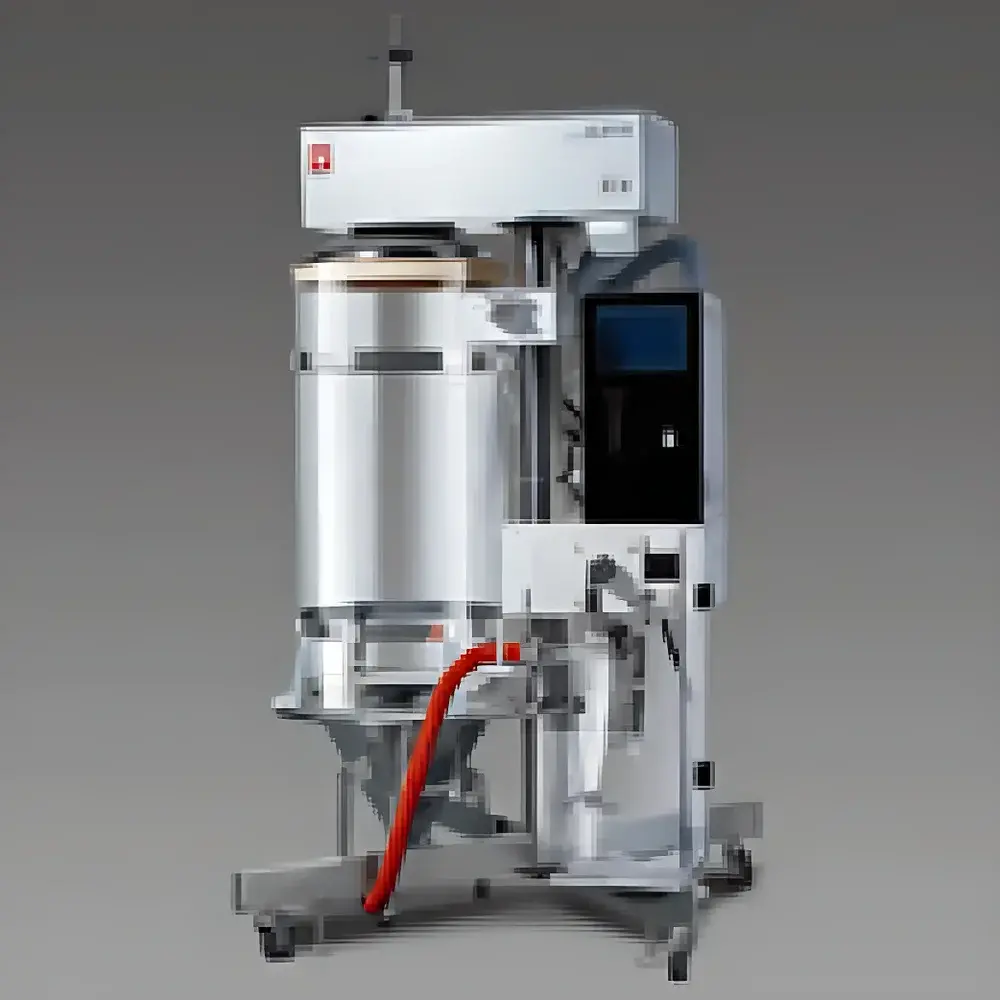
Yamato DL411C Laboratory Spray Dryer
| Brand | Yamato |
|---|---|
| Origin | Japan |
| Model | DL411C |
| Sample Types | Water-soluble & Organic Solvent-based Solutions |
| Max. Feed Rate | 1500 mL/h (up to 3000 mL/h when coupled with GAS411C solvent recovery unit) |
| Inlet Air Temperature Range | 40–300 °C |
| Outlet Temperature Control Range | 40–240 °C |
| Particle Size Output | 40–100 µm |
| Drying Chamber Dimensions | Ø457 × H975 mm (borosilicate glass) |
| Touchscreen Interface | 7-inch, Multilingual (EN/JP/CN) |
| Safety Features | Overheat Protection, Reverse Pump Detection, Leakage Current Protection, Independent Over-Temperature Cut-off |
Overview
The Yamato DL411C is a high-capacity, research-grade laboratory spray dryer engineered for reproducible production of spherical, free-flowing microparticles in the 40–100 µm range—size fractions typically unattainable with conventional benchtop units. It operates on the principle of concurrent-flow spray drying: atomized feed solution is introduced vertically downward into a heated airstream, enabling rapid solvent evaporation and controlled particle formation via droplet-to-particle transition. Its large-diameter borosilicate glass drying chamber (Ø457 mm × 975 mm height) provides extended residence time, critical for complete drying of thermally sensitive or low-volatility organic solvents and for achieving dense, low-moisture-content powders comparable to those produced in pilot-scale or production equipment. Designed for GMP-aligned R&D environments, the DL411C supports process development for pharmaceutical granulation, functional food ingredient encapsulation, ceramic precursor synthesis, and advanced material formulation where particle morphology, size distribution, and residual solvent content are strictly regulated.
Key Features
- Concurrent-flow dual-fluid nozzle system (standard 0.7 mm orifice) with optional tri-fluid configuration for core-shell emulsion atomization
- Integrated nozzle cooling and automated pulsed-air cleaning cycle to prevent nozzle clogging during prolonged operation with viscous or high-solids feeds
- Zoned PID temperature control architecture—separate regulation of inlet air heater, chamber wall heating jacket (optional), and exhaust duct—ensures thermal stability ±1 °C at inlet and precise outlet temperature tracking
- Large-diameter vertical drying chamber constructed entirely from ultra-hard borosilicate glass (Schott Duran® equivalent), enabling real-time visual monitoring of spray pattern, particle trajectory, and wall deposition behavior
- Dual-mode air handling: standalone operation with integrated blower and filter system, or seamless integration with Yamato GAS411C solvent recovery unit for Class I/II organic solvent processing (e.g., ethanol, acetone, chloroform)
- Motorized lift-and-rotate drying chamber lid with quick-release mechanism simplifies cleaning and minimizes operator exposure to residual powder
- 7-inch industrial-grade touchscreen HMI with configurable data logging (optional), multi-language UI (English, Japanese, Chinese), and full parameter archiving including inlet/outlet temperatures, airflow rates, feed pump speed, and nozzle pressure
Sample Compatibility & Compliance
The DL411C accommodates aqueous and organic solvent-based feedstocks—including ethanol, methanol, ethyl acetate, and dichloromethane—when used with the GAS411C solvent recovery add-on. Its stainless steel fluid pathways, silicone-free gasketing (where applicable), and inert glass chamber meet USP Class VI biocompatibility requirements for pharmaceutical excipient drying. The system supports ASTM E2927-22 (spray drying process validation), ISO 8503-2 (surface cleanliness verification), and aligns with FDA 21 CFR Part 11 electronic record integrity standards when equipped with optional audit-trail-enabled software. All electrical components comply with IEC 61000-6-4 EMC and IEC 61000-6-2 immunity specifications. Built-in safety interlocks include independent overtemperature cut-off (separate from main controller), earth leakage protection (30 mA), and feed pump rotation direction monitoring to prevent backflow-induced nozzle damage.
Software & Data Management
Standard firmware enables real-time display and manual logging of 12 process variables (inlet/outlet temperature, airflow, feed rate, nozzle pressure, chamber static pressure, etc.). With the optional Data Acquisition Module (DAM-DL411C), users gain continuous timestamped CSV export, trend graphing, alarm history with cause-code tagging, and 4–20 mA analog outputs for integration into LIMS or SCADA systems. Remote operation and diagnostics are supported via Ethernet (TCP/IP) using Modbus TCP protocol—enabling secure access from lab PCs or centralized control rooms. All logged data includes operator ID, session start/stop timestamps, and instrument calibration status flags, satisfying GLP/GMP documentation traceability requirements.
Applications
- Pharmaceutical Granulation: Production of directly compressible excipient blends (e.g., microcrystalline cellulose, lactose) with narrow PSD and improved flowability (Hausner ratio <1.25)
- Microencapsulation: Fabrication of taste-masked APIs, controlled-release nutraceuticals, and volatile fragrance carriers using gelatin, maltodextrin, or modified starch wall materials
- Ceramic & Advanced Materials: Synthesis of sinterable zirconia, alumina, and hydroxyapatite powders with minimized agglomeration and high tap density (>2.0 g/cm³)
- Food & Flavor Technology: Encapsulation of omega-3 oils, probiotics, and heat-labile enzymes without significant activity loss (<15% activity reduction under optimized conditions)
- Solvent-Based Nanoparticle Drying: Stabilized nanoparticle suspensions (e.g., PLGA, chitosan) dried with minimal aggregation using nitrogen-assisted inert atmosphere mode (via GAS411C)
FAQ
What particle size distribution can be consistently achieved with the DL411C?
The system delivers a median particle diameter (D50) of 40–100 µm with a span (D90/D10) typically <2.0 under optimized feed concentration, inlet temperature, and airflow settings.
Is the DL411C suitable for drying heat-sensitive biologics?
Yes—its concurrent-flow geometry, adjustable outlet temperature control (down to 40 °C), and optional nitrogen purge capability enable gentle drying of proteins, peptides, and live cultures while maintaining structural integrity.
Can the DL411C be validated per GMP requirements?
Absolutely—the system’s modular design, calibrated PT100 sensors (traceable to NIST), configurable audit trail, and IQ/OQ documentation support package facilitate full qualification under EU Annex 15 and FDA Process Validation Guidance.
What maintenance intervals are recommended for the dual-fluid nozzle?
Nozzle inspection and ultrasonic cleaning are advised after every 20 hours of continuous operation; the integrated pulse-cleaning function extends service intervals by up to 3× compared to manual-only systems.
Does Yamato provide installation qualification (IQ) and operational qualification (OQ) services?
Yes—factory-authorized field engineers deliver turnkey IQ/OQ execution, including sensor calibration certificates, airflow mapping, temperature uniformity testing, and performance qualification runs with user-defined reference materials.



