
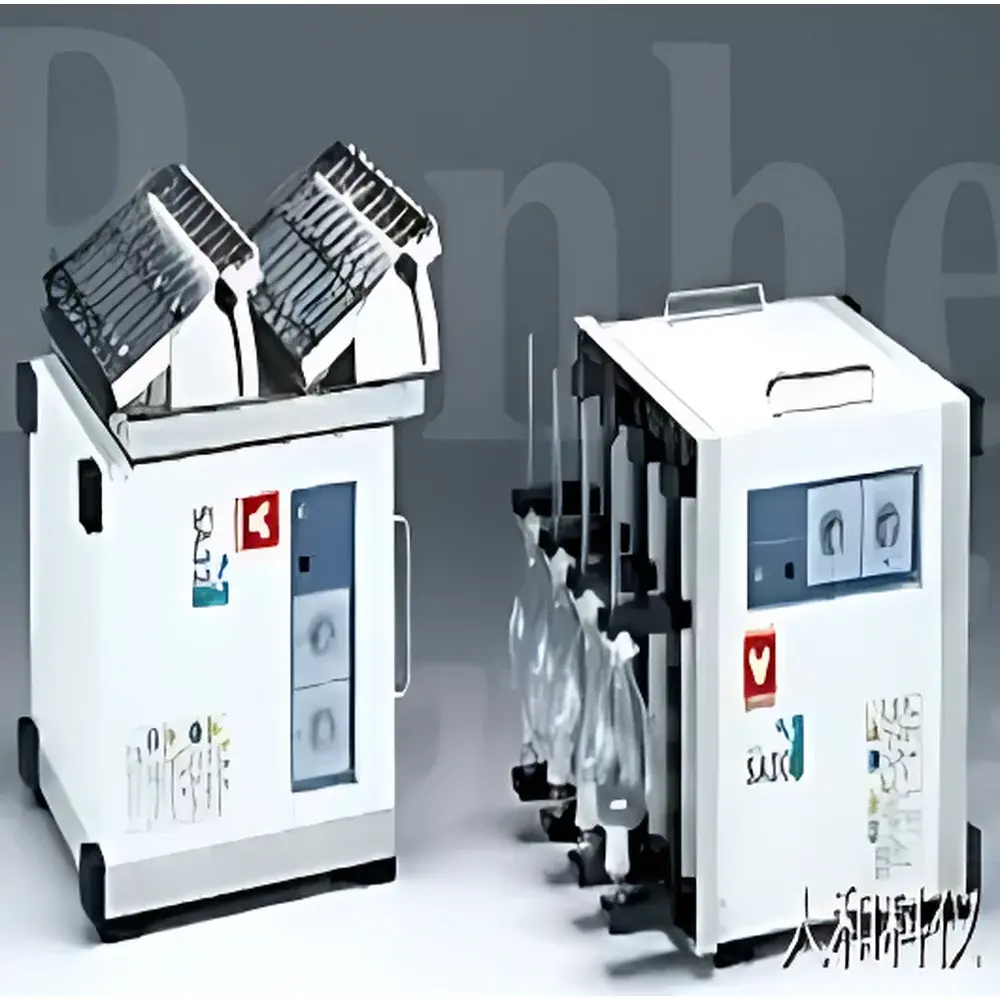
YAMATO SA300 Dual-Orientation Reciprocal Shaker
| Brand | YAMATO |
|---|---|
| Origin | Japan |
| Model | SA300 |
| Oscillation Mode | Horizontal/Vertical Reciprocal |
| Speed Range | 20–300 rpm (both modes) |
| Timer | 0–60 min (5-min increments) |
| Motor | 90 W DC Brush Motor |
| Dimensions (W×D×H) | 425 × 460 × 425 mm |
| Weight | ~40 kg |
| Power Supply | AC 100 V, 2.2 A |
| Max Load Capacity | 3 × 1000 mL or 2 × 2000 mL Separatory Funnel Racks |
| Control | Analog Speed Knob + Mechanical Timer Dial + Continuous Operation Toggle Switch |
| Accessories | 1 Fuse, 1 Set of Carbon Brushes |
Overview
The YAMATO SA300 Dual-Orientation Reciprocal Shaker is an engineered platform for precise, reproducible agitation in microbiological culture, extraction, solubilization, and suspension-based protocols. Unlike conventional orbital or rotary shakers, the SA300 employs a robust reciprocating motion driven by a high-torque 90 W DC brush motor—enabling consistent low-speed stability (<50 rpm) and high-speed uniformity (up to 300 rpm) without mechanical resonance or audible vibration transmission. Its defining mechanical feature is dual-axis orientation flexibility: the unit may be operated in standard horizontal configuration for optimal liquid surface mixing (e.g., aerobic bacterial growth in flasks), or rotated 90° to vertical orientation to generate intensified shear and particle resuspension—particularly effective for viscous media, precipitate reconstitution, or immiscible phase mixing in separatory funnels. This mechanical adaptability eliminates the need for multiple dedicated shakers across routine lab workflows.
Key Features
- Dual-orientation design allows seamless transition between horizontal and vertical reciprocal shaking without hardware modification—validated for both Erlenmeyer flask cultures and large-volume separatory funnel applications.
- DC brush motor delivers linear speed control from 20 to 300 rpm with <±2 rpm repeatability across load conditions (up to 6 kg total payload), ensuring process consistency under GLP-compliant documentation requirements.
- Analog speed and timer interface provides tactile feedback and operational simplicity—no firmware updates, no software dependencies, and zero risk of digital lockout during extended unattended runs.
- Compact footprint (425 × 460 mm base) integrates into standard biosafety cabinets or incubator chambers; structural rigidity minimizes floor-transmitted vibration—critical for adjacent sensitive instrumentation (e.g., microscopes, analytical balances).
- Reinforced rack-mounting system supports up to three 1000 mL or two 2000 mL separatory funnels with secure clamping geometry, maintaining center-of-mass alignment at all speeds and orientations.
Sample Compatibility & Compliance
The SA300 accommodates a broad range of vessel types—including glass and polypropylene Erlenmeyer flasks (50–2000 mL), serum bottles, centrifuge tubes (50 mL), and standardized separatory funnels—without requiring custom adapters. Its mechanical oscillation profile complies with ASTM D2709 (standard test method for water separation characteristics of diesel fuels) and ISO 8573-1 (compressed air purity classes) for controlled agitation during particulate dispersion validation. While not intrinsically rated for Class II biosafety environments, its non-sparking motor and sealed carbon brush housing meet IEC 61000-6-2 immunity standards for electromagnetic compatibility in shared laboratory infrastructure. Routine maintenance (carbon brush replacement, fuse inspection) aligns with manufacturer-recommended intervals per YAMATO Technical Bulletin TB-SA300-Rev.4.
Software & Data Management
The SA300 operates as a stand-alone analog instrument with no embedded firmware, network interface, or data logging capability. This architecture ensures deterministic behavior—no boot delays, no firmware corruption risk, and full operational transparency for audit-ready environments governed by FDA 21 CFR Part 11 Annex 11 or ISO/IEC 17025 clause 5.9.2. For labs requiring traceable run records, external time-stamped video monitoring or programmable relay timers (e.g., Omron H3CR-F8) may be integrated via the continuous-operation toggle switch output. All mechanical adjustments—including orientation mounting bolt torque specifications (12 N·m ±10%) and rack alignment tolerances (±0.3 mm)—are documented in the English-language Operation Manual (PN: SA300-OM-EN-2023), supplied with each unit.
Applications
- Microbial cultivation: Horizontal mode enables homogeneous O2 transfer in 500–1000 mL shake flasks for E. coli, Bacillus subtilis, and yeast strains under defined aeration profiles.
- Solvent extraction: Vertical reciprocation at 60–120 rpm optimizes phase separation kinetics in 2000 mL separatory funnels per USP <467> residual solvent testing protocols.
- Cell lysate homogenization: Low-speed (20–40 rpm) vertical agitation prevents foaming while maximizing membrane disruption in detergent-based lysis buffers.
- Standard curve preparation: Precise, repeatable mixing of calibration standards across 12–96-well plate formats using optional microplate carriers (YAMATO Accessory Kit SA-MP-01).
- Quality control stability studies: Long-duration (24–72 h), unattended shaking under controlled temperature (when placed inside environmental chambers) per ICH Q5C guidelines.
FAQ
Can the SA300 be used inside a CO2 incubator?
Yes—provided the incubator’s internal dimensions accommodate the unit’s 425 mm height in vertical orientation, and ambient humidity remains below 80% RH to prevent carbon brush oxidation. Confirm clearance with YAMATO Application Support prior to installation.
Is speed calibration traceable to NIST standards?
Speed calibration is performed using a certified optical tachometer (NIST-traceable Model DT-2234B) at three points (30, 150, and 300 rpm) during factory QA; calibration certificate is included with shipment.
What is the maximum allowable imbalance tolerance per rack?
Total mass asymmetry across any mounted rack must not exceed 150 g to maintain bearing service life >10,000 operating hours per ISO 20816-1 vibration severity thresholds.
Are replacement carbon brushes available as consumables?
Yes—YAMATO Part No. CB-SA300-02 (set of two) is stocked globally through authorized distributors and carries a shelf life of 5 years when stored at 25°C/60% RH.
Does the SA300 meet CE marking requirements for the European Economic Area?
Yes—the unit bears CE marking per Directive 2014/30/EU (EMC) and 2014/35/EU (LVD), verified by TÜV Rheinland Test Report No. RHE/2022/08763.



