
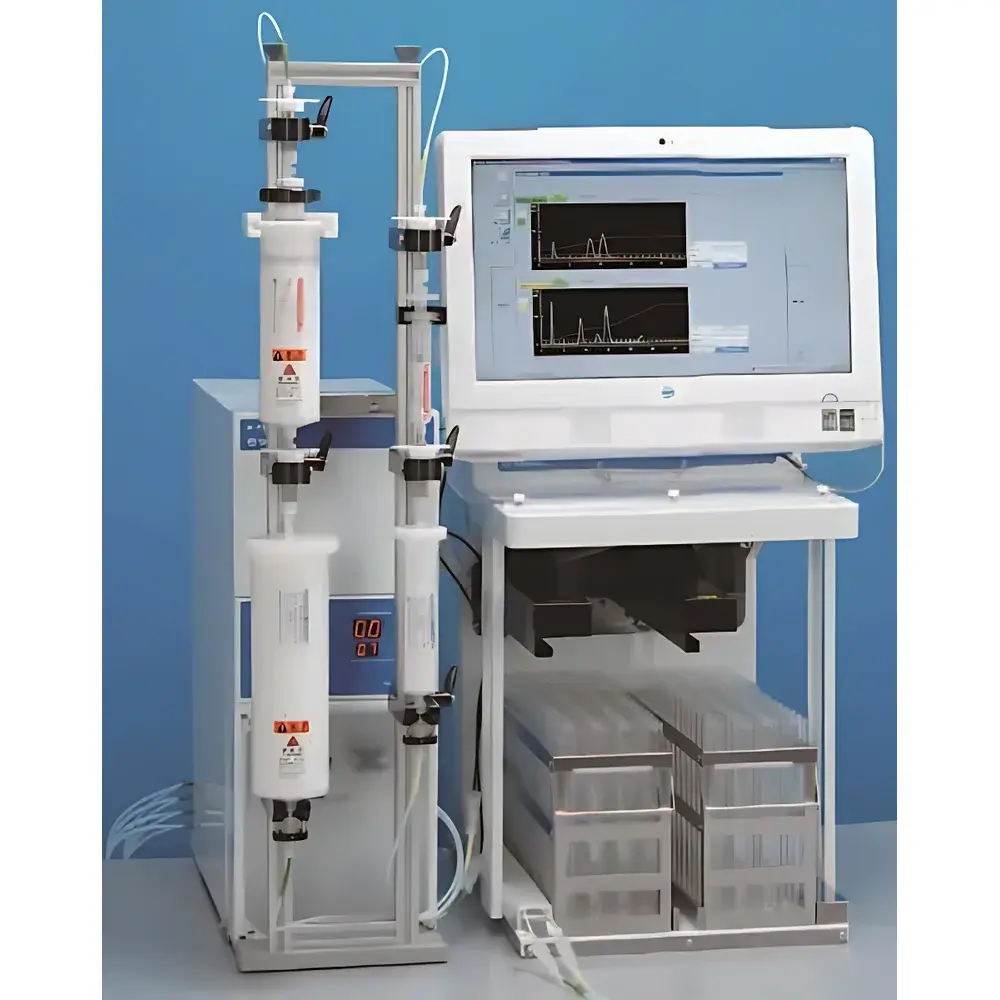
Yamazen W-Prep 2XY Dual-Channel Medium-Pressure Preparative Liquid Chromatography System
| Brand | Yamazen |
|---|---|
| Origin | Japan |
| Model | W-Prep 2XY |
| Application Level | Laboratory Grade |
| Instrument Type | Medium-Low Pressure Preparative LC |
| Flow Rate Range | 0–80 mL/min |
| Flow Accuracy | RSD ≤ 1% (n = 6) |
| Flow Precision | RSD ≤ 1% (n = 6) |
| Maximum Operating Pressure | 1.0 MPa |
| Wavelength Range Options | 254 nm fixed / 190–380 nm / 190–600 nm |
| Wavelength Reproducibility | ≤ 0.1 nm |
| Baseline Noise | ≤ 1 × 10⁻⁵ AU |
| Data Acquisition Rate | 20 Hz |
Overview
The Yamazen W-Prep 2XY is a dual-channel medium-pressure preparative liquid chromatography (PLC) system engineered for high-throughput, reproducible compound isolation in research and development laboratories. Built upon Yamazen’s four-decade heritage in chromatographic instrumentation—spanning method development, column design, and system integration—the W-Prep 2XY implements a parallel-flow architecture grounded in classical chromatographic theory and practical purification workflow optimization. Unlike analytical HPLC systems, this platform operates at controlled pressure regimes (up to 1.0 MPa) to accommodate larger internal diameter columns (typically 10–50 mm i.d.), enabling milligram-to-gram scale fractionation with minimal band broadening. Its core function is the automated, scalable separation of complex mixtures—including natural product extracts, synthetic reaction mixtures, and biopharmaceutical intermediates—using gradient or isocratic elution protocols. The system supports both reversed-phase and normal-phase chemistries and integrates seamlessly with post-column detection and fraction collection strategies compliant with GLP-aligned laboratory practices.
Key Features
- Dual independent chromatographic channels housed in a single compact chassis—each channel replicates the performance envelope of the standalone Al-580S system, eliminating inter-channel cross-talk while maximizing bench space efficiency.
- Programmable flow control per channel (0–80 mL/min), with certified accuracy and repeatability (RSD ≤ 1% over six consecutive injections), ensuring consistent loading and elution kinetics across parallel runs.
- Modular detector compatibility: UV/Vis (fixed 254 nm or tunable 190–380 nm / 190–600 nm), refractive index (RI), evaporative light scattering (ELSD), and mass spectrometry (MS) interfaces—enabling universal detection of chromophoric, non-chromophoric, and semi-volatile analytes.
- Real-time spectral acquisition at 20 Hz with baseline noise < 1 × 10⁻⁵ AU, supporting high-fidelity peak tracking and precise fraction triggering based on integrated absorbance thresholds or derivative-based retention time windows.
- Intelligent method development software rooted in chromatographic retention modeling—automatically proposes gradient profiles, estimates elution volumes, and overlays predictive elution markers (yellow arrow indicators) aligned with target compound log P or polarity indices.
Sample Compatibility & Compliance
The W-Prep 2XY accommodates a broad range of sample matrices: crude organic extracts, peptide digests, polymer fractions, and small-molecule API intermediates. Its solvent compatibility spans water, methanol, acetonitrile, tetrahydrofuran, dichloromethane, and hexane—subject to pump seal and check valve material specifications (standard PTFE/ruby configuration). System architecture conforms to ISO/IEC 17025 requirements for calibration traceability, and software functionality supports audit trail generation, electronic signatures, and user access controls aligned with FDA 21 CFR Part 11 readiness. All hardware components—including UV flow cells, fraction collector trays, and column ovens—are designed for easy cleaning, validation, and requalification under GMP-relevant SOPs.
Software & Data Management
Yamazen’s proprietary ChromaManager software provides a unified interface for instrument control, method building, real-time visualization, and fraction management. It features embedded retention modeling algorithms that correlate mobile phase strength (φ) with k-values using Snyder–Soczewiński equations, allowing users to extrapolate optimal gradients from scouting runs. Raw data are stored in vendor-neutral .csv and .cdf formats; chromatograms support overlay, peak deconvolution, and area normalization against internal standards. Audit trails record all parameter modifications, injection events, and fraction triggers with timestamped operator IDs. Optional integration with LIMS platforms is supported via ASTM E1384-compliant XML export and OPC UA protocol adapters.
Applications
- Purification of natural products from plant and microbial extracts—enabling rapid isolation of bioactive flavonoids, alkaloids, and terpenoids prior to NMR characterization.
- Parallel purification of diastereomeric or regioisomeric synthetic intermediates in medicinal chemistry campaigns, reducing cycle time between iterative SAR studies.
- Desalting and buffer exchange of peptides and oligonucleotides prior to lyophilization or formulation studies.
- Removal of catalyst residues (e.g., Pd, Ru) from cross-coupling reaction mixtures—critical for preclinical toxicology batch preparation.
- Preparative-scale chiral separations using immobilized polysaccharide-based columns (e.g., Chiralpak IA/IB/IC), leveraging dual-channel capability for method scouting and production-scale replication.
FAQ
What is the maximum column internal diameter supported by the W-Prep 2XY?
The system is optimized for columns ranging from 10 mm to 50 mm i.d., with flow rate scalability ensuring laminar flow conditions and minimal wall effects across this range.
Can the two channels operate with different mobile phases simultaneously?
Yes—each channel has independent solvent selection valves, pump heads, and detector modules, permitting fully asynchronous operation including mixed-mode elution (e.g., RP on Channel A, NP on Channel B).
Is method transfer from analytical to preparative scale supported?
ChromaManager includes a scale-up calculator that applies linear velocity preservation and constant resolution principles (k and α maintenance) to translate UHPLC or HPLC methods to preparative conditions, adjusting flow, injection volume, and gradient slope accordingly.
Does the system comply with 21 CFR Part 11 for electronic records?
While the base software provides audit trail logging and user authentication, full Part 11 compliance requires validated installation, documented change control procedures, and periodic review of electronic signature workflows—services available through Yamazen-certified implementation partners.
What maintenance intervals are recommended for the dual-pump system?
Pump seals and check valves should be inspected every 500 hours of operation or after 2000 injections; UV lamp replacement is advised every 2000 hours; system suitability testing (SST) using standard test mixtures is recommended before each high-value purification campaign.



