
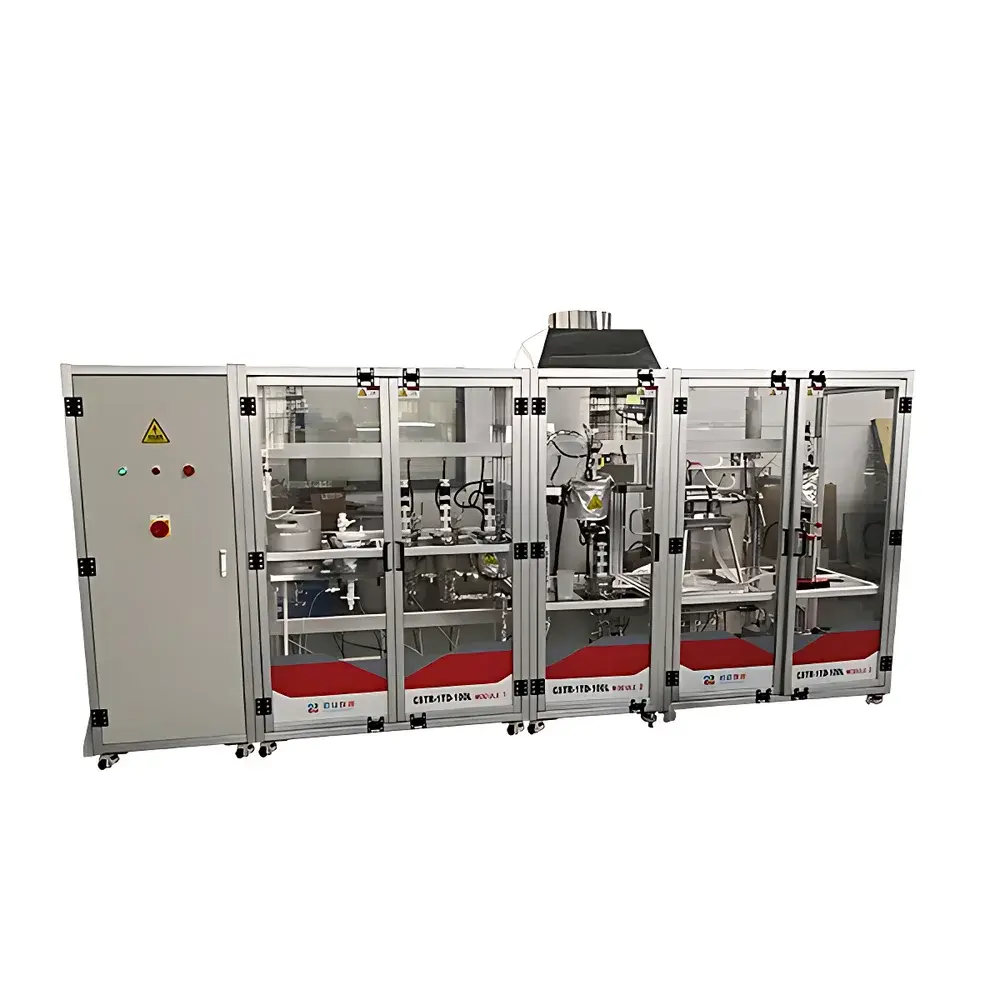
YAN ZHENG INSTRUMENT Catalyst Evaluation System DV-500/10MPa
| Brand | YAN ZHENG INSTRUMENT |
|---|---|
| Origin | Shanghai, China |
| Manufacturer Type | Direct Manufacturer |
| Country of Origin | China |
| Model | DV-500/10MPa |
| Reaction Pressure | 10 MPa |
| Reaction Temperature | 500 °C |
| Catalyst Bed Volume | 5 mL |
Overview
The YAN ZHENG INSTRUMENT Catalyst Evaluation System DV-500/10MPa is a modular, bench-scale fixed-bed catalytic testing platform engineered for rigorous kinetic, mechanistic, and screening studies under industrially relevant process conditions. It operates on the principle of continuous-flow heterogeneous catalysis, supporting gas–solid, gas–liquid, and gas–liquid–solid reaction regimes. The system integrates precision mass flow control, high-temperature/pressure reactor management, and real-time effluent monitoring to deliver reproducible, quantitative performance data essential for catalyst development, process intensification, and scale-up validation. Designed in accordance with ASME B31.3 process piping guidelines and compatible with ISO 9001-compliant laboratory workflows, the DV-500/10MPa serves as a bridge between academic catalyst synthesis and industrial pilot-stage evaluation.
Key Features
- Stainless steel 316L fixed-bed reactor with dual-zone heating (up to 500 °C), ±1 °C temperature uniformity across 150 mm active zone
- Maximum operating pressure of 10 MPa (1450 psi), certified to PED 2014/68/EU Category IV design standards
- Modular feed architecture: independent gas train (4-channel MFCs, 0–100 sccm range) and liquid feed module (HPLC-grade syringe pump, 0.01–5 mL/min, solvent-compatible with THF, water, alcohols, and hydrocarbons)
- Integrated pre-treatment section with in-situ catalyst activation capability (reduction, oxidation, sulfidation) under controlled atmosphere
- Pneumatically actuated high-pressure back-pressure regulator (BPR) with digital setpoint control and dynamic pressure hold stability ±0.02 MPa
- Industrial-grade PLC-based automation (Siemens S7-1200) with HMI touchscreen interface, password-protected operation levels, and audit-trail logging compliant with GLP requirements
- Skid-mounted mechanical design (W × D × H: 1200 × 700 × 1800 mm), CE-marked, equipped with emergency shutdown (ESD) circuit and redundant overpressure relief
Sample Compatibility & Compliance
The DV-500/10MPa accommodates powdered, extruded, or pelletized catalysts within a standardized 5 mL fixed-bed volume (ID: 12 mm, L: 45 mm). Reactor internals are chemically resistant to H₂, CO, NH₃, H₂S, steam, and common organic vapors at elevated temperatures. All wetted parts meet ASTM A269 TP316L specifications. The system supports catalyst conditioning protocols aligned with ASTM D3226 (catalyst activity testing), ISO 11545 (heterogeneous catalyst characterization), and USP <621> chromatographic method transfer requirements when coupled with downstream GC or FTIR analyzers. Full traceability of operational parameters—including temperature ramp rates, pressure hold durations, and feed stoichiometry—is maintained for regulatory submissions under FDA 21 CFR Part 11 (electronic records and signatures).
Software & Data Management
Control and data acquisition are managed via YZ-CEMS v3.2 software, a Windows-based platform supporting real-time trending, automated sequence execution (e.g., TPR/TPO cycles, stepwise temperature-programmed reactions), and CSV/Excel export with timestamped metadata. The software enforces user role-based access control (administrator, operator, reviewer), generates electronic batch records (EBR), and embeds checksum-verified audit trails for all parameter modifications. Raw sensor data (thermocouple voltages, pressure transducer outputs, flow integrals) are logged at 10 Hz sampling rate and archived in HDF5 format for post-processing in MATLAB or Python environments. Optional OPC UA server integration enables seamless connection to enterprise LIMS or MES platforms.
Applications
- Kinetic modeling of Fischer–Tropsch synthesis, methanol-to-hydrocarbons (MTH), and selective hydrogenation reactions
- Deactivation studies including coking, sintering, and sulfur poisoning under accelerated aging protocols
- Screening of zeolite, MOF, and supported metal catalysts for CO₂ hydrogenation, ammonia decomposition, and VOC abatement
- Validation of catalyst lifetime predictions using time-on-stream (TOS) data under variable space velocity (GHSV/WHSV)
- Development of structure–activity relationships (SAR) via correlative analysis of XRD/XPS pre-/post-reaction samples with corresponding activity/selectivity metrics
- Support for DOE-driven experimental design (e.g., central composite design) to optimize multi-variable reaction landscapes (T, P, H₂:hydrocarbon ratio, LHSV)
FAQ
What catalyst forms are compatible with the 5 mL reactor bed?
Powdered catalysts (40–100 mesh), extrudates (1–3 mm diameter), and tablets (≤6 mm diameter) can be loaded directly; optional quartz wool or ceramic frits ensure uniform flow distribution.
Can the system perform temperature-programmed reduction (TPR)?
Yes—integrated gas switching manifold and linear ramp control (0.1–10 °C/min) support standard TPR, TPD, and TPO protocols with H₂/Ar or O₂/He mixtures.
Is remote monitoring supported?
Via optional VPN-configured Ethernet port and web-accessible HMI proxy, enabling secure off-site supervision of run status, alarms, and live trend plots.
How is catalyst loading and unloading performed safely at high pressure?
Reactor assembly uses a front-flange quick-connect design with helium-leak-tested sealing; depressurization and purge sequences are automated prior to mechanical disassembly.
Does the system comply with explosion protection requirements for flammable gas handling?
All electrical components are rated Ex d IIB T4 Gb per ATEX 2014/34/EU; gas cabinets include forced ventilation interlocks and hydrogen-specific leak detection sensors.



