
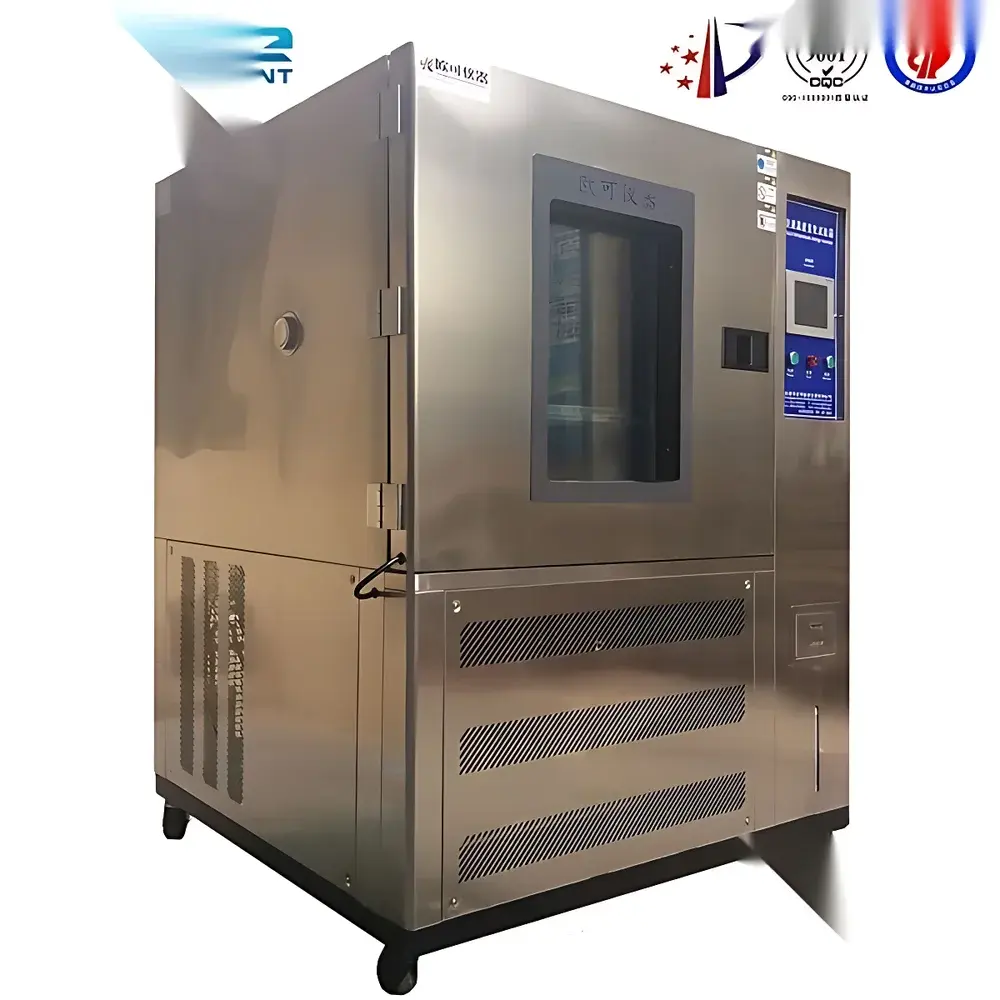
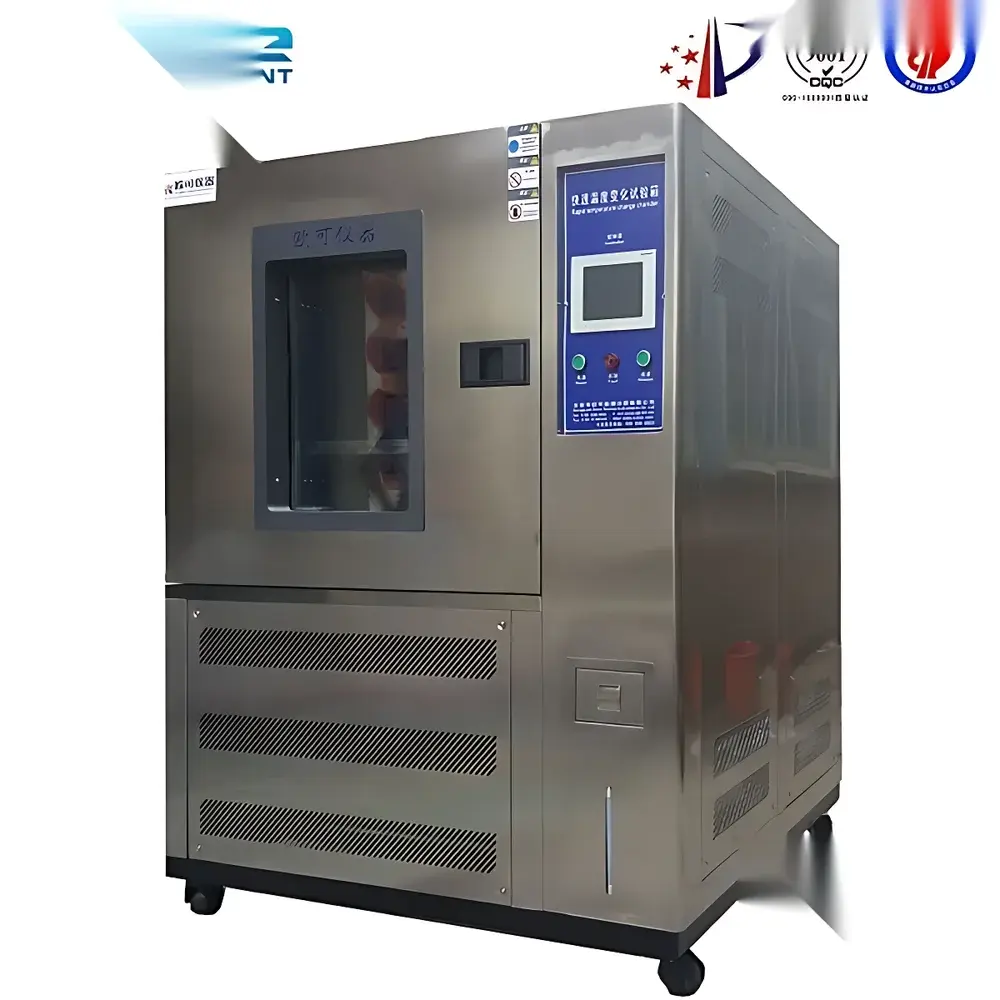
Yancheng Rapid Temperature Change Environmental Test Chamber
| Brand | Other Brands |
|---|---|
| Origin | Imported |
| Manufacturer Type | General Distributor |
| Price | USD 14,000 (Reference Only) |
| Temperature Range | −70 °C to +150 °C |
| Humidity Range | 20–98% RH (optional: 5–98% RH) |
| Rapid TC Range | −45 °C to +85 °C or −20 °C to +85 °C |
| Ramp Rates | 5–25 °C/min (customizable) |
| Temperature Uniformity | ±2 °C |
| Temperature Stability | ±0.5 °C |
| Humidity Uniformity | ±3.0% RH (at ≥75% RH) |
| Humidity Stability | ±2.5% RH |
| Interior Material | SUS#304 Stainless Steel |
| Refrigeration System | Hermetic Dual-Stage Compressor with Eco-Friendly Refrigerants (R404A/R23) |
| Controller | Touchscreen LCD with English/Chinese Interface |
| Power Supply | AC 380 V ±5%, 50 Hz ±0.5 Hz, 3-Phase 5-Wire |
Overview
The Yancheng Rapid Temperature Change Environmental Test Chamber is an engineered thermal stress screening system designed for accelerated reliability validation of electronic components, automotive modules, aerospace assemblies, and industrial materials under dynamically varying thermal-hygrometric conditions. It operates on the principle of controlled thermal cycling—inducing repetitive expansion and contraction in test specimens by rapidly alternating between extreme upper and lower temperature limits. This process accelerates latent defects—including microcracks in solder joints, interfacial delamination in multilayer PCBs, coefficient-of-thermal-expansion (CTE) mismatch failures, and moisture-induced degradation—without requiring extended real-time exposure. The chamber complies with fundamental thermodynamic stability criteria for environmental simulation, maintaining precise control over both temperature and humidity gradients across the working volume to ensure reproducible stress profiles per internationally recognized test protocols.
Key Features
- Programmable ramp rates from 5 °C/min up to 25 °C/min, enabling high-fidelity replication of field-relevant thermal transients (e.g., engine bay cycling, avionics power-up/down events)
- Dual-stage hermetic refrigeration architecture using R404A/R23 blends—optimized for low-noise operation, energy efficiency, and compliance with EU F-Gas Regulation (EC No. 517/2014)
- SUS#304 stainless steel interior with seamless welding and electropolished finish—resistant to corrosion, condensate accumulation, and organic residue buildup
- Touchscreen controller with real-time data logging, multi-segment profile programming, and user-accessible calibration offset adjustment
- Independent humidity generation via steam injection and dehumidification via cold trap condensation—supporting stable RH control down to 5% RH (optional configuration)
- Thermal uniformity validated per IEC 60068-3-5:2018 Annex A, with sensor mapping performed at nine spatial points across the chamber volume
Sample Compatibility & Compliance
The chamber accommodates samples up to 100 cm × 100 cm × 100 cm (OK-TH-1000 model), with customizable internal dimensions available upon request. Its design meets structural and operational requirements specified in multiple national and defense standards, including GB/T 2423.1–2023 (Cold Testing), GB/T 2423.2–2023 (Dry Heat), GB/T 2423.22–2012 (Temperature Change), GJB 150.3A–2009 (High Temperature), GJB 150.4A–2009 (Low Temperature), and GJB 150.5A–2009 (Temperature Shock). While not certified to ISO/IEC 17025 for calibration traceability, the system supports third-party verification against NIST-traceable reference sensors and is routinely deployed in GLP-compliant laboratories conducting pre-qualification testing prior to formal MIL-STD-810 or IEC 60068 qualification campaigns.
Software & Data Management
The embedded controller provides local data acquisition at 1-second intervals, storing up to 10,000 hours of timestamped temperature/humidity readings internally. Export is supported via USB 2.0 to CSV format for post-processing in MATLAB, Python (pandas), or statistical analysis platforms such as JMP. Optional Ethernet connectivity enables remote monitoring through Modbus TCP or HTTP API endpoints—compatible with enterprise LIMS integration and centralized test fleet management systems. Audit trails include operator ID, profile revision history, and deviation alerts—aligned with basic FDA 21 CFR Part 11 data integrity expectations when paired with procedural controls (e.g., password-protected access levels, manual signature logs).
Applications
This chamber serves critical roles in failure mode identification during Design Verification Testing (DVT), Process Validation (PV), and incoming component screening. Typical use cases include: thermal fatigue assessment of BGA packages under JEDEC JESD22-A104D; humidity-stress preconditioning of conformally coated circuit boards prior to HAST; validation of battery module thermal management systems across −40 °C to +85 °C extremes; and accelerated aging of polymer seals used in medical device enclosures. Its rapid transition capability makes it particularly suitable for simulating transient thermal environments encountered in electric vehicle power electronics, satellite thermal control subsystems, and industrial IoT edge controllers.
FAQ
Is this chamber suitable for qualification testing to MIL-STD-810 Method 502.6?
Yes—it satisfies the equipment-level performance criteria for temperature cycling and shock profiles defined in that method, though final qualification requires test plan approval and independent laboratory witnessing.
Can the controller be configured for automated pass/fail evaluation based on preset tolerance bands?
Not natively; the standard firmware supports alarm thresholds and data logging only. Custom scripting via optional PC-based software add-on is required for real-time decision logic.
What maintenance intervals are recommended for the refrigeration system?
Compressor oil analysis and filter-drier replacement every 24 months; full refrigerant charge verification and leak detection annually per ASHRAE Guideline 3-2021.
Does the chamber support external sensor inputs for monitoring DUT surface temperature?
Yes—four auxiliary analog input channels (0–10 V or 4–20 mA) are available for integrating thermocouples or RTDs mounted directly on test articles.
Is calibration documentation provided with shipment?
A factory-as-built verification report is included, listing measured uniformity/stability values at three representative setpoints. NIST-traceable calibration certificates require separate procurement and on-site verification.



