
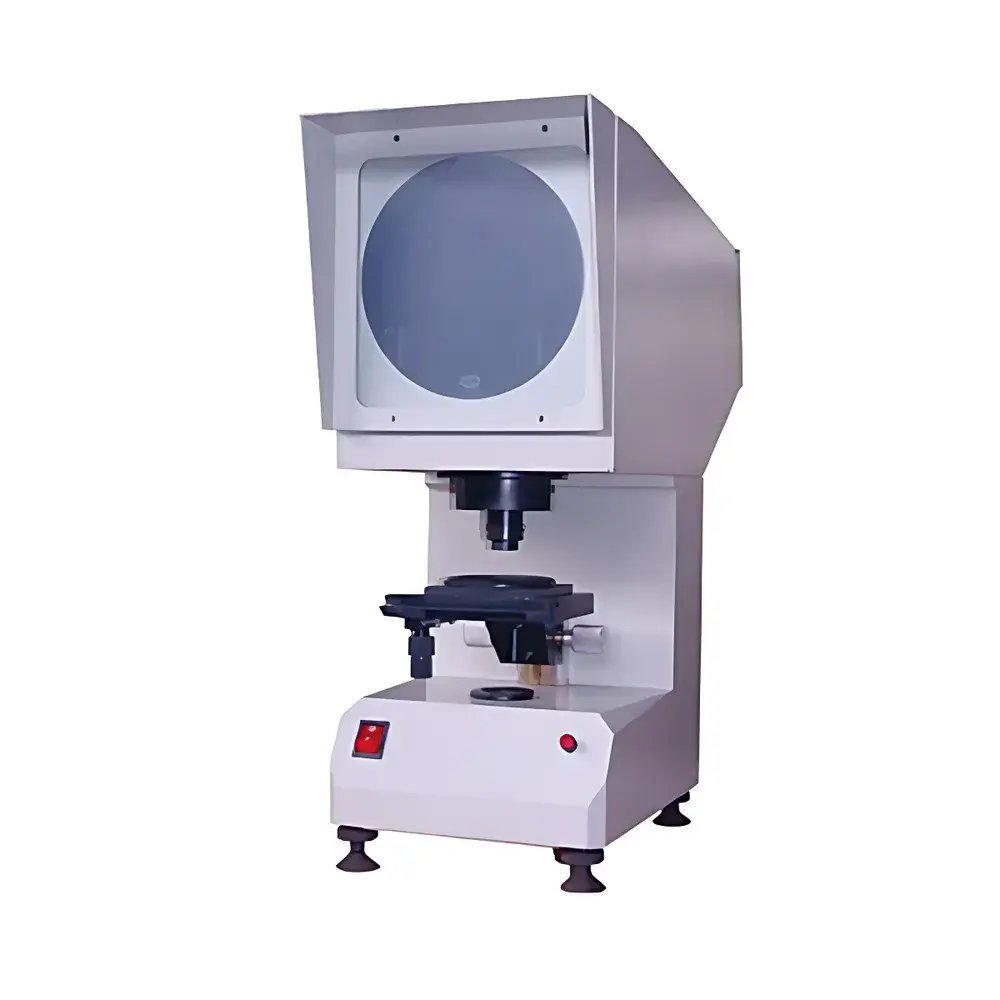
YANRUN CST-50 Impact Test Notch Projector
| Brand | YANRUN |
|---|---|
| Origin | Shanghai, China |
| Manufacturer Type | Direct Manufacturer |
| Country of Origin | China |
| Model | CST-50 |
| Projection Screen Size | 200 × 200 mm (graduated scale etched on optical glass) |
| Stage Dimensions | Square stage 110 × 125 mm |
| Stage Travel | Longitudinal ±10 mm, Transverse ±10 mm, Vertical ±12 mm |
| Stage Rotation | 0–360° continuous |
| Total Optical Magnification | 50× (Objective: 2.5×, Projection Lens: 20×) |
| Illumination Source | 12 V / 100 W halogen tungsten lamp |
| Power Supply | 220 V AC, 50 Hz |
| Overall Dimensions | 515 × 224 × 603 mm |
Overview
The YANRUN CST-50 Impact Test Notch Projector is a precision optical metrology instrument engineered for rapid, non-contact verification and dimensional assessment of standardized notches in Charpy and Izod impact test specimens. It operates on the principle of high-fidelity shadow projection using collimated illumination and calibrated optical magnification to project a scaled, edge-sharp silhouette of the specimen’s notch profile onto a fixed, engraved reference screen. Designed in strict accordance with ISO 148-1, ASTM E23, and GB/T 229 requirements for notch geometry tolerances—particularly for depth, radius (typically 0.25 mm or 1.0 mm), and root angle—the CST-50 enables laboratory technicians and quality control personnel to perform visual pass/fail evaluation and semi-quantitative measurement without destructive contact or time-consuming coordinate metrology. Its rigid mechanical architecture, thermally stable optical path, and precisely indexed rotational stage support consistent alignment across repeated inspections, ensuring high reproducibility in routine QC workflows.
Key Features
- Graduated 200 × 200 mm projection screen with permanent laser-etched metric and imperial scales for direct on-screen measurement of notch depth, width, and root radius tolerance zones.
- Multi-axis precision stage with independent longitudinal (±10 mm), transverse (±10 mm), and vertical (±12 mm) micrometer-driven adjustment—enabling fine positioning and focus optimization for varying specimen thicknesses and notch orientations.
- Full 360° continuously rotatable stage with locking mechanism, facilitating angular inspection of asymmetric notches and validation of symmetry per ASTM E23 Annex A1.
- Optimized dual-stage magnification system: 2.5× objective lens coupled with a 20× projection lens delivers stable 50× total magnification with minimal distortion and high depth-of-field retention—critical for evaluating curved notch roots and flank straightness.
- High-intensity 12 V / 100 W halogen illumination source with uniform Köhler-type light distribution, ensuring high-contrast, low-glare projection even under ambient laboratory lighting conditions.
- Compact benchtop footprint (515 × 224 × 603 mm) and integrated power conditioning—designed for integration into ISO/IEC 17025-accredited testing laboratories and production-floor QA stations.
Sample Compatibility & Compliance
The CST-50 accommodates standard Charpy V-notch (CVN), U-notch, and keyhole specimens per ISO 148-1 (10 × 10 × 55 mm, 10 × 7.5 × 55 mm, 10 × 5 × 55 mm) and ASTM E23 (including subsize geometries). The square stage (110 × 125 mm) and optional circular stage (Ø90 mm) support both clamped and free-standing specimen placement. The Ø70 mm glass aperture ensures unobstructed light transmission while maintaining mechanical stability during stage rotation. All optical and mechanical specifications comply with the metrological requirements outlined in ISO/IEC 17025 Clause 6.4 (Equipment) and support traceable calibration against NIST-traceable step gauges and radius standards. The instrument is routinely deployed in GLP-compliant environments where documented verification of notch conformity is required prior to impact energy testing.
Software & Data Management
The CST-50 is a standalone optical inspection tool requiring no software interface or computer connection. However, its design supports digital documentation workflows: the high-contrast projected image is compatible with standard industrial USB microscopes or DSLR adapters (optional accessories) for image capture. Captured images may be annotated, measured using calibrated third-party metrology software (e.g., ImageJ with stage calibration), and archived as part of electronic test records. While the unit itself does not generate audit trails, its use can be fully integrated into FDA 21 CFR Part 11-compliant LIMS or QMS platforms through procedural controls—including operator ID logging, calibration certificate referencing, and defined acceptance criteria per internal SOPs.
Applications
- Pre-test verification of machined or milled notches on metallic and polymer impact specimens prior to Charpy/Izod testing.
- Routine calibration checks of milling cutters and EDM tools used in notch fabrication.
- Root cause analysis of anomalous impact fracture behavior by correlating observed notch geometry deviations (e.g., excessive radius, asymmetry, or undercuts) with energy absorption anomalies.
- Training and certification of laboratory personnel in visual notch assessment per ISO 17660 or ASTM E384 guidelines.
- Supporting accreditation audits by providing objective, repeatable evidence of specimen compliance prior to mechanical testing.
FAQ
Is the CST-50 suitable for measuring notch radius quantitatively?
Yes—when used with calibrated stage micrometers and reference radius standards, the 50× magnified projection allows estimation of root radius within ±0.02 mm tolerance under optimal lighting and focus conditions.
Does the instrument require periodic recalibration?
Yes—annual optical alignment verification and stage travel calibration are recommended per ISO 9001 and ISO/IEC 17025 requirements. Calibration certificates traceable to national metrology institutes are available upon request.
Can it be used with non-standard specimen geometries?
The stage design accommodates custom fixtures; however, geometric interpretation must be validated against applicable standards (e.g., ASTM E23 Section 7.2) for any deviation from nominal dimensions.
Is the halogen lamp user-replaceable?
Yes—the 12 V / 100 W halogen bulb is a standard industrial component with accessible socket and thermal shielding; replacement requires no optical realignment.
What environmental conditions are recommended for optimal performance?
Operate within 15–25 °C ambient temperature, <60% RH, and minimal vibration exposure to maintain optical stability and stage repeatability.



