
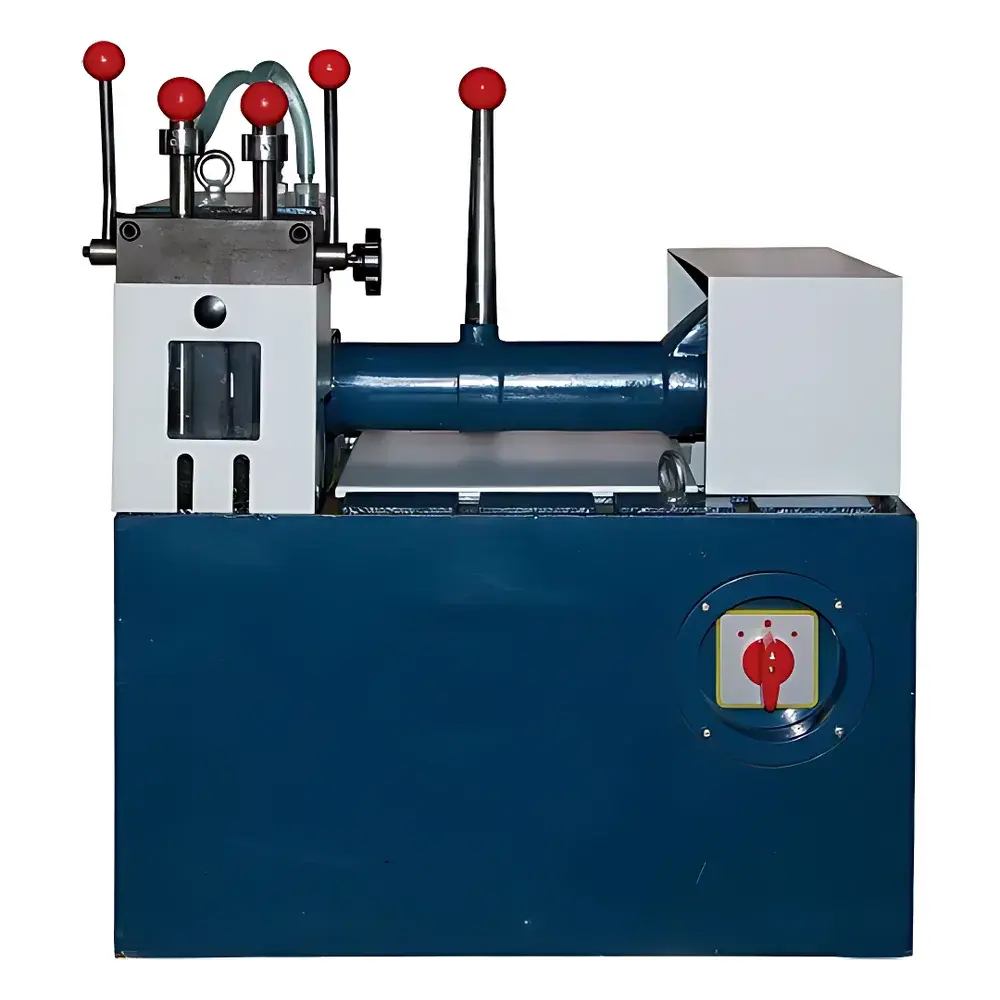
YANRUN Q-3 Metallographic Sample Cutting Machine
| Brand | YANRUN |
|---|---|
| Origin | Shanghai, China |
| Manufacturer Type | Direct Manufacturer |
| Country of Origin | China |
| Model | Q-3 |
| Instrument Type | Metallographic Cutting Machine |
| Max Cutting Cross-Section | Ø50 × 70 mm |
| Motor Power | Not Specified (380 V / 50 Hz) |
| Grinding Wheel Size | Ø250 × 2.0 × Ø4 mm |
| Rotational Speed | 2840 rpm |
| Dimensions (L×W×H) | 600 × 620 × 470 mm |
| Weight | Not Specified |
| Cooling System | Integrated adjustable coolant flow with manual valve and hollow clamping arm |
Overview
The YANRUN Q-3 Metallographic Sample Cutting Machine is a manually operated, precision-engineered benchtop instrument designed for the controlled sectioning of metallurgical, geological, and ceramic specimens prior to mounting, grinding, and polishing. It operates on the principle of abrasive cutting using a rotating silicon carbide or diamond-impregnated wheel under continuous coolant delivery—ensuring thermal management during high-speed material removal. Unlike automated or CNC-based systems, the Q-3 employs a manual rocker-arm feed mechanism, granting the operator direct tactile control over cutting speed and pressure—a critical advantage when handling brittle, layered, or heat-sensitive samples where excessive dwell time or uncontrolled feed rates may induce microstructural artifacts such as smearing, cracking, or phase transformation at the cut interface. Its robust cast-iron base, rigid swing-arm bearing assembly, and integrated coolant circulation path are engineered for long-term dimensional stability and consistent repeatability in academic, quality control, and failure analysis laboratories.
Key Features
- Manually actuated rocker-arm feed system enabling real-time adjustment of cutting force and feed rate—optimized for minimizing thermal damage and mechanical distortion in sensitive microstructures.
- Integrated coolant delivery architecture: Coolant flows through a hollow clamping lever directly to the cutting zone, with an inline manual valve permitting precise regulation or full shutoff of flow rate based on sample composition and wheel type.
- V-grooved jaw clamping mechanism with vertically adjustable pressure bar ensures secure fixation of cylindrical, rectangular, or irregularly shaped specimens up to Ø50 × 70 mm cross-section.
- Transparent acrylic safety shield mounted above the worktable provides unobstructed visual monitoring while containing abrasive debris and coolant splash—compliant with general laboratory eye and face protection guidelines (ANSI Z87.1).
- Motor-driven spindle (2840 rpm) accommodates standard Ø250 × 2.0 × Ø4 mm cutting wheels—compatible with both resin-bonded and metal-bonded abrasives per ISO 6344 and EN 12413 specifications.
- Modular internal coolant channel routing minimizes leakage risk and simplifies maintenance; inlet/outlet ports are positioned for easy connection to external reservoirs or recirculating chillers.
Sample Compatibility & Compliance
The Q-3 supports a broad spectrum of conductive and non-conductive materials including ferrous and non-ferrous alloys, sintered metals, cemented carbides, geological thin sections, refractory ceramics, and composite laminates. Its open-frame design facilitates rapid specimen loading/unloading and accommodates oversized or irregular geometries that exceed standard chuck constraints. While not certified to UL/CE for standalone industrial deployment, the unit meets baseline electrical safety requirements for Class I laboratory equipment operating at 380 V / 50 Hz. All structural components conform to GB/T 19001–2016 (equivalent to ISO 9001:2015) manufacturing protocols. The absence of programmable logic controllers or digital interfaces renders it inherently compatible with GLP environments requiring minimal software validation burden.
Software & Data Management
The YANRUN Q-3 is a fully mechanical, analog-operated system with no embedded firmware, touchscreen interface, or data logging capability. This architecture eliminates cybersecurity vulnerabilities, software obsolescence risks, and regulatory complexities associated with computerized instruments—making it particularly suitable for regulated environments where audit trails, electronic signatures, or 21 CFR Part 11 compliance are not required. Operational parameters—including feed rate, coolant flow, and wheel wear—are documented manually in laboratory notebooks or LIMS-integrated paperless workflows. No proprietary drivers, OS dependencies, or cloud connectivity are involved.
Applications
- Preliminary sectioning of bulk metallographic specimens prior to hot/cold mounting and sequential grinding/polishing.
- Controlled decapsulation of electronic packages and solder joint cross-sections for failure root cause analysis.
- Preparation of rock and mineral thin sections in geoscience research and exploration labs.
- Routine quality assurance cuts on incoming raw materials, weldments, and heat-treated components per ASTM E3, ISO 14487, and GB/T 13298.
- Educational use in undergraduate metallurgy and materials science laboratories due to its intuitive operation and transparent mechanical design.
FAQ
What types of cutting wheels are compatible with the Q-3?
Standard Ø250 × 2.0 × Ø4 mm abrasive wheels—both resinoid-bonded (for general-purpose steel and aluminum) and metal-bonded (for hard ceramics and carbides)—are mechanically and dimensionally supported.
Is the machine supplied with coolant or a reservoir?
No. The Q-3 includes only internal plumbing and a manual flow valve; users must provide an external coolant source (e.g., polyethylene reservoir with submersible pump) and select appropriate aqueous or oil-based formulations per material class.
Can the Q-3 be used for precision cuts requiring tight tolerances?
It is intended for rough sectioning—not final dimensional machining. Achievable kerf width and positional repeatability depend on operator skill, wheel condition, and feed consistency; typical tolerance is ±0.3 mm over 50 mm travel.
Does the unit comply with CE or UL standards?
It is manufactured to Chinese national safety standards (GB) and carries CCC marking where applicable; formal CE/UL certification is not provided, and integration into production lines requires third-party risk assessment.
What maintenance intervals are recommended?
Bearing lubrication every 500 operating hours; coolant line inspection before each shift; wheel flange torque verification per ISO 5272 prior to installation.



