
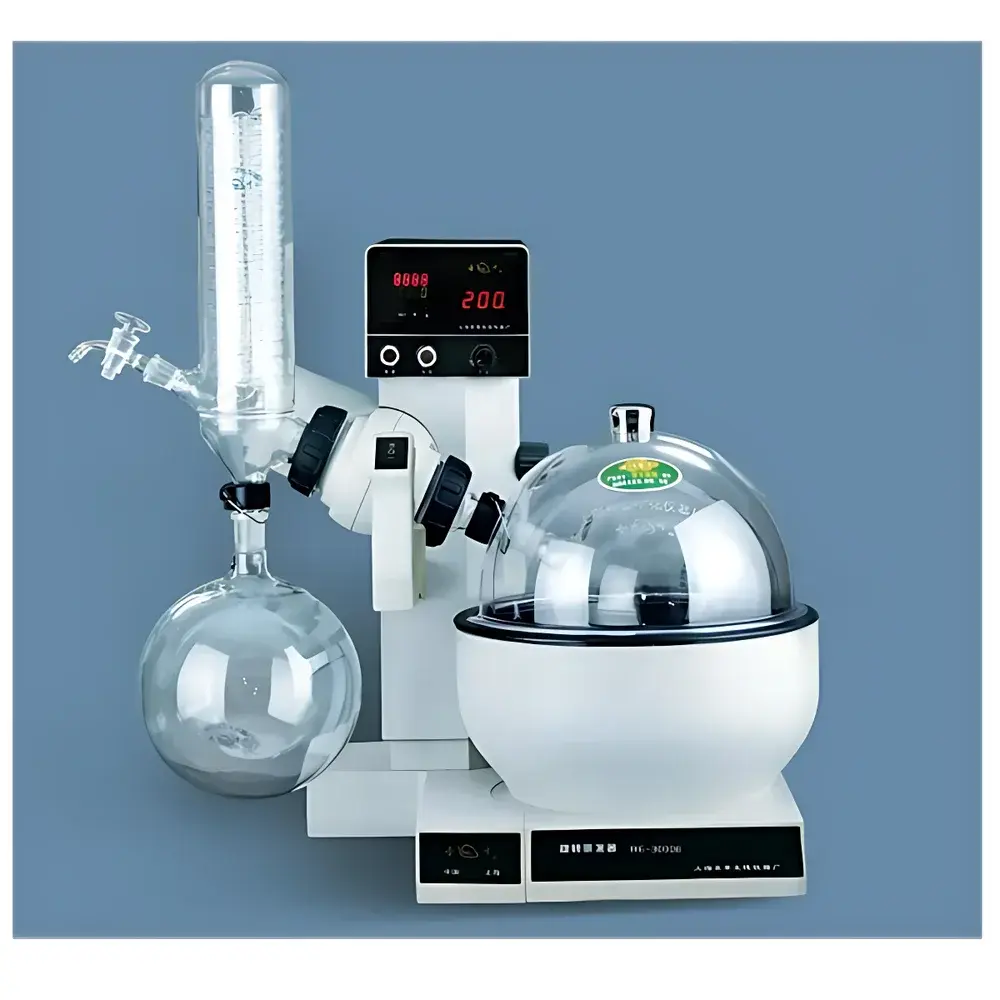
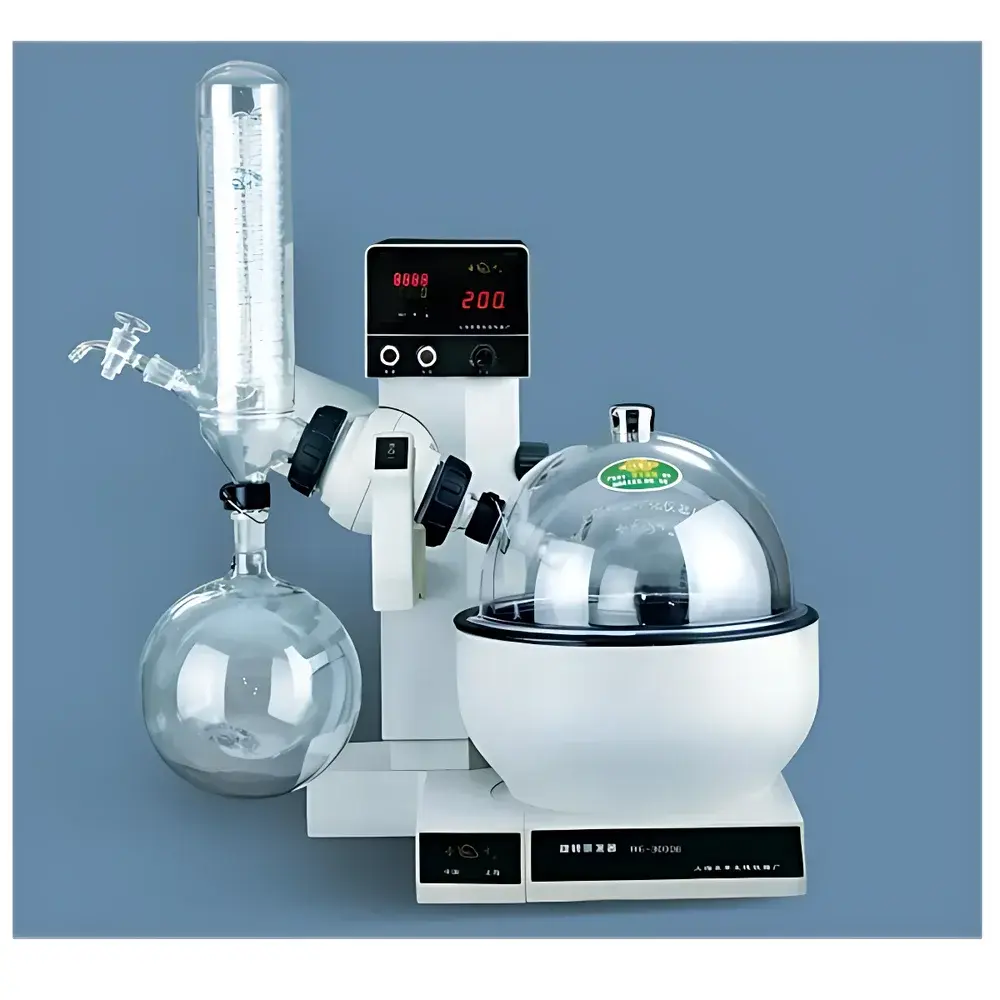
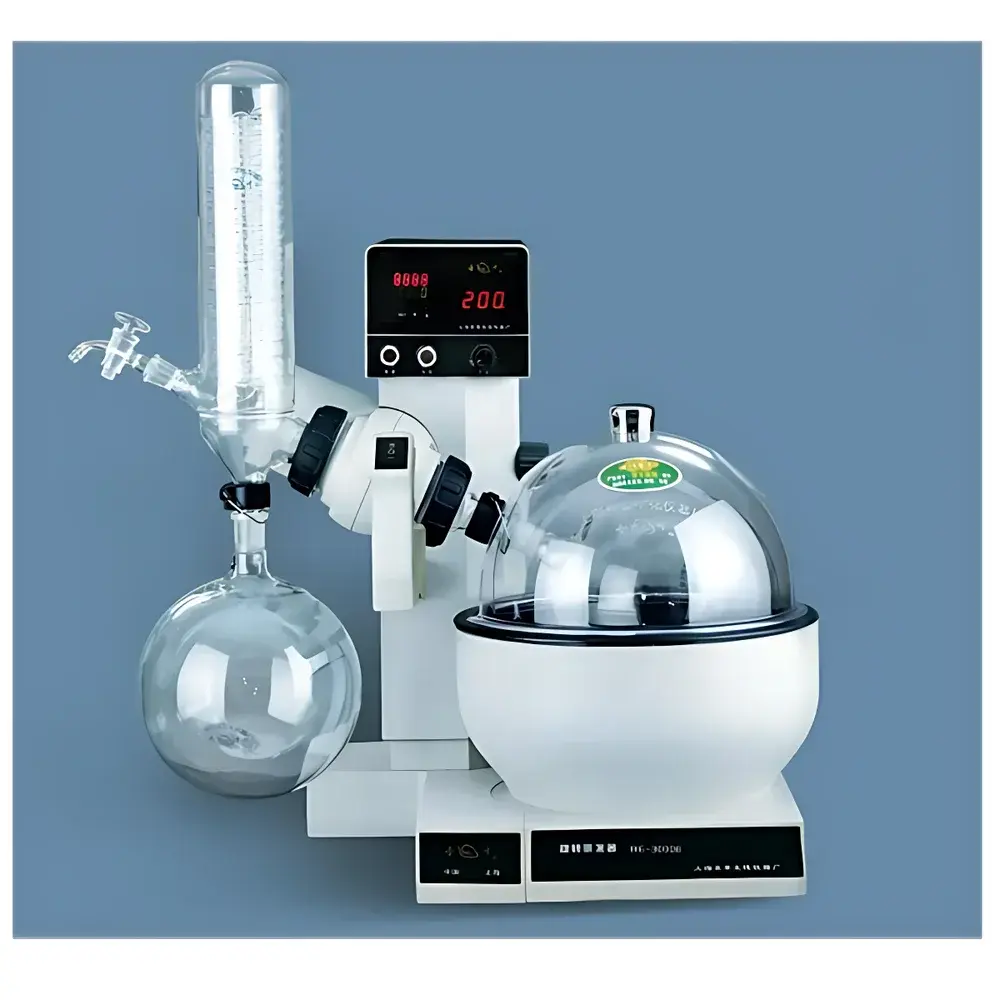
Yarong RE-2000B Rotary Evaporator
| Brand | Yarong |
|---|---|
| Origin | Shanghai, China |
| Manufacturer Type | Authorized Distributor |
| Country of Manufacture | China |
| Model | RE-2000B |
| Price | Upon Request |
| Lift Mechanism | Motorized vertical lift (0–150 mm) |
| Rotational Speed Range | 0–200 rpm |
| Bath Capacity | 4 L |
| Compatible Flask Sizes | 50–2000 mL |
| Heating Power | 1.2 kW |
| Temperature Control Range | Ambient to 99 °C |
| Temperature Accuracy | ±1 °C |
| Condenser Surface Area | 0.15 m² |
| Evaporation Rate (Water) | ≥1.2 L/h |
| Motor Power | 40 W |
| Voltage/Frequency | 220 V / 50 Hz |
| Bath Material | PTFE-coated aluminum alloy |
| Safety Enclosure | Fully transparent polycarbonate shield |
| Housing Material | Aluminum alloy + high-strength engineering polymers |
| Display | Digital LED temperature readout |
Overview
The Yarong RE-2000B Rotary Evaporator is a precision-engineered laboratory instrument designed for efficient solvent removal, concentration, and recovery under reduced pressure. It operates on the principle of rotary evaporation—rotating an evaporation flask in a thermostatically controlled water bath while applying vacuum, thereby increasing surface area and reducing boiling point to accelerate gentle, reproducible evaporation. Its robust mechanical architecture, integrated digital temperature control, and motorized lift system make it suitable for routine use in synthetic chemistry, pharmaceutical development, natural product isolation, and quality control laboratories where consistent process repeatability and operator safety are critical.
Key Features
- Motorized vertical lift mechanism with smooth, quiet operation and precise 0–150 mm travel range—enabling rapid flask immersion and withdrawal without manual adjustment.
- Digital PID temperature controller with LED display ensures stable bath temperature maintenance within ±1 °C across the full 20–99 °C operating range; ambient start capability allows low-temperature evaporation of thermolabile compounds.
- PTFE-coated aluminum alloy heating bath provides uniform thermal distribution, corrosion resistance, and extended service life—even with aggressive solvents such as chlorinated or acidic media.
- High-efficiency dual-layer condenser with 0.15 m² effective cooling surface area maximizes reflux efficiency and minimizes vapor loss during continuous operation.
- Full-height transparent polycarbonate safety shield meets ISO 13857 ergonomic clearance requirements and provides unobstructed visual monitoring while containing potential splashes or implosions.
- Brushless DC drive motor delivers consistent 0–200 rpm rotation across load conditions, minimizing torque fluctuation and ensuring homogeneous film formation on flask walls.
- Modular design supports integration with external vacuum controllers, chillers, and solvent traps—facilitating compliance with GLP documentation workflows and multi-step purification protocols.
Sample Compatibility & Compliance
The RE-2000B accommodates standard ground-glass jointed flasks from 50 mL to 2000 mL (including 1 L and 2 L round-bottom formats), enabling scalable batch processing without hardware modification. Its vacuum-tight glassware interface complies with ISO 380 and DIN 12250 standards for laboratory joint dimensions. The unit is CE-marked per 2014/30/EU (EMC Directive) and 2014/35/EU (Low Voltage Directive). While not certified for Class I Div 1 hazardous locations, its sealed motor housing and non-sparking controls render it appropriate for general-purpose organic solvent handling in accordance with OSHA 1910.1200 and CLP Regulation (EC) No 1272/2008 labeling guidelines.
Software & Data Management
The RE-2000B operates as a standalone analog-digital hybrid system with no embedded firmware or network connectivity. All operational parameters—including bath temperature setpoint, rotation speed, and lift position—are manually configured via front-panel controls. For regulated environments requiring audit trails, optional third-party data loggers (e.g., Omega OM-DAQPRO-5300 series) may be connected to the analog temperature output port (0–5 V DC) to record time-stamped bath profiles compliant with FDA 21 CFR Part 11 when paired with validated software platforms. No internal memory or user-accessible calibration logs are present; periodic verification against NIST-traceable RTD standards is recommended per ISO/IEC 17025 clause 6.4.10.
Applications
- Solvent recovery and concentration of reaction mixtures in medicinal chemistry synthesis.
- Removal of low-boiling solvents (e.g., diethyl ether, dichloromethane, ethyl acetate) prior to lyophilization or crystallization.
- Extraction and fractionation of plant metabolites using ethanol or methanol-based macerates.
- Preparative-scale purification of polymer solutions and nanoparticle dispersions.
- Residual solvent analysis sample preparation per USP and ICH Q3C guidelines.
- Teaching laboratory demonstrations of phase equilibria, Raoult’s law, and vacuum thermodynamics.
FAQ
What vacuum level is recommended for optimal performance with the RE-2000B?
A vacuum range of 10–100 mbar is typical for most organic solvents; final pressure should be selected based on solvent boiling point depression curves and thermal sensitivity of the analyte.
Can the RE-2000B be used with dry ice–acetone condensers?
Yes—the condenser’s standard 29/32 outer joint accepts commercially available cold finger assemblies; however, prolonged sub-zero operation requires compatible gasket materials (e.g., Viton®) and vacuum pump oil rated for low-temperature service.
Is the water bath fluid level sensor included?
No—operators must visually verify bath volume prior to activation; minimum fill level is 2.5 L to ensure full immersion of the 4 L bath’s heating element and temperature probe.
Does the unit support RS-232 or USB communication?
No—this is a manually operated instrument without digital interface ports; automation requires external relay modules or programmable logic controllers.
What maintenance intervals are advised for long-term reliability?
Inspect PTFE bath coating integrity every 6 months; lubricate lift rail with silicone grease annually; replace vacuum tubing and septa per usage frequency—typically every 3–6 months in high-throughput labs.



