
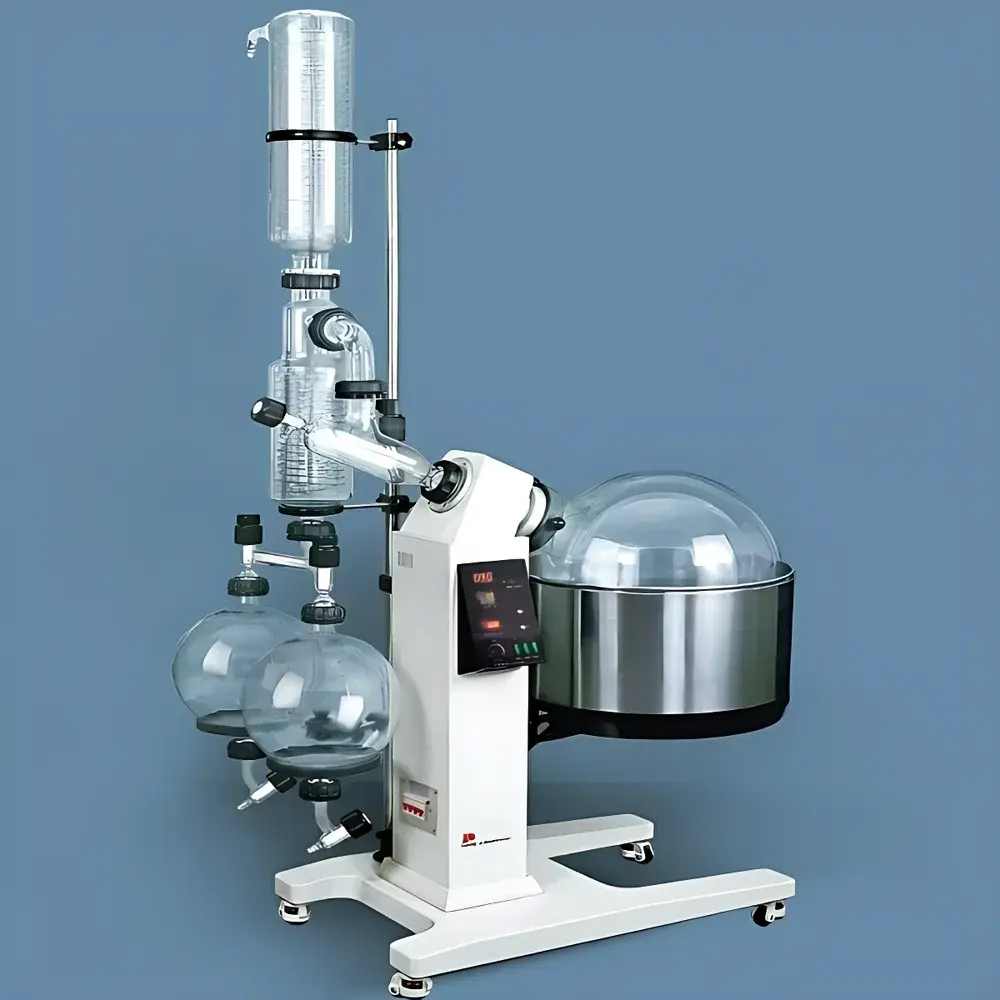
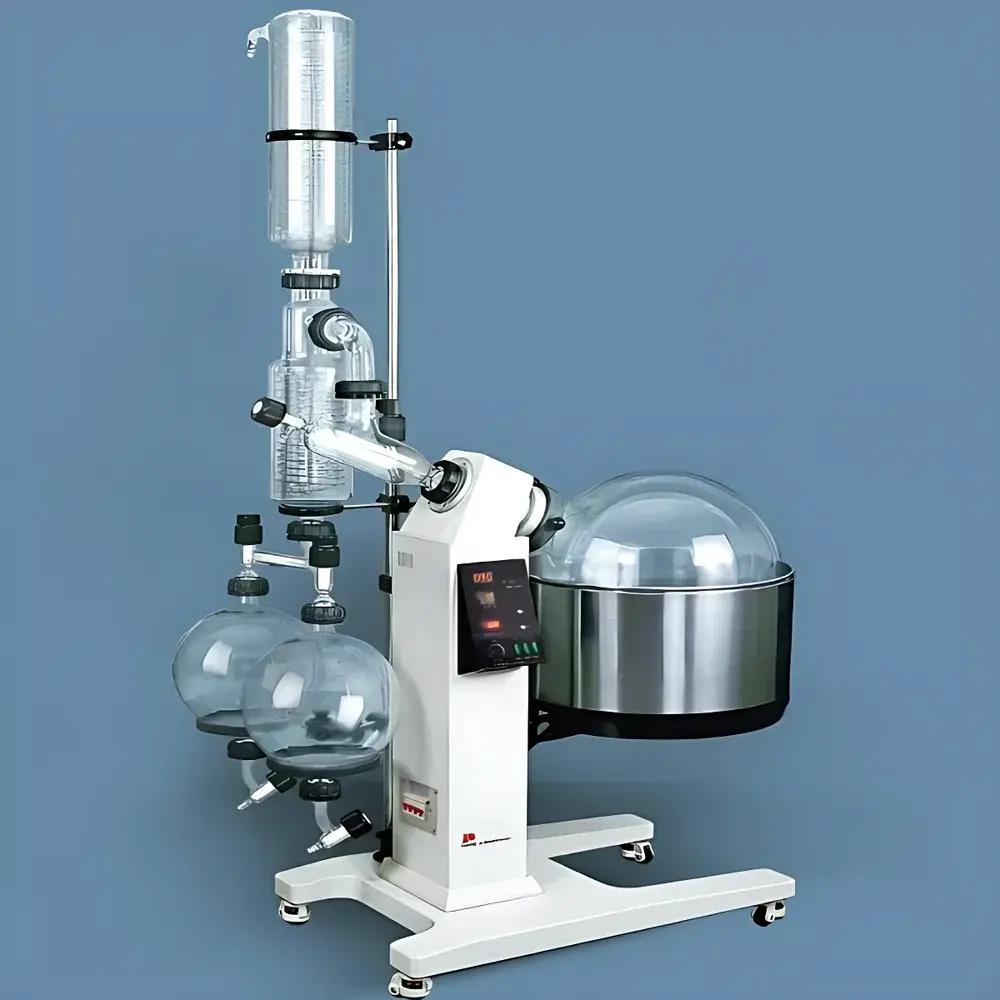
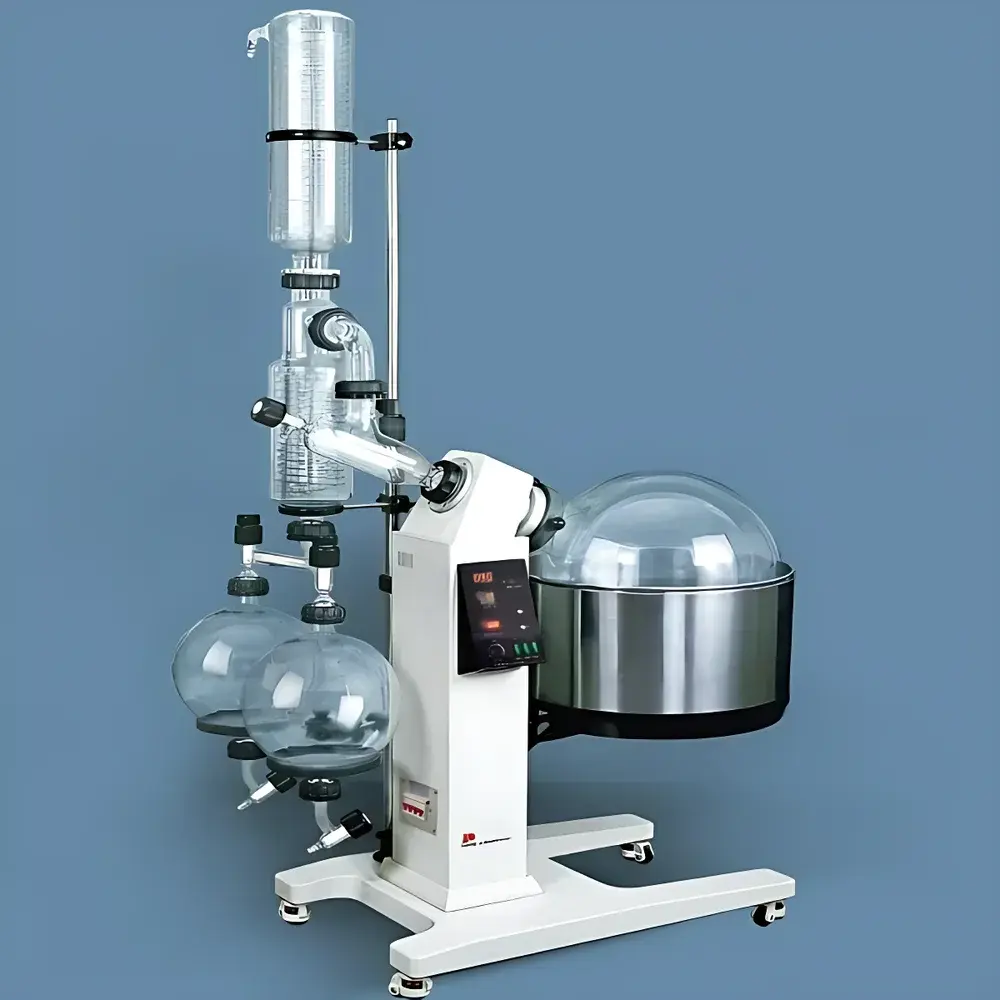
Yarong RE-5250 Rotary Evaporator
| Brand | Yarong |
|---|---|
| Origin | Shanghai, China |
| Model | RE-5250 |
| Evaporation Flask Capacity | 50 L (125 mm neck diameter) |
| Collection Flask Capacity | 20 L (dual 10 L flasks) |
| Rotation Speed Range | 0–70 rpm (variable-frequency drive) |
| Evaporation Rate | >9 L/h (water, at optimal conditions) |
| Vacuum Display | Dual analog gauge + digital display (<100 Pa) |
| Vacuum Control | Solenoid valve with pressure sensor feedback |
| Heating Bath Temperature Range | Ambient to 99 °C (±1 °C accuracy) |
| Heating Power | 2 × 4.5 kW (stainless steel 316 immersion heaters) |
| Bath Dimensions | 560 × 300 mm |
| Bath Material | SUS304 stainless steel |
| Lift Mechanism | Automatic cantilever-type vertical lift (0–320 mm travel) |
| Cooling System | Integrated air-cooling for motor and electronics |
| Filtration | GG-17 borosilicate glass vacuum trap with built-in particulate barrier |
| Overall Dimensions (L×W×H) | 1200 × 800 × 2220 mm |
| Power Supply | 380 V AC, 3-phase, 25 A |
| Compliance | Designed per IEC 61010-1 safety standards for laboratory equipment |
Overview
The Yarong RE-5250 Rotary Evaporator is a high-capacity, industrial-grade solvent removal system engineered for continuous, scalable concentration and purification of heat-sensitive liquid mixtures in R&D laboratories and pilot-scale production environments. It operates on the principle of reduced-pressure distillation: by lowering the system’s absolute pressure, the boiling point of solvents is significantly depressed—enabling efficient evaporation at controlled, non-destructive temperatures. The RE-5250 integrates dual independent heating modules (each 4.5 kW), a 50 L evaporation flask with standardized 125 mm ISO-KF neck interface, and a dual-collection configuration supporting uninterrupted batch-to-batch transfer without venting. Its robust mechanical architecture—including a sealed, maintenance-free planetary gear transmission and cantilever lift mechanism—ensures long-term operational stability under sustained vacuum (<100 Pa) and thermal load.
Key Features
- High-throughput design: 50 L evaporation flask paired with dual 10 L collection flasks enables sequential or parallel recovery without process interruption.
- Dual-mode vacuum monitoring: Analog Bourdon-tube gauge and digital pressure sensor provide redundant, real-time vacuum feedback (<100 Pa resolution) with valve-based active regulation.
- Intelligent temperature control: Microprocessor-driven bath thermostat maintains ±1 °C uniformity across the 560 × 300 mm SUS304 heating surface; calibrated against PT100 reference sensors.
- Modular dual-heater system: Two independently controllable 4.5 kW SS316 immersion elements allow asymmetric heating profiles or redundancy during extended operation.
- Automated vertical lift: Cantilever suspension system delivers smooth, backlash-free 320 mm stroke with position memory and overload protection.
- Integrated thermal management: Dedicated forced-air cooling channels dissipate heat from the motor housing and control electronics, extending component service life and improving repeatability.
- GG-17 glass train: All wetted components conform to DIN/ISO 3585 specifications for hydrolytic class HGB 1; vacuum trap includes sintered glass frit for aerosol capture.
Sample Compatibility & Compliance
The RE-5250 accommodates a broad spectrum of organic solvents (e.g., ethyl acetate, dichloromethane, methanol, toluene), aqueous solutions, and viscous extracts (up to ~500 cP). Its GG-17 glass construction ensures chemical resistance to pH 1–14 media under standard operating conditions. The system complies with IEC 61010-1:2010 for electrical safety in laboratory equipment and meets CE marking requirements for electromagnetic compatibility (EMC Directive 2014/30/EU). While not certified for GMP manufacturing, its design supports GLP-aligned documentation practices—including vacuum log export, temperature profile recording, and operator-accessible calibration history—facilitating audit readiness in regulated research settings.
Software & Data Management
The RE-5250 features embedded firmware with RS-485 Modbus RTU interface for integration into centralized lab automation networks. Optional PC software (Yarong LabLink v3.x) provides time-stamped logging of bath temperature, rotation speed, vacuum setpoint/actual, and lift position. All data are stored in CSV format with configurable sampling intervals (1–60 s); audit trails include user ID, timestamp, and parameter change events. The system supports 21 CFR Part 11–compliant configurations when deployed with validated third-party electronic lab notebook (ELN) platforms—enabling role-based access control, digital signatures, and immutable record retention.
Applications
- Concentration of natural product extracts (e.g., botanical infusions, fermentation broths) prior to chromatographic analysis.
- Removal of low-boiling solvents from polymer synthesis intermediates under inert atmosphere.
- Crystallization seeding and mother liquor recovery in fine chemical API purification workflows.
- Preparative-scale lyophilization feedstock conditioning in biopharmaceutical development.
- Distillative fractionation of multi-component essential oil blends using programmable vacuum ramps.
- Environmental sample preparation: EPA Method 3510C-compliant solvent exchange for GC-MS analysis of wastewater extracts.
FAQ
What is the maximum recommended solvent volume for continuous operation?
For stable thermal equilibrium and optimal film formation, the 50 L flask should be filled to 40–45 L with low-viscosity solvents; higher fill levels require reduced rotation speed and extended bath equilibration.
Can the RE-5250 operate under inert gas blanket?
Yes—the system includes dedicated gas inlet ports compatible with nitrogen or argon purging; optional pressure-relief valves maintain slight positive overpressure during distillation.
Is the digital vacuum display NIST-traceable?
The integrated pressure sensor is factory-calibrated against a primary-standard capacitance manometer; full calibration certificates (including uncertainty budgets) are available upon request.
What maintenance intervals are recommended for the lift mechanism?
Lubrication of the cantilever pivot bearings is advised every 1,000 operational hours; linear guide rails require cleaning and re-greasing every 6 months under continuous use.
Does the unit support remote start/stop via PLC signal?
Yes—dry-contact terminals (24 V DC) are provided for external interlock integration, including vacuum pump enable/disable sequencing and emergency stop chaining.



