
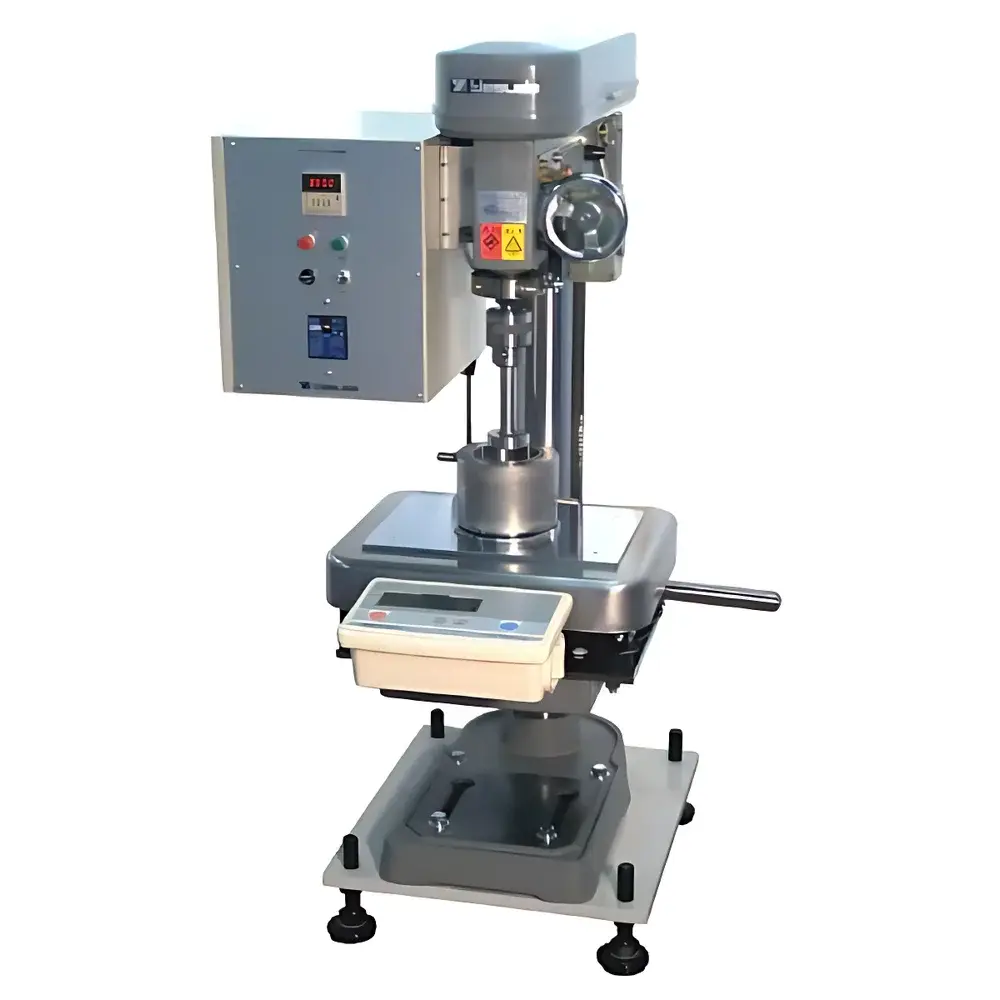
Yasuda No.156 Maron-Type Mechanical Stability Tester
| Brand | Yasuda |
|---|---|
| Origin | Japan |
| Model | No.156 |
| Compliance | JIS K6387, JIS K6392, JIS K6828 |
| Measurement Principle | Rotational shear-induced coagulation under controlled pressure and speed |
| Sample Form | Liquid latex emulsions (synthetic rubber latex, synthetic resin latex) |
| Test Output | Coagulum mass or volume after defined rotational cycle |
| Operating Mode | Manual or semi-automated rotational test with fixed-speed motor drive |
| Sample Container | Cylindrical vessel with replaceable polyethylene liner |
| Pressure Application | Pneumatically or mechanically applied axial load on lid assembly |
| Rotation Speed | Fixed-speed (standardized per JIS, typically 100–300 rpm range) |
| Test Duration | Programmable or timer-controlled (commonly 5–30 min per run) |
Overview
The Yasuda No.156 Maron-Type Mechanical Stability Tester is a precision-engineered instrument designed to evaluate the mechanical stability of aqueous polymer emulsions—specifically synthetic rubber latex (e.g., SBR, NBR, CR) and synthetic resin dispersions (e.g., acrylic, vinyl acetate copolymers). It operates on the fundamental principle of controlled rotational shear stress: a standardized cylindrical sample container, fitted with a disposable polyethylene liner, is subjected to uniform axial loading while rotating at a fixed speed for a defined duration. This simulates industrial handling conditions—including pumping, agitation, and transfer—where mechanical degradation may trigger premature coagulation. The resulting coagulum (insoluble fraction) is quantified gravimetrically or volumetrically post-test, providing a reproducible metric of emulsion robustness. Unlike dynamic rheometers or high-shear homogenizers, the No.156 implements a deterministic, standards-based protocol aligned exclusively with Japanese Industrial Standards (JIS), making it indispensable for QC laboratories in latex manufacturing, formulation development, and regulatory documentation.
Key Features
- Compliance-certified design adhering strictly to JIS K6387 (rubber latex), JIS K6392 (acrylic emulsions), and JIS K6828 (general synthetic resin dispersions)
- Stainless-steel main frame with vibration-damped base and precision-machined spindle assembly ensuring rotational stability and torque consistency
- Adjustable pneumatic or mechanical axial loading system enabling repeatable application of standardized compressive force (typically 1–5 kgf, per JIS specifications)
- Fixed-speed AC motor drive calibrated to ±1% accuracy across operational range (standard configurations: 150 rpm or 300 rpm, configurable per method requirement)
- Interchangeable sample cups with certified polyethylene liners—chemically inert, low-adhesion surface minimizes wall coagulation artifacts
- Integrated safety interlock preventing operation unless lid is fully seated and pressure threshold is verified
- No integrated digital controller; designed for manual timing and operator-mediated endpoint assessment—ensuring full traceability and alignment with traditional JIS lab workflows
Sample Compatibility & Compliance
The No.156 accepts standard 100–200 mL emulsion samples in accordance with JIS sampling protocols. It is validated for use with anionic, nonionic, and stabilized cationic latex systems exhibiting solids content from 30–70 wt%. The polyethylene liner eliminates metal-ion catalysis and surface nucleation effects common in stainless-steel vessels—critical for avoiding false-positive coagulation. Regulatory applicability includes internal QC release testing, supplier qualification per automotive OEM material specifications (e.g., Toyota TSM 0002G, Honda HES D 6104), and technical dossier preparation for JIS certification. While not FDA 21 CFR Part 11–compliant by default (lacking electronic audit trail), its output supports GLP-compliant manual recordkeeping when paired with bound lab notebooks and signed test reports.
Software & Data Management
The Yasuda No.156 is a hardware-only platform with no embedded firmware or proprietary software. All test parameters—including rotation duration, applied load, ambient temperature, and coagulum measurement—are documented manually using standardized JIS reporting templates (e.g., JIS Z8401 for rounding, JIS Z8402 for statistical treatment of replicate runs). Laboratories integrate results into LIMS or ELN systems via structured CSV import or direct entry. For automated data capture, third-party USB timers or load-cell interfaces may be externally coupled—but such configurations fall outside Yasuda’s factory validation scope and require user-led IQ/OQ documentation.
Applications
- Quality control of synthetic rubber latex prior to compounding or dipping processes (e.g., glove, condom, foam production)
- Formulation screening of surfactant packages and stabilizer systems for emulsion polymerization products
- Stability benchmarking across batch-to-batch production runs under ISO 9001 Clause 8.5.2
- Technical support for customer complaints involving gel formation during storage or transport
- Reference testing in inter-laboratory comparison studies coordinated by JIS Technical Committees (e.g., JISC TC 59 “Rubber and Rubber Products”)
- Validation of emulsion freeze-thaw resistance when combined with pre-conditioning per JIS K6256 Annex B
FAQ
What emulsion types are validated for use with the No.156?
Synthetic rubber lattices (SBR, NBR, CR, BR) and synthetic resin dispersions (acrylics, vinyl acetate, styrene-butadiene copolymers) meeting JIS-defined viscosity and solids ranges.
Is calibration service available from Yasuda or authorized partners?
Yes—annual mechanical calibration (rotational speed verification, load cell traceability to JCSS standards, timer accuracy) is offered through Yasuda’s Tokyo Service Center or JIS-accredited regional distributors.
Can the No.156 be used for ASTM or ISO methods?
No—it is purpose-built for JIS protocols only; ASTM D1644 and ISO 11357-6 require distinct geometries, shear profiles, and detection methodologies.
What maintenance is required to ensure long-term measurement fidelity?
Bi-weekly inspection of polyethylene liner integrity, monthly spindle lubrication with food-grade silicone grease, and annual torque verification of clamping mechanism per Yasuda Maintenance Bulletin MB-156-Rev.4.




