
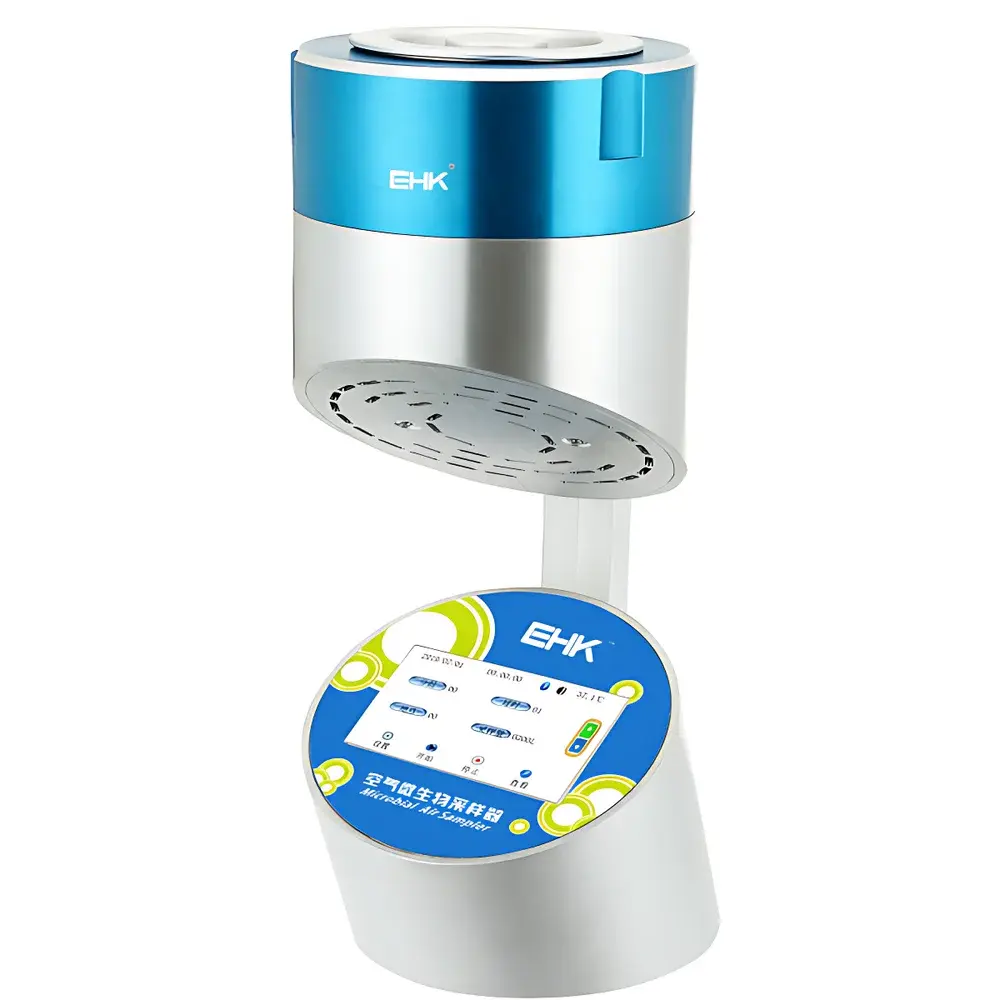
Huan Kai HKM-III Anderson Impactor Air Microbial Sampler
| Brand | Huan Kai (BHK) |
|---|---|
| Origin | Guangdong, China |
| Model | HKM-III |
| Flow Rate | 100 L/min |
| Flow Accuracy | ±2% |
| Sampling Duration | Up to 8 h |
| Operating Temperature | Ambient |
| Operating Humidity | Standard Range |
| Sample Collection Efficiency | ≥95% for particles 0.8–19.0 µm (per ISO 14698-1 Annex B & C) |
| Power Source | Rechargeable polymer lithium battery (≥8 h continuous operation) |
| Display | 3.5-inch HD capacitive touchscreen |
| Data Storage | 8,000 records with timestamp, location code, volume, and operator ID |
| Weight | 2.6 kg |
| Dimensions | 110 × 115 × 330 mm |
| Culture Dish Compatibility | 90 mm standard Petri dishes |
| Compliance | ISO 14698-1, ISO 14698-2 |
Overview
The Huan Kai HKM-III Anderson Impactor Air Microbial Sampler is a precision-engineered instrument designed for quantitative monitoring of viable airborne microorganisms in controlled environments. It operates on the principle of inertial impaction—specifically, the Andersen cascade impactor methodology—where air is drawn at calibrated velocity through an array of precisely sized orifices. Microbial particles ≥0.8 µm in aerodynamic diameter are accelerated and impacted onto the surface of standard 90 mm agar-filled Petri dishes under laminar flow conditions. This ensures physical collection efficiency exceeding 95% across the critical particle size range (0.8–19.0 µm), as validated per ISO 14698-1 Annex B and C protocols. The device maintains isokinetic sampling by matching inlet velocity to ambient airflow in cleanrooms (e.g., ISO Class 5–8), minimizing particle bounce, re-entrainment, and stratification artifacts—thereby delivering statistically representative colony-forming unit (CFU) data essential for GMP compliance, environmental monitoring (EM), and process validation.
Key Features
- Isokinetic Sampling Design: Inlet velocity dynamically aligns with local cleanroom airflow profiles (typically 0.3–0.5 m/s), reducing sampling bias and enhancing fidelity of microbial concentration measurement.
- High-Resolution Touch Interface: 3.5-inch HD capacitive touchscreen supports bilingual (English/Chinese) navigation, real-time display of sampled volume (0.01–6.0 m³), location coding, delay timing, backlight duration, and date/time stamping.
- Universal Culture Medium Compatibility: Accepts standard 90 mm Petri dishes with conventional nutrient agars (e.g., Tryptic Soy Agar, Sabouraud Dextrose Agar); no proprietary consumables required.
- Adjustable Sampling Orientation: Impact head rotates continuously from horizontal to vertical (0–90°), enabling flexible deployment on flat surfaces or via optional tripod mount for ceiling-, wall-, or workstation-level sampling.
- Multi-Orifice Impact Plate: Optimized orifice count and distribution minimizes colony overlap and improves statistical accuracy of CFU enumeration—validated via Feller correction modeling.
- Robust Data Traceability: Each sampling event generates a unique audit trail including start/stop time, total volume, location ID, operator code, and battery status; up to 8,000 records stored internally with timestamped metadata.
- Long-Duration Field Operation: Integrated rechargeable polymer lithium battery supports ≥8 hours of continuous sampling (typical use case: 1,000 L at 100 L/min), with no memory effect and UL-certified charging circuitry (110–240 V AC, 50–60 Hz).
- Bluetooth-Enabled Remote Control: Dedicated mobile application allows wireless configuration of sampling parameters, dynamic/static mode switching, and real-time status monitoring—eliminating physical access requirements during critical operations.
Sample Compatibility & Compliance
The HKM-III is validated for use with conventional microbiological growth media in 90 mm Petri dishes, including but not limited to Tryptic Soy Agar (TSA), Sabouraud Dextrose Agar (SDA), and malt extract agar (MEA). It complies fully with ISO 14698-1:2003 (“Biological contamination control — General principles and methods”) and ISO 14698-2:2003 (“Evaluation of bioaerosol sampling methods”), supporting routine environmental monitoring programs under EU GMP Annex 1, USP , and FDA Aseptic Processing Guidance. Its design facilitates integration into GLP/GMP workflows requiring full traceability, electronic signature support (via paired software), and 21 CFR Part 11–compliant data handling when used with validated reporting modules.
Software & Data Management
While the HKM-III operates autonomously with embedded firmware, its internal database exports ASCII-formatted logs compatible with laboratory information management systems (LIMS) and Excel-based trending analysis. The companion Bluetooth mobile application provides immediate parameter configuration, session logging, and export-ready CSV reports—including volume-normalized CFU/m³ calculations. For enterprise deployment, optional HKM Series Data Manager software enables centralized fleet monitoring, automated report generation (PDF/Excel), user access controls, and audit log archiving aligned with ALCOA+ principles (Attributable, Legible, Contemporaneous, Original, Accurate, Complete, Consistent, Enduring, Available).
Applications
This sampler serves critical roles in pharmaceutical manufacturing (sterile fill-finish suites, isolators, RABS), biotechnology cleanrooms (cell culture, downstream processing), hospital operating theatres and isolation rooms, food and dairy production facilities (aseptic packaging zones), and academic research laboratories conducting aerosolized pathogen studies or HVAC system validation. It is routinely deployed for baseline qualification, routine EM, investigation of excursions, and media fill simulation support—providing legally defensible, metrologically sound data for regulatory submissions and quality reviews.
FAQ
Does the HKM-III require calibration certification prior to use?
Yes. Initial verification must include flow rate calibration using a NIST-traceable dry gas meter or thermal mass flow calibrator, documented per SOP and retained for audit. Annual recalibration is recommended.
Can the HKM-III be used in high-humidity environments such as fermentation chambers?
Yes. Its sealed aluminum chassis and conformal-coated electronics ensure stable operation across 20–90% RH without condensation-induced drift or sensor interference.
Is the 95% collection efficiency applicable to all microbial species?
The efficiency refers to physical particle capture across the specified aerodynamic diameter range. Biological viability post-impact depends on organism stress tolerance and agar formulation—validation per ISO 14698-2 is required for each target microbe.
How is data integrity ensured during power interruption?
The device implements non-volatile flash memory with automatic checkpointing; sampling resumes from last valid record upon restart, preserving volume accuracy and timestamp continuity.
What maintenance is required between sampling sessions?
Surface disinfection with 75% ethanol followed by ≥5 min purge cycle is mandatory. Orifice plates and impact heads require weekly ultrasonic cleaning in isopropyl alcohol and visual inspection for clogging or deformation.
Related Products







