
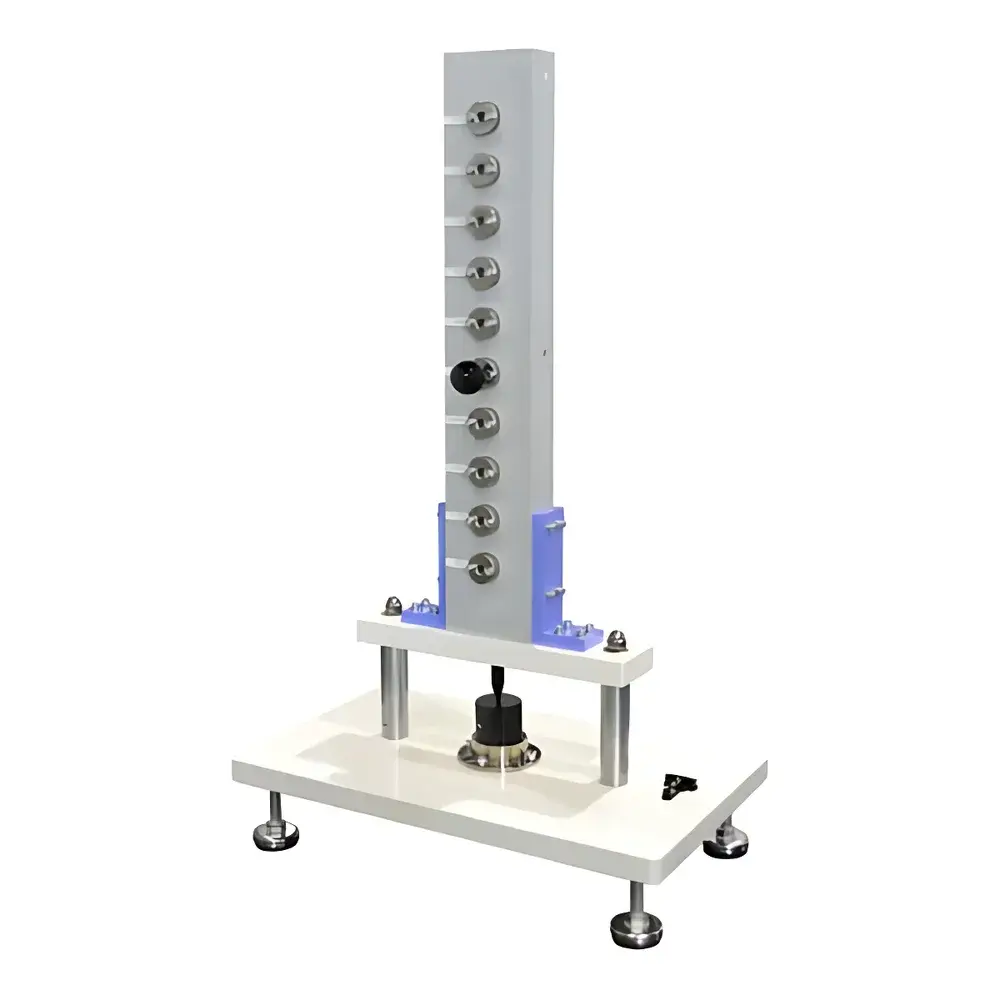
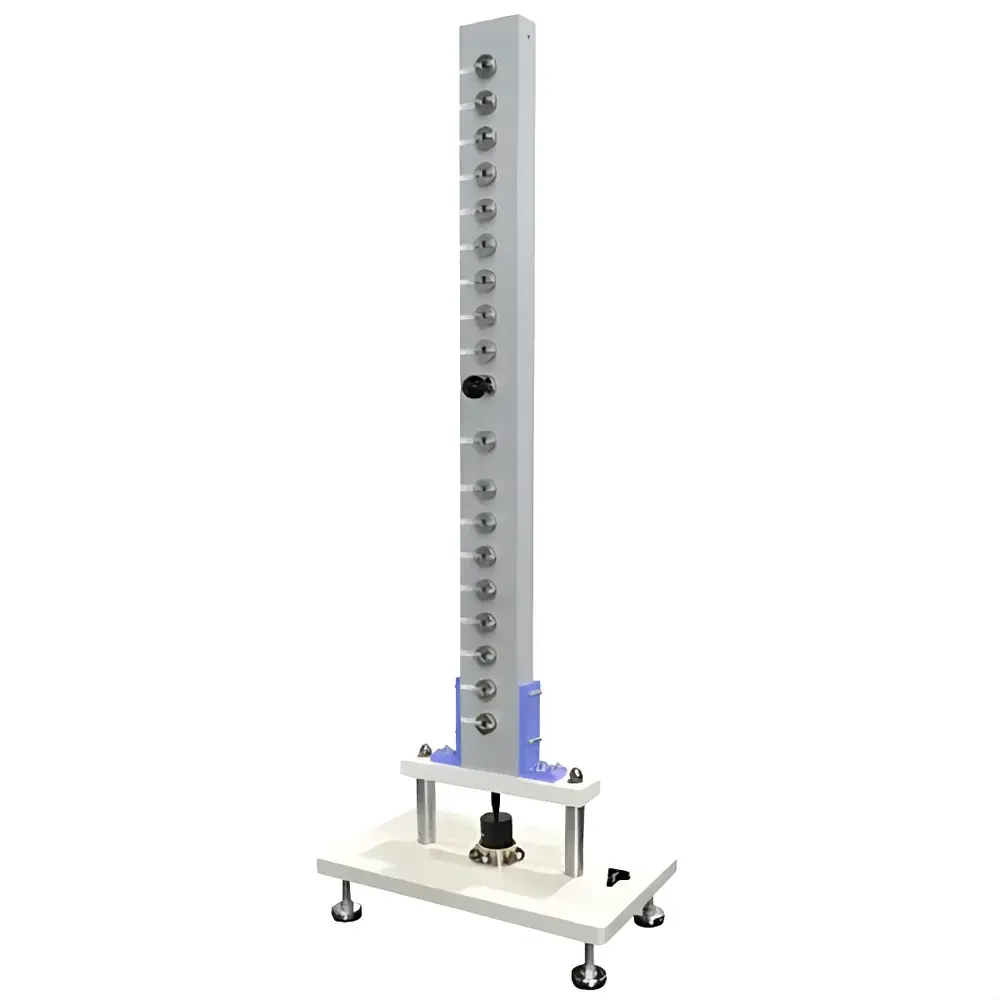
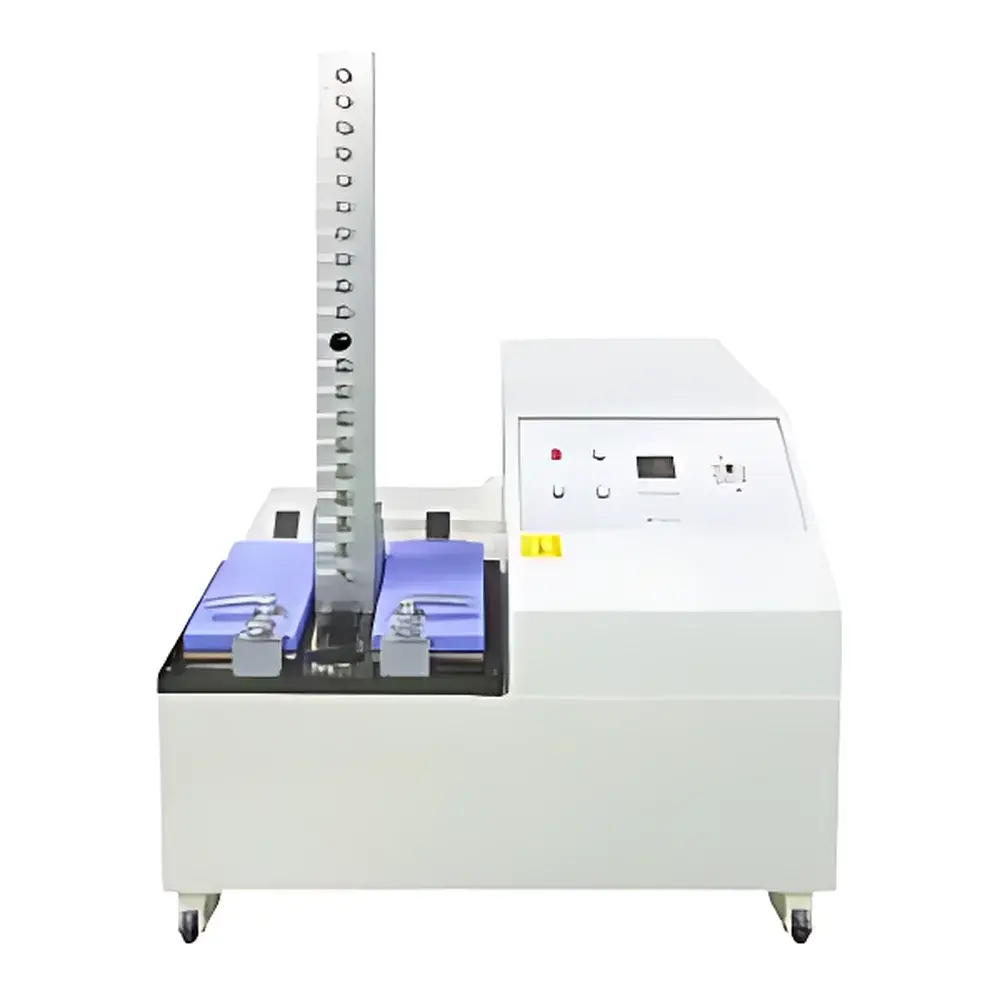
Yasuda No.517 Du Pont-Type Falling Weight Impact Tester
| Brand | Yasuda |
|---|---|
| Origin | Japan |
| Model | No.517 |
| Type | Falling Weight Impact Tester |
| Applicable Standards | JIS K5400, JIS K5600-5-3, ASTM D2794, ISO 6272 |
| Optional Low-Temperature Configuration | No.517-L (with integrated refrigerated chamber) |
Overview
The Yasuda No.517 Du Pont-Type Falling Weight Impact Tester is a precision-engineered mechanical impact testing instrument designed for quantitative evaluation of coating and plastic film resistance to localized dynamic loading under controlled conditions. Based on the classical Du Pont geometry—featuring a vertically guided free-falling weight impacting a specimen clamped between a hemispherical tup and rigid anvil—the system operates on fundamental principles of energy transfer and plastic deformation mechanics. The tester delivers reproducible impact energy by varying drop height (standardized range: 0–1000 mm) and calibrated hammer mass (typically 1.0 kg or 2.0 kg per JIS/ASTM alignment), enabling compliance with internationally recognized test protocols for brittle fracture initiation, cohesive/adhesive failure, and substrate-dependent delamination behavior. Its modular architecture supports both ambient and low-temperature operation (via optional No.517-L configuration with integrated refrigeration unit), permitting evaluation of temperature-dependent embrittlement in automotive clearcoats, aerospace primers, and thermoplastic films.
Key Features
- Fixed-geometry Du Pont impact head with interchangeable hardened steel tups (12.7 mm and 15.9 mm diameter options) meeting dimensional tolerances specified in ASTM D2794 and ISO 6272.
- Vertically aligned, low-friction guide column with precision-machined linear bearing surfaces ensures minimal lateral deviation (< ±0.3 mm) during hammer descent, critical for consistent energy delivery.
- Digital height adjustment mechanism with vernier scale and lockable stop position enables repeatable drop height selection from 0 to 1000 mm in 10 mm increments.
- Robust cast-iron base frame with vibration-damping feet provides mechanical stability during high-energy impacts, minimizing resonance artifacts in deformation assessment.
- Optional No.517-L variant integrates a closed-loop refrigerated chamber capable of maintaining specimen temperatures from –40 °C to +40 °C (±1.5 °C accuracy), compliant with JIS K5600-5-3 low-temperature impact requirements.
- Specimen clamping system features adjustable torque-controlled fasteners and standardized 65 mm × 120 mm test area aperture, ensuring uniform pressure distribution across coated metal or plastic substrates.
Sample Compatibility & Compliance
The No.517 accommodates flat, rigid substrates up to 3 mm thickness—including cold-rolled steel panels (0.8 mm), aluminum alloy sheets (1.0 mm), and polycarbonate plates—pre-conditioned per ASTM D618 or ISO 291. Test specimens must be fully cured and free of surface contaminants prior to mounting. The system conforms to regulatory and industry-standard test methodologies including: JIS K5400 (coating impact resistance), JIS K5600-5-3 (paint film impact at low temperature), ASTM D2794 (impact resistance of organic coatings on plastic substrates), and ISO 6272-1 (paints and varnishes — impact testing — Part 1: Falling-weight test). Data generated supports GLP-compliant quality control documentation and is admissible in ISO/IEC 17025-accredited laboratories.
Software & Data Management
While the No.517 is a manually operated mechanical tester requiring visual or optical assessment post-impact, its design incorporates traceability features essential for regulated environments. Each test cycle records hammer mass, drop height, substrate type, conditioning temperature (if applicable), and observer-assigned failure classification (e.g., “no cracking”, “craze only”, “adhesive failure”, “cohesive fracture”). These parameters are logged in accordance with internal SOP templates aligned with FDA 21 CFR Part 11 principles for handwritten records—ensuring audit readiness, reviewer signatures, and dated entries. For digital integration, third-party lab information management systems (LIMS) may interface via CSV export of standardized test logs generated from companion spreadsheet templates provided by Yasuda Technical Support.
Applications
- Evaluation of automotive OEM and refinish coating systems for resistance to stone-chip-induced damage during road testing.
- Qualification of powder-coated aluminum extrusions used in architectural façades under thermal cycling and impact stress.
- Comparative analysis of UV-cured acrylate topcoats versus traditional polyurethane systems in consumer electronics housings.
- Development-stage screening of bio-based polymer films for food packaging applications requiring puncture resistance at sub-zero storage conditions.
- Failure mode mapping in multi-layer coating architectures (e.g., primer-surfacer-topcoat) to identify interfacial weakness points under transient load.
FAQ
What standards does the Yasuda No.517 comply with?
The No.517 is engineered to meet JIS K5400, JIS K5600-5-3, ASTM D2794, and ISO 6272-1. Calibration and verification procedures follow JIS Z 8401 for measurement uncertainty estimation.
Is the No.517-L low-temperature version certified for GLP use?
Yes—the No.517-L includes temperature validation reports, chamber calibration certificates (traceable to JCSS), and documented IQ/OQ protocols suitable for GLP audits.
Can the impact energy be calculated directly from the instrument settings?
Yes—impact energy (in joules) is calculated as E = m × g × h, where m is hammer mass (kg), g = 9.80665 m/s², and h is drop height (m); all values are entered manually into test records per ISO/IEC 17025 clause 7.7.
Are replacement tups and calibration weights available through Yasuda?
Original-specification tups (HRC 60–64), certified calibration masses (±0.1% tolerance), and clamping fixtures are supplied with full traceable calibration documentation.
Does the system require electrical power for basic operation?
No—the core impact mechanism is gravity-driven and requires no power; only the No.517-L refrigeration unit operates on single-phase 200 V AC, 50/60 Hz supply.



