
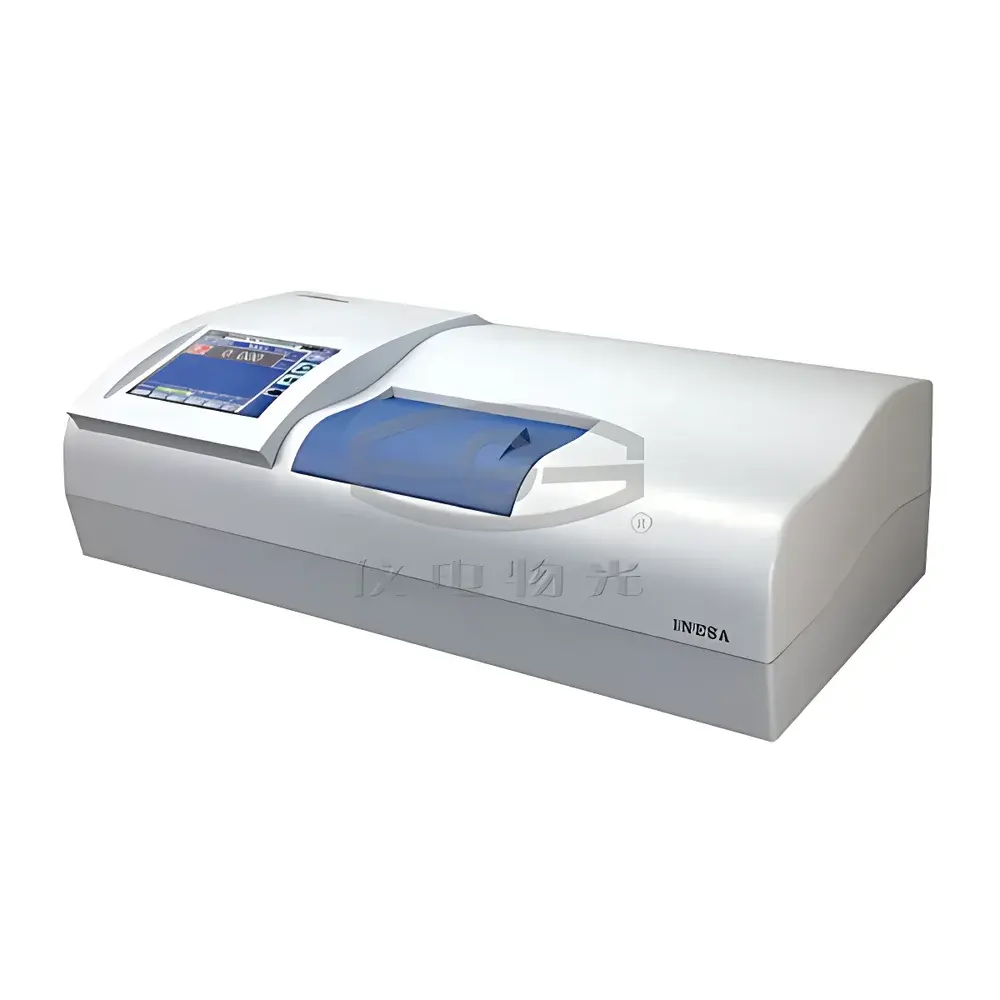
YDWG SGW®-537 Automated High-Speed Multi-Wavelength Polarimeter
| Brand | YDWG |
|---|---|
| Origin | Shanghai, China |
| Model | SGW®-537 |
| Product Type | Automated Polarimeter |
| Temperature Control | Peltier-integrated (10–50 °C, ±0.2 °C accuracy) |
| Display | 8-inch color TFT touchscreen |
| Light Source | 20 W halogen lamp |
| Standard Wavelengths | 546 nm, 589 nm |
| Optional Wavelengths | 365, 405, 436, 578, 633 nm (7 total) |
| Measurement Range | ±90° (optical rotation), ±259°Z (saccharimetric scale) |
| Minimum Resolution | 0.001° |
| Accuracy | ±0.004° |
| Repeatability (σ) | ≤0.002° |
| Zero repeatability | 0.001° |
| Response Speed | 8°/s (full scale) |
| Avg. Measurement Time | 26 s (6 measurements) |
| Sample Transmittance Limit | ≥0.1% |
| Data Storage | 16 GB internal |
| Compliance Options | FDA 21 CFR Part 11 audit trail software (optional), GMP/GLP-ready configuration |
| OS | Windows-based, LIMS-compatible |
| Interfaces | USB, VGA, Ethernet, optional Wi-Fi & thermal printer |
| Standard Cells | 100 mm / 200 mm pathlength (ambient & thermostatted) |
| Dimensions | 702 × 376 × 240 mm |
| Net Weight | 21 kg |
| Calibration | Multi-point automatic calibration |
| Regulatory Conformance | JJG 536–2015 Class 0.01 |
Overview
The YDWG SGW®-537 Automated High-Speed Multi-Wavelength Polarimeter is a precision optical instrument engineered for quantitative measurement of optical rotation in chiral substances—primarily pharmaceutical actives, natural products, carbohydrates, and fine chemicals. It operates on the fundamental principle of polarimetry: linearly polarized light is rotated upon passage through an optically active medium, with the magnitude and direction of rotation directly proportional to analyte concentration, path length, wavelength, and specific molecular structure. The SGW®-537 employs a high-stability halogen light source coupled with Glan-Thompson calcite polarizers—selected for their superior extinction ratio and minimal wavelength-dependent birefringence drift—ensuring metrological integrity across its seven selectable wavelengths (365–633 nm). Its digital servo-controlled optical train, combined with real-time angular position feedback via high-resolution rotary encoder, enables sub-milli-degree resolution and exceptional long-term stability. Designed for regulated laboratory environments, the instrument meets JJG 536–2015 Class 0.01 performance requirements and supports traceable operation under ISO/IEC 17025, USP <781>, and EP 2.2.7 frameworks.
Key Features
- Multi-wavelength capability (7 discrete wavelengths): standard 546 nm and 589 nm; optional 365, 405, 436, 578, and 633 nm—enabling wavelength-specific method development and verification per pharmacopoeial monographs.
- Peltier-based temperature control (10–50 °C, ±0.2 °C accuracy) with integrated thermostatted cell holder—critical for temperature-sensitive assays such as sucrose inversion kinetics or enantiomeric excess determination at controlled conditions.
- High-speed acquisition architecture: full-scale response in ≤8°/s, average measurement time of 26 seconds for six replicate readings—optimized for high-throughput QC laboratories.
- 8-inch capacitive touchscreen interface with Windows OS integration—supports direct connection to LIMS, ELN, and enterprise data management systems via Ethernet, USB, or optional Wi-Fi.
- Robust data governance architecture: 16 GB onboard storage, 1000 user-defined methods, 4-tier password-protected access control, electronic signatures, and full audit trail (optional FDA 21 CFR Part 11-compliant software upgrade).
- Comprehensive calibration suite: automated multi-point zero and span calibration using certified quartz control plates—fully documented and exportable per GLP requirements.
Sample Compatibility & Compliance
The SGW®-537 accommodates standard 100 mm and 200 mm pathlength cells (glass or quartz), including thermostatted variants for temperature-critical applications. Optional 50 mm micro-cells support low-volume sample analysis (≥0.5 mL), while corrosion-resistant cell materials (e.g., sapphire windows, PTFE-sealed caps) are available for aggressive solvents or acidic/basic matrices. All cell configurations maintain optical alignment integrity within ±0.001° zero repeatability. The instrument complies with national metrological verification regulation JJG 536–2015 (Class 0.01), and its optional audit trail software package satisfies FDA 21 CFR Part 11, EU Annex 11, and ICH GCP data integrity expectations—including immutable timestamps, operator identification, change history, and electronic signature validation. Full validation documentation (IQ/OQ/PQ protocols) and third-party compliance verification services are available upon request.
Software & Data Management
Built on a Windows 10 IoT Enterprise platform, the SGW®-537’s embedded software provides intuitive method setup, real-time graphical display of rotation vs. time, and automated calculation of specific rotation ([α]), concentration, or degree Brix. Data files are stored in structured CSV and XML formats—with metadata including instrument ID, operator, timestamp, environmental conditions (temperature, humidity), calibration status, and raw detector signals. Export options include USB drive, network share, and direct LIMS push via HL7 or ASTM E1384-compliant interfaces. The optional Audit Trail Upgrade adds role-based permissions, electronic signature capture with biometric or token-based authentication, and tamper-evident logging compliant with 21 CFR Part 11 Subpart C. All data operations—including method edits, result overrides, and report generation—are fully traceable and exportable in PDF/A-1b format for regulatory submission.
Applications
- Pharmaceutical quality control: assay of chiral APIs (e.g., levofloxacin, ibuprofen, atenolol), enantiomeric purity verification, and stability-indicating assays per ICH Q5C.
- Sugar and sweetener analysis: sucrose, glucose, fructose, and invert sugar quantification in food, beverage, and biofuel feedstocks using standardized saccharimetric scales (°Z).
- Natural product characterization: determination of specific rotation for alkaloids, terpenes, glycosides, and essential oils—supporting botanical identity and adulteration screening.
- Academic and method development labs: wavelength-dependent optical rotation studies for conformational analysis, solvent effect evaluation, and chiroptical spectroscopy correlation.
- Contract manufacturing organizations (CMOs): fully auditable, 21 CFR Part 11-ready operation for client-facing release testing and regulatory filing support.
FAQ
Does the SGW®-537 support GMP-compliant operation out of the box?
No—the base configuration meets general metrological standards (JJG 536–2015 Class 0.01), but GMP/GxP readiness requires the optional Audit Trail Software Package and associated validation services.
Can the instrument be integrated into a centralized LIMS environment?
Yes—via native Ethernet connectivity and support for ASTM E1384, HL7, or custom API-based data exchange protocols.
What is the minimum sample volume required for accurate measurement?
With the optional 50 mm micro-cell, the minimum recommended volume is 0.5 mL at ≥0.1% transmittance; standard 100 mm cells require ≥2.0 mL.
Is temperature calibration traceable to NIST or equivalent national standards?
Yes—Peltier temperature sensors are factory-calibrated against PT100 reference probes with certificate of calibration traceable to CNAS-accredited laboratories (equivalent to ISO/IEC 17025).
How is data security ensured during remote network access?
All network communications use TLS 1.2 encryption; optional hardware security modules (HSMs) and Windows Defender Application Control policies can be deployed for enhanced endpoint protection.



