
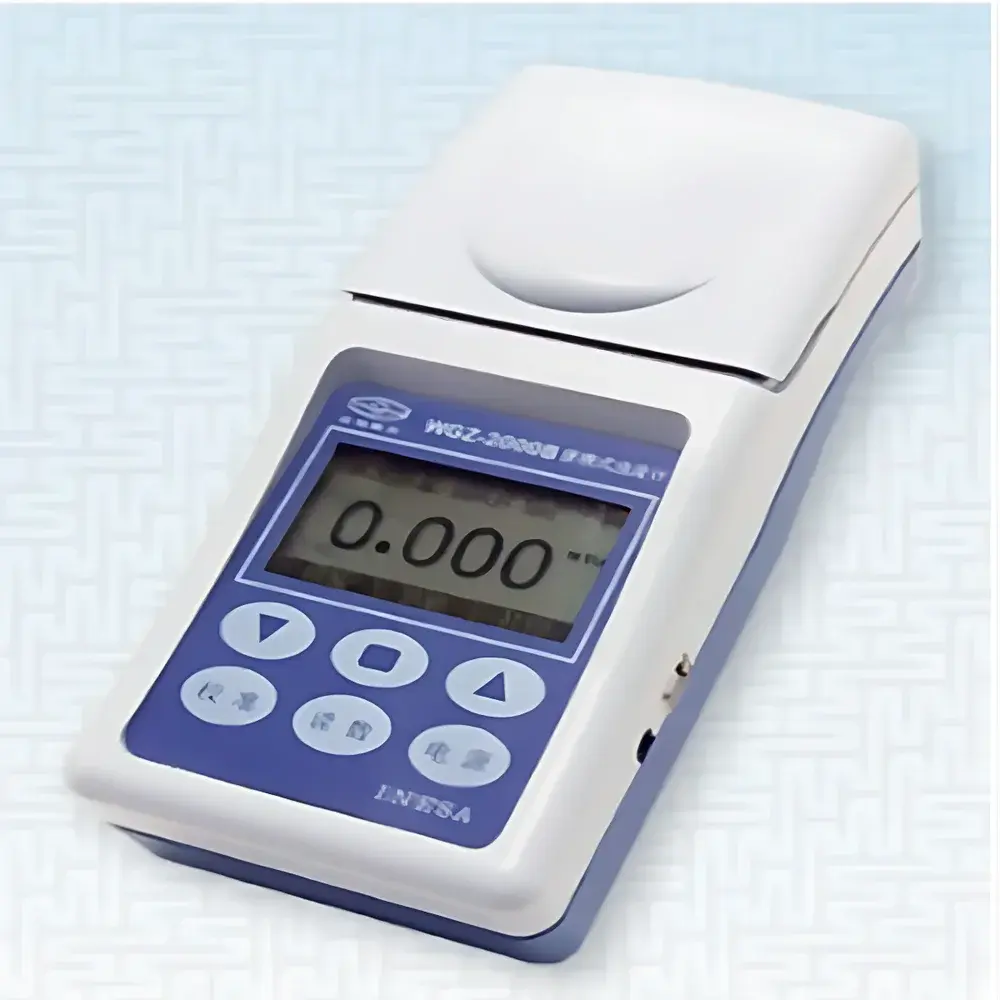
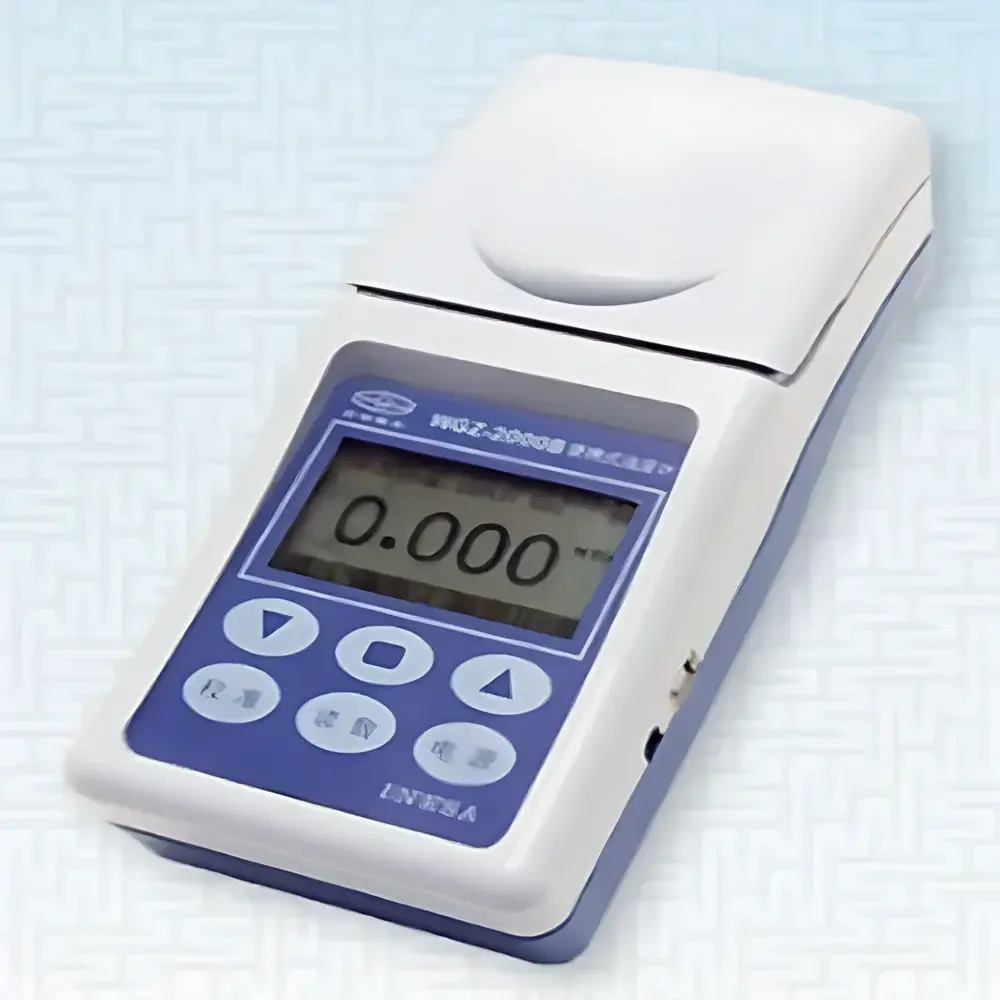
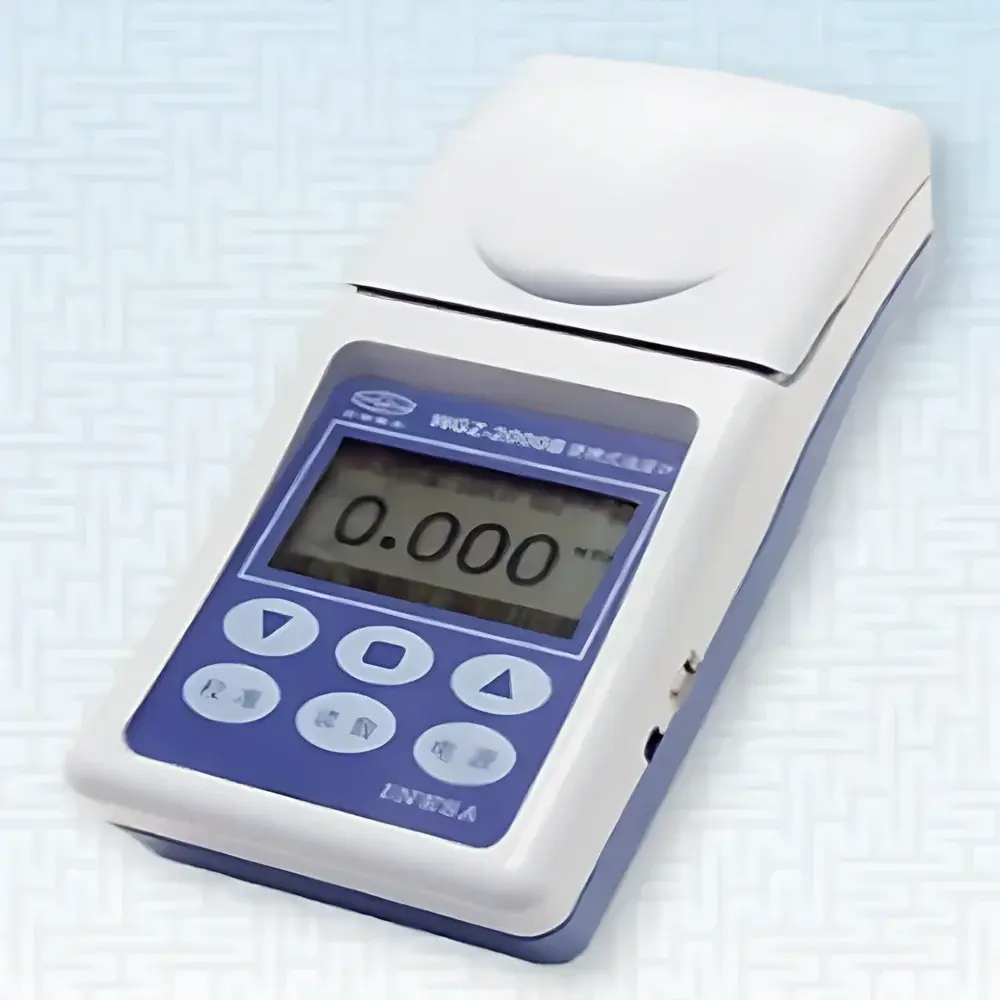
YDWG WGZ-2000B Portable Turbidimeter
| Brand | YDWG |
|---|---|
| Origin | Shanghai, China |
| Model | WGZ-2000B |
| Type | Portable |
| Measurement Range | 0.000–20.00 NTU |
| Resolution | 0.001 NTU |
| Operating Temperature | 5–40 °C |
| Accuracy | ≤ ±2% |
| Power Supply | 4 × AA alkaline batteries or 5 V USB power |
Overview
The YDWG WGZ-2000B Portable Turbidimeter is a compact, field-deployable optical instrument engineered for precise quantification of turbidity in clear liquids—primarily aqueous samples—based on the principle of 90° scattered light detection. It operates according to the nephelometric method defined in ISO 7027 and ASTM D6508, where incident light from a stable LED source interacts with suspended particulates, generating scattered radiation measured perpendicular to the beam path. The ratio of scattered intensity to incident intensity correlates directly with particle concentration, enabling trace-level turbidity assessment down to 0.001 NTU. Designed for rugged portability without compromising metrological integrity, the WGZ-2000B integrates a calibrated optical path, temperature-compensated signal processing, and dual-power capability (battery or USB), making it suitable for both routine field surveys and controlled laboratory environments.
Key Features
- High-resolution measurement capability with 0.001 NTU resolution across a 0.000–20.00 NTU dynamic range
- Stable 850 nm LED light source with precision current regulation to minimize thermal drift and ensure long-term photometric repeatability
- Integrated 90° scattering geometry compliant with ISO 7027:2016 for standardized, inter-laboratory comparable results
- Dual power mode: Operates on four standard AA alkaline batteries (typical runtime > 20 hours) or via regulated 5 V USB input—ideal for remote or mobile use
- Backlit LCD display with intuitive menu navigation and real-time unit switching (NTU only)
- Onboard calibration support using Formazine standard solutions; includes factory calibration certificate traceable to national reference standards
- Rugged ABS housing with IP54-rated ingress protection against dust and splashing water
Sample Compatibility & Compliance
The WGZ-2000B is validated for use with clean water matrices, process effluents, filtered pharmaceutical waters (PW, WFI), beverage formulations, and low-viscosity chemical solutions. It accommodates standard 25 mm round glass cuvettes (10 mL volume) and supports sample temperature stabilization within 5–40 °C ambient conditions. Relative humidity tolerance is ≤85% non-condensing. Instrument design conforms to general electrical safety requirements per IEC 61010-1 and electromagnetic compatibility (EMC) guidelines per IEC 61326-1. While not certified for GMP-regulated release testing, its calibration traceability, audit-ready manual log capability, and Formazine-based verification protocol align with GLP documentation practices and support compliance with USP <<730> and EP 2.2.17 for turbidity assessment in quality control workflows.
Software & Data Management
The WGZ-2000B operates as a standalone, embedded-system instrument with no proprietary PC software dependency. All measurements are displayed and stored locally on the device’s non-volatile memory (up to 200 data points with timestamp). Data export is performed manually via visual readout or documented in laboratory notebooks. For integration into LIMS or QA/QC digital workflows, users may record values alongside batch identifiers, operator IDs, and environmental parameters (e.g., ambient temperature, sample ID) to satisfy 21 CFR Part 11–aligned record-keeping requirements when paired with institutional SOPs. Calibration history—including date, standard used (Formazine concentration), and deviation from reference value—can be maintained externally to support internal audits.
Applications
- Drinking water quality monitoring at intake, filtration, and distribution points
- In-process turbidity verification in pharmaceutical water systems (PW, Purified Water) per USP <<1231>
- Final rinse validation in medical device cleaning processes
- Clarity testing of syrups, injectables, and oral suspensions during formulation development
- Effluent screening in municipal wastewater treatment plants prior to discharge
- Quality assurance of food-grade process water in dairy, brewing, and bottling facilities
- Educational use in university analytical chemistry and environmental science laboratories
FAQ
What calibration standards are supported?
The WGZ-2000B is calibrated using Formazine suspension standards (e.g., 0.1 NTU, 10 NTU, 20 NTU). Users may prepare or purchase NIST-traceable Formazine solutions for verification or recalibration.
Is the instrument suitable for high-turbidity samples above 20 NTU?
No. Samples exceeding 20.00 NTU must be diluted with turbidity-free water (e.g., filtered deionized water, <0.001 NTU) and results multiplied by the dilution factor. Dilution protocols should follow ISO 7027 Annex B guidelines.
Can measurements be temperature-compensated?
The instrument does not feature automatic temperature compensation (ATC); however, its optical and electronic architecture minimizes thermal influence within the specified 5–40 °C operating range. For critical applications, users should equilibrate samples to ambient lab temperature prior to measurement.
Does the device meet FDA or EPA regulatory requirements?
While not individually EPA-certified, the WGZ-2000B implements the ISO 7027 nephelometric method accepted by U.S. EPA Method 180.1 for drinking water analysis and referenced in 40 CFR Part 141 compliance monitoring.
How often should calibration be verified?
Per ISO/IEC 17025 recommendations, calibration verification should occur before each measurement session or at least every 2 hours during continuous use, using a mid-range Formazine standard (e.g., 10 NTU).







